If you have been researching ways to add height or correct a limb discrepancy, you have probably come across the term leg lengthening surgery. Turkey has become one of the most sought-after destinations for this transformative procedure, attracting thousands of international patients every year. Whether you are dealing with a leg length difference caused by injury, a congenital condition, or you simply want to increase your stature, understanding the different methods available is the essential first step on your journey. In this guide, you will find a comprehensive breakdown of every major technique, what to expect, and how to choose the approach that best fits your goals.
Before diving into specific methods, it helps to understand the underlying biological principle that makes leg lengthening possible. The process relies on a concept called distraction osteogenesis — a remarkable ability your body already has. During the procedure, your surgeon carefully cuts the bone (a step called an osteotomy) and then very gradually pulls the two ends apart. As the gap widens at a rate of roughly one millimetre per day, your body fills in the space with new bone tissue.
This new bone hardens and consolidates over time, resulting in a permanently longer limb. The same principle applies to the soft tissues — muscles, nerves, and blood vessels — which also adapt and elongate alongside the growing bone. The key variable between the different methods is the device used to apply that gradual traction, and where that device is positioned: outside the body, inside the bone, or a combination of both.
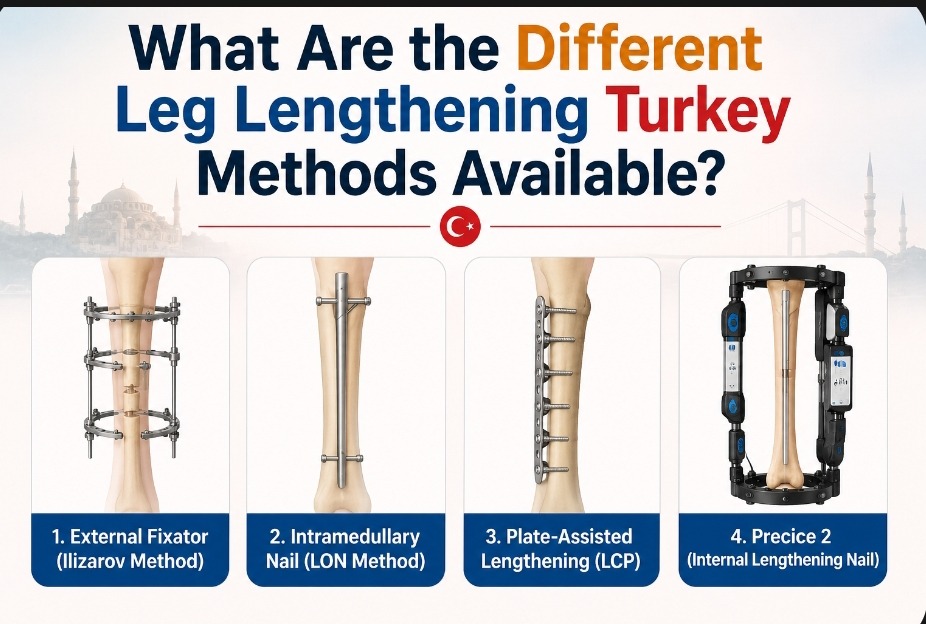
The Ilizarov method is where the modern science of leg lengthening began, and it remains relevant today for certain complex cases. Developed by Soviet surgeon Gavriil Ilizarov in the 1950s, this technique uses a circular external frame made of metal rings connected to the bone by wires and pins that pass through the skin. You wear this frame on the outside of your leg throughout the entire lengthening and consolidation period.
Key advantages of the Ilizarov fixator include:
The main trade-off is that external frames are bulky, require daily pin-site care to prevent infection, restrict your daily activities, and can be uncomfortable to sleep with. That said, for patients with significant deformities or bone infection, no internal device can yet match its versatility.
The LON (Lengthening Over Nail) method was a significant step forward in patient comfort and safety. In this hybrid approach, your surgeon first inserts an intramedullary (IM) nail — a solid metal rod — down through the hollow centre of your femur (thigh bone) or tibia (shin bone). An external fixator is then attached to the bone simultaneously.
During the active lengthening phase, the external fixator does the work of slowly pulling the bone apart. Once the desired length is achieved, the external device is removed and the internal nail takes over, bearing your weight and protecting the new bone as it consolidates. This dramatically shortens the time you spend wearing the external frame — often from around a year down to just three or four months.
You benefit from a reduced external fixator period and a stronger consolidation phase compared to external-only methods. The LON method is especially popular in Turkey because it strikes a practical balance between cost-effectiveness and improved patient experience. It is well suited for patients seeking cosmetic height gain of up to five to eight centimetres.
The most advanced and patient-friendly option currently available is the fully implantable motorised nail system. The most widely used brand in Turkey is the PRECICE nail, manufactured by NuVasive. With this method, there is no external frame at all — the entire lengthening mechanism lives inside your bone.
The PRECICE nail contains an internal magnet connected to a precision drive mechanism. Each day, you hold a handheld External Remote Controller (ERC) against your skin over the nail. The device creates a rotating magnetic field that turns the internal magnet, advancing a small threaded rod and separating the bone ends by the programmed increment — typically 0.25 mm, four times a day.
Why patients choose fully internal nails:
The STRYDE nail was a titanium-alloy version designed to allow full weight-bearing during distraction, but it was withdrawn from the market due to concerns about implant fracture. Most Turkish surgeons now exclusively use the PRECICE 2 system, which requires protected weight-bearing with crutches during the active phase.
The primary disadvantage of the PRECICE nail is cost — the implant itself is expensive, making this the most costly method overall. However, if you factor in the reduced need for nursing care, pin-site supplies, and the improvement in quality of life, many patients find it the most worthwhile investment. If you are considering this option, you can find world-class surgeons offering the best limb lengthening surgery in Turkey at internationally accredited hospitals.
Turkish orthopaedic surgeons perform lengthening on both the femur and the tibia, and in some cases both simultaneously — a procedure known as bilateral lengthening. Your surgeon will guide you on which bone is most appropriate based on your anatomy, proportionality goals, and the amount of height you wish to gain.
General guidelines for safe lengthening amounts:
It is worth noting that proportionality matters enormously. An experienced surgeon will assess your current leg-to-torso ratio and advise on the maximum gain that will look natural and balanced for your frame. Pushing beyond safe limits increases the risk of complications such as nerve stretch, joint contracture, and delayed bone consolidation.
If you are reading this from Europe, the Middle East, or further afield, you may be wondering why so many patients choose Turkey specifically. The answer lies in a combination of surgical expertise, infrastructure, and value that is genuinely difficult to match elsewhere.
Turkish orthopaedic surgeons who specialise in limb lengthening often complete fellowships and training with the pioneers of modern lengthening techniques in the US, Germany, and South Korea. Many leading centres, particularly in Istanbul and Ankara, perform hundreds of these procedures every year — a volume that directly translates into expertise and better outcomes for you.
Cost is another decisive factor. The same PRECICE nail surgery that might cost $80,000–$100,000 in the United States is typically available in Turkey for $20,000–$35,000, all-inclusive. This price difference covers the implant, the surgical team, hospitalisation, post-operative physiotherapy, and in many cases your accommodation and airport transfers.
Turkish hospitals catering to international patients are accredited by the Joint Commission International (JCI), the same body that certifies hospitals in the US and UK. You will find state-of-the-art operating theatres, multilingual patient coordinators, and dedicated international patient departments that manage your entire journey from initial consultation to discharge planning.
Understanding the full timeline before you commit is essential. Leg lengthening is not a quick procedure — it requires a significant investment of time and dedication to physical therapy. Here is a broad overview of what you can expect regardless of the method chosen:
Physiotherapy is not optional — it is absolutely central to a successful outcome. You will work with a physical therapist multiple times per week throughout the consolidation phase to maintain joint range of motion, strengthen the surrounding muscles, and ensure your gait develops correctly. Patients who commit fully to their rehabilitation programmes consistently achieve better results and fewer complications.
The right leg lengthening method depends on your individual anatomy, your budget, the amount of length you are hoping to achieve, and your lifestyle during recovery. If you have a complex deformity or a bone infection history, an external fixator or hybrid LON method may be the safest choice. If you are a cosmetic height gain patient prioritising comfort and discretion, a fully implantable PRECICE nail is almost certainly the better option.
What all methods share is the need for an experienced surgeon, a well-equipped facility, and your personal commitment to a thorough rehabilitation programme. Turkey offers all three at a standard that rivals — and in many cases surpasses — what is available in Western Europe and North America.
Your next step is to arrange a consultation with a specialist who can assess your X-rays, discuss your goals, and recommend the specific technique tailored to you. For a curated list of verified clinics and surgeons offering the best limb lengthening surgery in Turkey, along with transparent pricing and patient reviews, visit FlyMedi — your trusted guide to world-class medical care abroad.