Studies show that under-inflated tires can reduce an electric vehicle's range by up to 10%—a significant loss when every mile matters. For EV owners already navigating range anxiety, this hidden drain on battery efficiency is a frustrating and often overlooked problem.
Maintaining precise tire pressure isn't as straightforward as it sounds. EVs carry heavier battery packs than conventional cars, placing greater demands on tires and making accurate inflation even more critical. Too little pressure increases rolling resistance and saps your battery; too much compromises ride quality and traction. Finding that sweet spot consistently requires more than guesswork.
That's where a tire inflation time calculator becomes an invaluable tool. By estimating exactly how long inflation should take based on your current pressure, target pressure, and inflator specifications, it removes uncertainty from the process and helps you hit the right PSI every time. Paired with specialized equipment like electric vehicle inflators featuring precision digital displays, this approach transforms routine tire maintenance into a reliable, repeatable practice. This article explores how these tools work together to protect your EV's range, safety, and long-term performance.
Electric vehicles operate under fundamentally different conditions than gasoline-powered cars, and tire pressure sits at the center of that difference. When a tire runs below its recommended PSI, its contact patch with the road widens, generating more rolling resistance with every rotation. For a combustion engine, this translates to slightly worse fuel economy. For an EV, it directly drains the battery pack—the only energy source on board. Research consistently shows that for every 1 PSI drop across all four tires, range efficiency falls by roughly 0.2 to 0.5%. Multiply that across four tires running 5 to 10 PSI low, and you're potentially sacrificing 10% of your total range before you've even left the driveway. On a vehicle rated for 300 miles, that's 30 miles gone due to a maintenance oversight that takes minutes to correct.
Incorrect tire pressure creates serious safety risks for EV owners. Under-inflated tires reduce traction, increase stopping distances, and wear out faster because EVs are heavier due to their battery packs. Excessive flexing can also cause heat buildup at high speeds, increasing the risk of blowouts. On the other hand, over-inflated tires reduce the contact area with the road, leading to poor grip and a higher chance of skidding on wet or uneven surfaces. Since EVs deliver instant torque, proper tire pressure is essential for stable and predictable performance from the moment the vehicle moves. Regular tire pressure checks—preferably every week and before long trips—help improve safety, maintain handling, extend tire life, and ensure a smoother, more reliable driving experience for EV owners.
A tire inflation time calculator is a practical tool designed to estimate how long it will take to bring a tire from its current pressure to a target PSI, based on the specifications of your inflator. Rather than standing beside your vehicle and guessing when to stop, you input a few variables—starting pressure, desired pressure, tire volume, and your inflator's flow rate—and receive an estimated inflation duration. For EV owners who need to hit precise pressure targets consistently, this eliminates the trial-and-error approach that often results in over- or under-inflation.
A tire inflation time calculator works using simple physics. It estimates how long inflation will take by calculating the amount of air needed to raise tire pressure and comparing it with the inflator’s airflow rate. Users typically enter the current PSI, target PSI recommended by the EV manufacturer, tire size, and the inflator’s flow rate. Some online tools and smart inflators automatically handle these calculations through digital interfaces. The result is a clear time estimate, such as one or two minutes, helping drivers inflate tires more efficiently without repeated manual pressure checks. Many modern EV inflators also include auto-shutoff technology, which stops inflation automatically once the desired pressure is reached. This makes tire maintenance faster, more accurate, and more convenient for EV owners while helping maintain safety and performance.
A tire inflation time calculator offers benefits beyond convenience. It saves time by reducing the need for repeated pressure checks during inflation and provides more accurate results. This precision is especially important for EVs, where even small pressure differences can affect range, handling, and tire wear. The calculator also helps prevent over-inflation, a common issue when drivers rely on guesswork instead of exact measurements.
Selecting the right inflator for your EV isn't a decision to make casually. The weight differential between electric vehicles and their combustion counterparts means tires endure greater stress, and the inflator you use needs to match that demand with speed, accuracy, and reliability. Not every portable inflator on the market is built with EV requirements in mind—some lack the pressure range needed for heavier vehicles, while others sacrifice precision for portability. Understanding what separates an adequate inflator from an excellent one helps you invest in a tool that genuinely supports your vehicle's performance long-term.
When evaluating inflators specifically for tire inflation on EVs, four criteria matter most. Power source compatibility is the starting point—a 12V inflator that connects to your vehicle's power outlet offers reliable, consistent output without battery depletion concerns, while cordless models provide flexibility away from the car. Pressure range is equally critical; your inflator should comfortably reach and accurately maintain pressures up to at least 100 PSI to handle the higher recommended pressures common in EV tires. Inflation speed determines how practical the tool is in real-world use—a slow inflator that takes five minutes per tire becomes a genuine inconvenience during routine maintenance. Finally, durability and build quality signal whether the inflator can withstand regular use over years, not just occasional emergencies. An inflator designed for EV use should integrate these qualities without compromise.
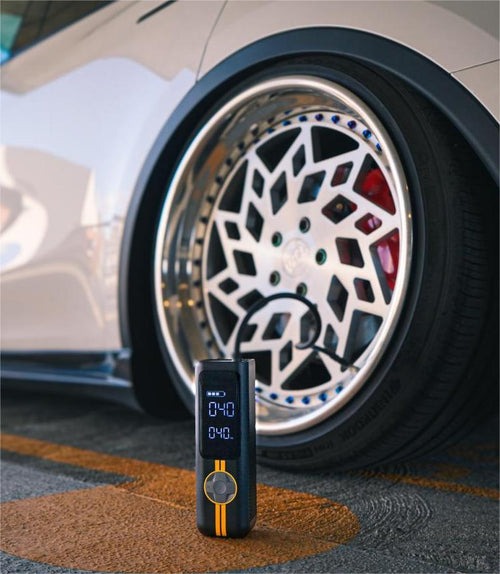
The Fanttik X8 APEX EV represents a purpose-built solution for electric vehicle owners who take tire maintenance seriously. Engineered with EV-specific demands in mind, it delivers rapid inflation speeds that make maintaining all four tires a quick, efficient task rather than a drawn-out process. Its construction reflects the durability expectations of owners who rely on consistent performance, and its compatibility with the power requirements of modern EVs ensures it integrates seamlessly into your maintenance routine. Where it particularly distinguishes itself is in its intelligent design—features like preset pressure targeting and automatic shutoff mean you can configure your desired PSI and let the inflator do the work without hovering over it. For EV owners pairing this inflator with a tire inflation time calculator, the combination creates a maintenance workflow that is both faster and more accurate than traditional methods.
A precision digital display transforms the inflation process from an approximate exercise into a controlled, measurable one. Analog gauges introduce reading errors and ambiguity—a needle sitting between two markings leaves room for a 1 to 2 PSI mistake that compounds across four tires. A high-resolution digital readout eliminates that uncertainty by showing exact pressure in real time, allowing you to monitor progress and stop precisely at your target. For EV owners, where a 2 PSI variance can measurably affect range and handling, this level of clarity isn't a luxury—it's a functional necessity. The Fanttik X8 APEX EV's digital interface provides that real-time feedback clearly and intuitively, making it straightforward to confirm you've reached the correct pressure without secondary verification tools. When combined with the time estimates from a tire inflation calculator, the digital display serves as your live confirmation that the process is proceeding as expected.
Knowing the theory behind tire pressure and inflation tools only gets you so far—what matters is putting that knowledge into a reliable routine. For EV owners, the goal is a repeatable process that consistently delivers accurate results without consuming unnecessary time or effort. Combining a tire inflation time calculator with a capable inflator like the Fanttik X8 APEX EV turns what might feel like a technical chore into a straightforward five-step workflow.
Start by gathering your tools before approaching the vehicle: your electric vehicle inflator, a reliable tire inflation time calculator (whether a smartphone app or a built-in inflator function), and your EV's owner manual for the manufacturer-specified PSI. Having everything ready prevents mid-process interruptions that lead to mistakes.
Next, check each tire's current pressure using your inflator's digital display or a dedicated gauge while the tires are cold—pressure readings taken after driving can run 4 to 6 PSI higher than actual resting pressure, skewing your calculations. Note the current PSI for each tire and confirm your target pressure from the manual, which for most EVs falls between 40 and 51 PSI depending on the model and load.
With those numbers in hand, input them into your tire inflation time calculator along with your tire size and the Fanttik X8 APEX EV's flow rate. The calculator will return an estimated inflation duration for each tire—use this as your operational benchmark. Connect the inflator, set your target PSI on the digital interface, and begin inflation. The real-time display lets you track progress precisely, while the auto-shutoff feature stops inflation exactly at your target without manual intervention.
Finally, verify each tire's pressure independently after inflation to confirm accuracy, then recheck all four before driving.
A few consistent practices dramatically improve long-term accuracy. Always check tire pressure in the morning before the vehicle has moved, since heat from driving artificially elevates readings. Ambient temperature also affects pressure—for every 10°F drop in temperature, tires lose approximately 1 PSI, so seasonal rechecks are essential rather than optional. Periodically verify your inflator's gauge calibration against a trusted reference gauge to catch any drift before it affects your maintenance routine. Before inflating, inspect the valve stem for debris or damage that could cause slow leaks after inflation—a properly inflated tire that loses pressure overnight usually points to a valve issue, not the inflation process itself. Finally, resist the temptation to inflate above the recommended PSI to compensate for anticipated pressure loss; over-inflation reduces your contact patch and compromises the traction that EV instant torque demands.
Maintaining the correct tire pressure is one of the easiest and most effective ways to improve an EV’s range, safety, and overall performance. Under-inflated tires can reduce battery efficiency by up to 10%, negatively affect handling, and increase tire wear due to the heavier weight and instant torque of electric vehicles. These issues not only shorten tire life but can also impact driving stability and long-term reliability.
Using a tire inflation time calculator helps remove uncertainty from the inflation process by providing an accurate estimate before inflation begins. When combined with a dedicated EV inflator such as the Fanttik X8 APEX EV, drivers gain faster inflation, precise pressure control, and convenient features like auto-shutoff and a digital pressure display. This ensures tires reach the exact recommended pressure every time, making maintenance more accurate and consistent.
Regular tire care delivers benefits on every journey. EV owners should check tire pressure weekly, especially during seasonal temperature changes that can affect pressure levels. By using the right tools and maintaining proper inflation, drivers can maximize battery range, improve road safety, extend tire lifespan, and ensure a smoother, more reliable driving experience over the long term.