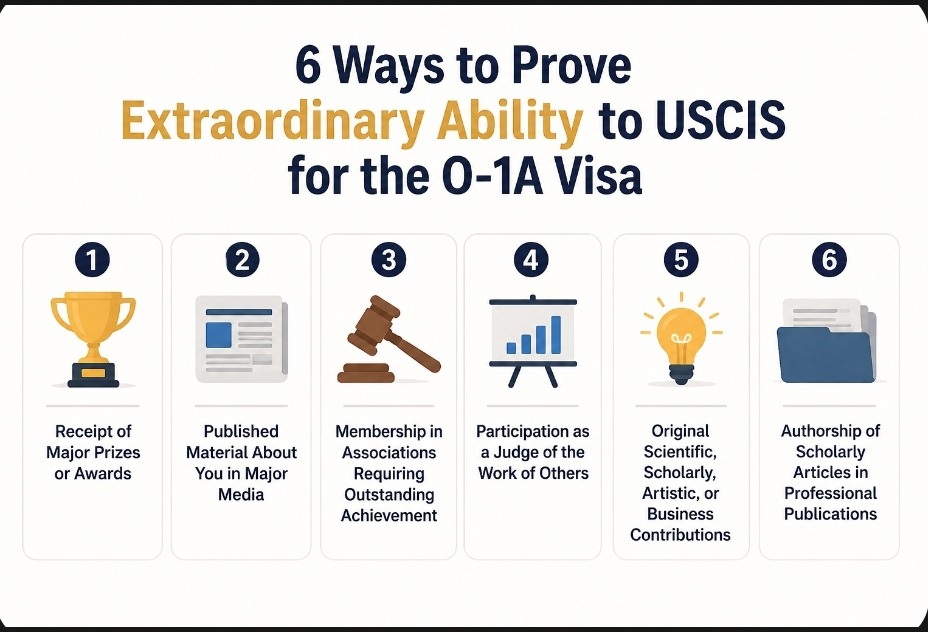
The O-1A visa is a popular route for professionals in tech, science and business who want to work in the United States. It's often called the "genius visa" but you don't need a Nobel Prize to qualify. In 2026, USCIS has become more structured in how they review these petitions. They now focus more on the quality of your evidence instead of just the quantity of documents you submit.
While the bar for entry remains high, the process is manageable if you know which evidence carries the most weight. You will need to satisfy at least three out of eight specific criteria to prove you belong at the top of your field. Read on to see how you can build a strong case by focusing on the most common categories for entrepreneurs and researchers.
One of the most effective ways to build your profile is through media coverage. USCIS looks for articles in major trade journals or mainstream news outlets that discuss you and your professional work. It's not enough for the article to just mention your company. It needs to focus on your specific role and achievements to count towards the O-1A extraordinary ability visa requirements that officers look for.
When you gather these press clips, you should include data about the publication's reach. This might include website traffic statistics or circulation numbers to prove the outlet is a "major" medium. It's worth pointing out that a local newspaper mention usually won't be enough.
You should aim for well-known industry sites or national papers like The Telegraph or The Economist to make a real impact on your application. For digital publications, providing audited traffic data is now an essential step to prove the outlet reaches a significant and relevant audience.
If you have held a senior position in a well-known company, you can use this as a core part of your petition. USCIS calls this a "critical or leading role" in a distinguished organisation. You will need to show that your individual contribution was essential to the success of a specific project or the company as a whole.
Instead of just providing a job description, you should obtain a letter from a supervisor or colleague. This letter should detail your specific responsibilities and how your work led to measurable results. You will also need to provide evidence that the company itself has a distinguished reputation. This can be done by showing high revenue figures, major awards the company has won or significant venture capital funding.
In 2026, the ripple effect of your work is best proven by showing how other experts have implemented your methods or how your specific technology has been integrated into wider industry programmes.
This category is often the most difficult to prove but it's very persuasive when done correctly. You must demonstrate that you have created something original that has changed your industry.
For tech founders, this could be a patented technology that is now used by other companies. For researchers, it might be a new methodology that has been widely adopted by peers. To make this claim stick, you'll need to show the ripple effect of your work. You can do this by including:
Commanding a high salary is a direct way to prove you're at the top of your field. You will need to show that your total compensation is significantly higher than what other people in your specific role and location earn. You can also include bonuses, commissions and even equity stakes if they have a clear valuation.
When you present this evidence, you must provide a benchmark for comparison. You should use reputable sources like government labour statistics or industry-specific salary surveys. If you're a founder, you might use the valuation of your startup and your shareholding to show that your remuneration is exceptional. It's important to be transparent with your tax returns or payslips to back up these claims.
Participating as a judge for your peers is a great way to show you have reached a level of expertise where your opinion is valued. This could involve reviewing academic papers for a journal or sitting on the judging panel for a startup competition. USCIS wants to see that you were selected because of your high standing in the community.
You should keep all correspondence related to the judging process. This includes the initial invitation and any feedback you provided during the evaluation. You will also need to show that the competition or journal itself is prestigious. If you're reviewing for a small, unknown blog, it likely won't carry much weight. Aim for events or publications that are nationally recognised in your sector.
Winning a major award is the most straightforward way to meet the criteria. While a Nobel Prize or an Oscar is the gold standard, many industry awards also qualify. The key is to prove that the award is for "excellence in the field" and that the competition was fierce. You will need to provide the judging criteria and information about how many people applied versus how many won.
If you’ve won a startup pitch contest or a 30 under 30 style award, these are still valuable but require deep evidence regarding the judging process. You must provide data on the total number of nominees versus the final winners to prove the selection was truly exclusive and based on professional excellence. This will help the immigration officer understand that the prize is a mark of true distinction, not just a generic participation trophy.
Getting an O-1A visa approved in 2026 comes down to one thing more than anything else, and that's the quality of the documentation. Nobody needs to meet every single criteria. In fact, most successful applicants focus on three or four areas where their evidence is strongest. That targeted approach tends to work far better than trying to cover everything thinly.
For every document included in the petition, context matters. The reviewing officer needs to understand why a particular piece of evidence is significant. Without that framing, even impressive achievements can get overlooked. It sounds obvious but people skip this step all the time.
Independent evidence carries a lot of weight too. Media articles, expert letters, third-party recognition. That kind of material does far more heavy lifting than someone's own statements about themselves. If a person can show a consistent track record of high achievement and real impact in their field, they'll be in a much stronger position overall.
The best advice is to start collecting evidence early. And every single piece should link back clearly to extraordinary ability. That thread running through the whole application is what pulls it together.