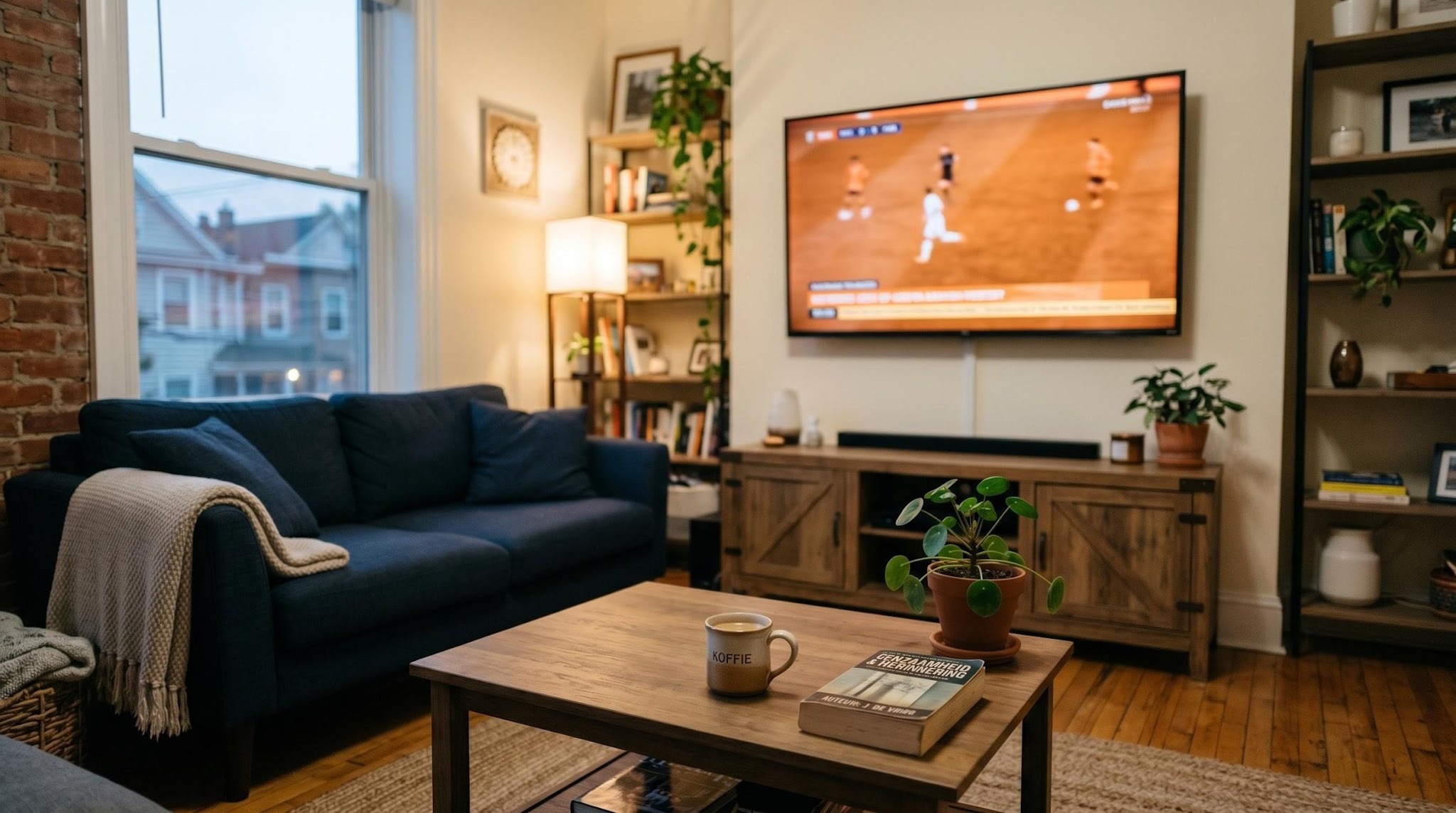
Anyone who has tried to open NPO Start from a New Jersey couch already knows the punchline: a gray screen, a polite apology, and no Eredivisie. Dutch IPTV is the workaround most expats eventually land on, and this guide explains what it is, why the legitimate Dutch services keep locking you out, and what actually works from the US.
IPTV stands for Internet Protocol Television. Instead of a cable line from Ziggo or a satellite dish, the channels arrive over your normal home internet, packaged as a stream your TV or streaming stick can play. Dutch IPTV is simply an IPTV service that carries Dutch channels, Dutch sports rights, and Dutch on-demand content.
Practically it feels like the old setup: turn it on, NPO 1 is there, RTL 4 is there, Ziggo Sport is there, and you flip channels. The important difference is what Dutch IPTV is not. It is not NPO Start, which is geo-locked outside the Netherlands. It is not Videoland, which demands a Dutch IBAN at signup. It is not Netflix Nederland, which will not show you Wie is de Mol? unless you are physically in the country. A Dutch IPTV service fills the gap those platforms leave.
The short version: licensing. Dutch broadcasters hold rights valid inside the Netherlands and nowhere else. The moment your IP address registers as American, the player checks your geo and cuts the feed.
NPO Start is the clearest case. Free inside the Netherlands, completely unavailable abroad. Videoland layers on top of the geo-block by requiring a Dutch payment method, which rules out most Dutch passport holders living in the US. Ziggo GO is tied to a live Ziggo cable subscription at a Dutch address, so expats have no path in.
VPNs patch some of this temporarily, until NPO or Videoland detects the VPN and blocks it too. That leaves Dutch IPTV as the option people actually settle on.
Not every Dutch IPTV service is built for expats, and the gap between a solid one and a bad one is larger than most buyers realize.
Start with channel coverage. The minimum list should include NPO 1, NPO 2, NPO 3, RTL 4, RTL 5, RTL 7, SBS 6, Net5, Veronica, and Ziggo Sport. Sports rights shift around often, so check whether the service carries F1 content on Viaplay, Eredivisie on ESPN NL, and live NOS Sport during tournaments. A provider like IPTV Mate Nederland publishes a 30,500-plus channel lineup with the full Dutch public and commercial stack alongside the sports feeds, which is roughly what to expect from a serious Dutch-market operator. Anything significantly thinner on Dutch channels is aimed at a different audience.
Next, Dutch subtitles on video-on-demand. Expats usually want the Dutch audio track, but kids, partners, and friends may not speak the language. Dutch subtitles across most VOD titles separate the serious Dutch-market services from the generic international IPTV resellers.
Uptime matters more than it sounds. A provider that crashes during the Oranje match you waited months for is useless even if it costs three euros a month. Look for services that publish an uptime figure and run dedicated anti-freeze infrastructure, not the ones that just promise "high quality streaming." The established Dutch providers cluster around a 99.9 percent uptime target.
Support in a language you speak is the last checkbox most people forget. When something breaks, you want to message someone who understands that "de stream hapert" is not a typo. Dutch WhatsApp support, available on weekends, has become the norm for Dutch-market providers and is the baseline to expect.
Price comes last. The Dutch IPTV market sits roughly between 30 and 220 euros depending on length and number of screens, and IPTV Mate's own lineup runs from 29.99 euros for three months to 219.99 euros for a two-year multi-screen plan. A service at one euro a month is either a scam or a reseller riding on stolen credentials that will vanish in a month.
A Dutch IPTV subscription is only worth it if the things you actually miss are in the lineup.
For most expats, that starts with NPO 1 news bulletins and the Sinterklaasjournaal in December, which families with Dutch kids abroad treat as non-negotiable. RTL 4 carries the entertainment backbone, including Boer zoekt Vrouw, The Voice of Holland reboots, and prime-time talk shows. SBS 6 holds Hart van Nederland and a heavier rotation of true-crime programming.
Sport is where things get specific. Formula 1 moved to Viaplay for the Dutch market, so following Max Verstappen from the US generally requires an IPTV service that carries Viaplay's F1 feed. Eredivisie now lives on ESPN NL rather than Fox Sports, and a proper Dutch IPTV lineup mirrors that shift. For international tournaments, NOS broadcasts the Oranje squad, which ties the whole thing back to NPO.
Then there are the cultural moments. Koningsdag on April 27th. Prinsjesdag in September. The Matthäus-Passion at Easter. The annual Top 2000 broadcast between Christmas and New Year's. These are not replaceable by Netflix. They are the reason a Dutch IPTV service ends up on more expat living-room TVs than any US cable package ever will.
The setup itself is boring, which is exactly what you want.
After payment, a decent Dutch IPTV service emails you two things: an M3U link and Xtream Codes credentials. You paste one or the other into a player app, and the Dutch channel list populates. IPTV Mate, for example, delivers both within five to fifteen minutes of purchase, which is standard for reputable providers.
On a Firestick, the typical app is IPTV Smarters Pro. Install it from the Amazon store, enter your M3U URL or Xtream Codes, and the channels are live in under a minute. Apple TV users run Smarters Pro as well, or alternatives like iPlayTV and IBO Pro Player. Samsung and LG smart TVs support Smart IPTV directly. Android TV boxes, Dreambox, Formuler, MAG devices, and older IPTV boxes you already own all work with the same credentials, which is the real advantage of IPTV over a proprietary app ecosystem.
Internet speed is the one variable most Americans get wrong. You do not need gigabit. Plan on 25 to 30 Mbps for HD and roughly 30 to 50 Mbps if you want clean 4K on a single screen. If your US ISP is Spectrum, Xfinity, or Verizon Fios, basic plans clear this easily. The bigger issue is Wi-Fi coverage: buffering in expat households almost always traces back to a weak signal between the router and the Firestick, not the provider itself. An Ethernet cable to the TV fixes it for good.
A service positioned as the Beste IPTV for the Dutch market should deliver clean 4K on the apps above without forcing you into a custom player nobody has heard of. If a provider insists you only use their proprietary app, that is usually a sign the M3U feed is unstable and they are hiding it behind a controlled UI. Real Dutch IPTV services hand you an open M3U link and trust you to pick your own app.
IPTV is legal. Distributing copyrighted content without a license is not.
That distinction matters because Dutch enforcement, led by BREIN, has intensified against unlicensed resellers in recent years. The providers that survive long-term are the ones paying for legitimate access, running their own infrastructure, and operating like any other subscription service. They are not ten-dollar-a-year sellers on Telegram.
For a viewer in the US, the personal legal risk is effectively zero either way. Dutch copyright law does not reach American living rooms. The practical risk is different: low-quality providers vanish overnight when BREIN shuts their upstream. Paying slightly more for an operator with years of continuous activity is mostly a stability decision, not a legal one.
The strongest Dutch IPTV services combine full Dutch channel coverage, Ziggo Sport and Viaplay feeds, Dutch subtitles on VOD, and Dutch-language support. IPTV Mate Nederland is one of the longer-running options, active since 2011 with a Dutch-focused lineup and multi-screen plans aimed at families.
Not through the official apps. NPO Start geo-blocks American IP addresses, Videoland requires a Dutch payment method, and Ziggo GO needs an active Ziggo subscription at a Dutch address. A Dutch IPTV service is the consistent workaround, because it streams the channels over the open internet rather than through a geo-restricted app.
There is no fully legitimate free way to watch Dutch TV from the US. Some NPO clips appear on YouTube, and Dutch news sites publish short video segments, but live broadcasts, Eredivisie, and Dutch series are all behind paywalls or geo-locked apps. Free IPTV streams exist but tend to be unstable and of unclear legality.
Yes, the technology itself is legal. What is illegal is streaming content without a license, which applies to the provider rather than the viewer. Licensed Dutch IPTV operators work within that framework. BREIN targets unlicensed resellers, not individual subscribers, and there is no record of viewers being prosecuted for personal use.
Yes, through a Dutch IPTV provider that carries ESPN NL, which now holds the Eredivisie broadcast rights. ESPN's US app is a separate product and does not show Dutch football. Kick-off times in the US fall on weekend mornings and early afternoons, which works well for East Coast viewers watching live.
Count on 25 to 30 Mbps for stable HD, and 30 to 50 Mbps for 4K on a single screen. Multi-screen households running two or three 4K streams at once should target 75 Mbps or higher. A wired Ethernet connection to the TV eliminates most buffering issues even on modest plans.
Missing Dutch television from an American living room is a very specific kind of homesickness. Dutch IPTV is not a cultural replacement, but it turns the Oranje match, the Sinterklaasjournaal, and the Sunday-evening RTL lineup back into part of daily life. Pick a provider with real Dutch channel coverage, real support, and a track record longer than a year, set it up on a device you already own, and the gray screen stops being part of the expat experience.