Introduction
When you are planning a building, renovation or signage project, one of the first questions you will face is which material is most suitable for your needs. Two popular options that often come up are plyboard and coreflute. Both materials have their advantages and limitations, and understanding the differences between them can save time, money and frustration. In this article, we will examine what plyboard and coreflute are, compare them across key characteristics, and guide you in choosing the right material for your project in Australia.
What is Plyboard?
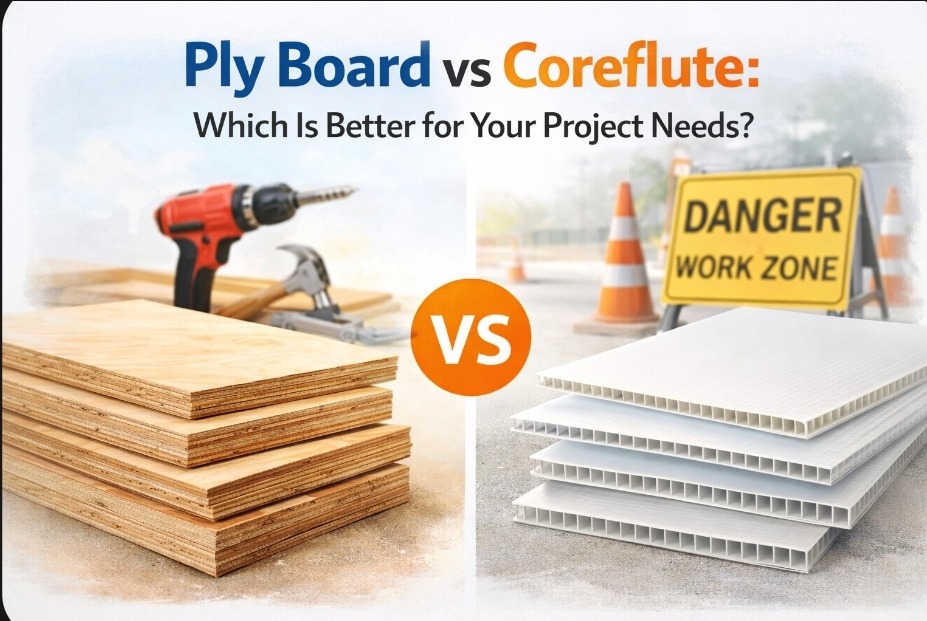
Plyboard is an engineered panel product made by sandwiching a core of softwood or hardwood strips between layers of veneer. In Australia, the term usually refers to panels used for furniture, cabinetry, partitions and interior wall linings rather than heavy structural plywood. Its construction provides a stable sheet that can be cut, shaped, painted or laminated to meet a variety of interior needs.
Plyboard is generally lighter than solid timber panels but offers reasonable strength for applications such as shelving, partitions and decorative panelling. However, it is less suitable for heavy load bearing structures when compared to structural plywood designed to building standards.
Because plyboard is wood based, it shares the characteristics and limitations of timber. It can be affected by moisture, may swell or distort if not properly sealed, and is usually less suitable for wet or exterior environments unless treated.
What is Coreflute?
Coreflute is a plastic sheet material, typically constructed with a twin wall hollow polypropylene structure. It is lightweight, water resistant, impact resistant and easy to install. The twin wall design provides good rigidity for its weight and allows it to withstand moderate impacts.
Coreflute is widely used in Australia for signage such as real estate boards and promotional displays, temporary surface protection on construction sites, and as a substrate for exhibition and display materials. Because it is plastic, coreflute is not prone to moisture damage, is easy to handle, cut and tape, and is suitable for both indoor and outdoor applications where temporary or flexible use is required.
Side by Side Comparison
Strength and Load Bearing
Plyboard offers moderate to good strength depending on its thickness and construction. It is suitable for cabinetry, shelving and decorative panels where loads are moderate. For heavy load bearing requirements, other structural panels may be more appropriate.
Coreflute, although rigid for its weight, is not designed for heavy structural loads. Its hollow design gives impact resistance and strength for lightweight applications but it cannot carry the same load as timber based panels.
If your project requires support for shelves, fixtures or other heavy items, plyboard is the safer option. Coreflute is better suited to temporary or lightweight applications such as signage or protective covering.
Moisture and Weather Resistance
Plyboard is susceptible to moisture and can swell, warp or deteriorate if not properly sealed. It is best used in dry interior environments or with appropriate moisture protection for damp areas.
Coreflute, being plastic, is inherently water resistant. It is ideal for outdoor signage, temporary protection during construction, and any application exposed to moisture or dust. Its resistance to weather makes it highly versatile for temporary and semi permanent uses.
Weight and Handling
Coreflute is very lightweight, making it easy to carry, cut and install, even in large sheet sizes. Plyboard, depending on thickness, can be heavier and more cumbersome to handle. For large panels, additional manpower or equipment may be required. In projects where mobility and ease of installation are important, coreflute has a clear advantage.
Surface Finish and Aesthetics
Plyboard has a timber based surface that can be painted, stained, laminated or veneered. This makes it ideal for visible interior applications where appearance is important. Coreflute has a smooth plastic surface suitable for printing and signage but does not offer the natural timber aesthetic. For high end furniture or decorative panels, plyboard is the preferred choice.
Cost and Sustainability
Plyboard is generally more expensive than coreflute, especially when finished or laminated. Installation costs may also be higher due to weight and handling requirements. However, for projects where durability and a polished finish are essential, the cost is often justified.
Coreflute is a cost effective option for temporary signage, protective covering, and lightweight panels. It is often recyclable and can be reused, although recycling availability may vary. For temporary projects or when cost is a priority, coreflute is a practical choice.
Lifecycle and Reuse
Coreflute is well suited to temporary applications, such as construction site protection, event signage, and display boards, where it can be installed, removed and reused. Plyboard is intended for permanent installations; once it is cut, fixed and finished, it becomes part of the building or furniture. For flexible or short term projects, coreflute is ideal.
Which Material Should You Choose?
Choose plyboard if:
Choose coreflute if:
In some cases, both materials may be used together. Plyboard can serve as the structural or decorative element while coreflute provides temporary protection or signage.
Project Use Cases in Australia
Common Mistakes to Avoid
Conclusion
The choice between plyboard and coreflute ultimately comes down to understanding the demands of your project. Plyboard is a timber based engineered panel suitable for interior applications, visible finishes, moderate structural loads and long term use. Coreflute is a plastic sheet ideal for lightweight, temporary, outdoor or protective applications where flexibility, cost efficiency and ease of handling are key.
By carefully evaluating load requirements, environmental conditions, permanence, finish expectations, budget and installation logistics, you can make an informed decision. For permanent joinery or decorative panels in a dry interior, plyboard is usually the best choice. For temporary protection, signage or flexible outdoor use, coreflute is the most practical option.
Taking the time to match the material to your project ensures durability, efficiency and a successful outcome. Both plyboard and coreflute have their place, and using each where it performs best can make a significant difference to your building or renovation project.