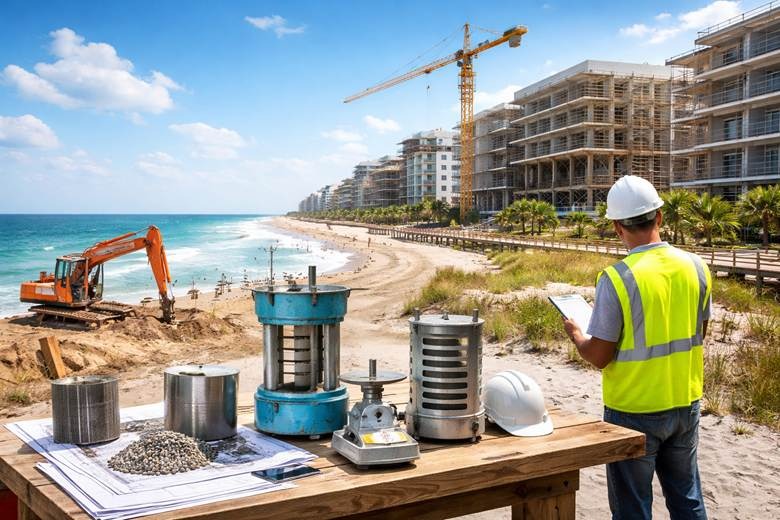
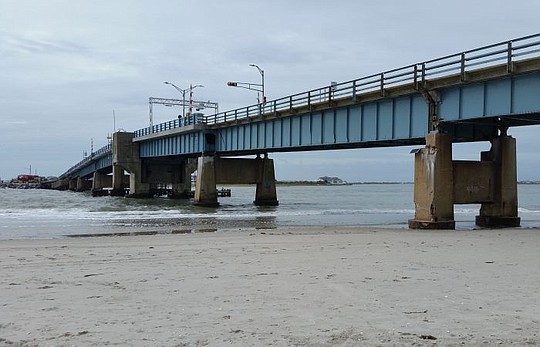
Coastal communities offer some of the most desirable places to live and visit, combining scenic beauty with economic activity driven by tourism, real estate, and infrastructure development. However, these same areas face unique environmental challenges that can significantly impact the safety, durability, and longevity of construction projects. From saltwater exposure to shifting soils and extreme weather conditions, building in coastal regions requires more than standard practices; it demands precision, planning, and rigorous material testing.
Unlike inland areas, coastal environments expose structures to a combination of stressors that can accelerate deterioration. Salt-laden air, high humidity, fluctuating temperatures, and storm surges all contribute to material degradation over time. Concrete can crack or corrode faster, steel reinforcement may rust, and asphalt surfaces may weaken under constant exposure to moisture and temperature variation.
In addition, sandy or loose soils often found in coastal regions can pose challenges for foundations. Without proper evaluation and preparation, buildings and roads may experience uneven settlement, leading to structural instability.
These risks make it essential to ensure that construction materials are tested thoroughly before and during the building process.
Material testing refers to the process of evaluating the physical and mechanical properties of construction materials such as soil, concrete, asphalt, and aggregates. The goal is to ensure that these materials meet specific standards for strength, durability, and performance.
Testing can take place in both laboratory and field environments. Common tests include:
● Soil compaction testing to determine load-bearing capacity
● Concrete compression testing to measure strength
● Asphalt density testing for roadway durability
● Moisture content analysis to prevent structural issues
By identifying potential weaknesses early, engineers and contractors can make informed decisions that improve the safety and lifespan of a project.
In coastal communities, the margin for error is much smaller. Structures must not only meet general safety standards but also withstand environmental forces that are more aggressive than those found inland.
Saltwater and salt air are among the biggest threats to construction materials. Reinforced concrete, which contains steel bars, is particularly vulnerable. If the concrete mix is not properly designed or tested, salt can penetrate the surface and cause the steel to corrode, leading to cracks and structural failure.
Material testing ensures that the correct mix designs, coatings, and protective measures are used to resist corrosion.
Coastal areas are often exposed to hurricanes, storms, and flooding. Roads, bridges, and buildings must be able to withstand high winds and water pressure. Testing helps verify that materials can endure these forces without compromising structural integrity.
Sandy and water-saturated soils require careful analysis. Without proper compaction and stabilization, foundations can shift over time. Soil testing helps determine the best construction approach, whether that involves reinforcement, drainage solutions, or alternative foundation systems.
Material testing is not just a technical requirement it is a critical component of public safety. Roads that crack prematurely, bridges that weaken, or buildings that fail under stress can lead to costly repairs and, more importantly, potential hazards for residents and visitors.
Quality control processes ensure that every stage of construction meets established standards. This includes verifying that materials delivered to a site match specifications, monitoring conditions during installation, and conducting post-construction evaluations.
For municipalities, investing in proper testing and inspection can reduce long-term maintenance costs and extend the life of public infrastructure.
Modern material testing has evolved significantly, making it more efficient and accurate than ever before. Portable testing equipment allows technicians to perform on-site evaluations in real time, reducing delays and improving decision-making during construction.
Digital tools and data analysis also play a growing role. Test results can now be recorded, shared, and analyzed instantly, enabling engineers to detect patterns and address issues quickly. This is especially valuable in fast-paced projects where time and accuracy are equally important.
Sustainability is becoming a key focus in construction, particularly in environmentally sensitive coastal areas. Material testing contributes to this effort by ensuring that resources are used efficiently and responsibly.
For example, testing can help determine whether recycled materials are suitable for use in a project, reducing the need for new raw materials. It can also identify ways to optimize mix designs, lowering the environmental impact without sacrificing performance.
Additionally, proper testing minimizes the risk of structural failure, which can lead to waste, pollution, and additional resource consumption during repairs or reconstruction.
When construction projects are built on a foundation of thorough material testing, the benefits extend far beyond the job site. Residents experience safer roads, more reliable infrastructure, and buildings that stand the test of time.
Tourism-driven communities, in particular, rely on well-maintained infrastructure to support economic activity. Visitors expect safe walkways, stable piers, and durable public spaces. By prioritizing quality and durability, local governments and developers can enhance both safety and visitor satisfaction.
Moreover, investing in proper testing helps protect property values. Homes and commercial buildings that are constructed with high-quality materials and verified processes are more likely to retain their value over time.
One of the most important aspects of material testing is its preventive nature. Instead of reacting to problems after they occur, testing allows stakeholders to identify and address issues before they become costly or dangerous.
This proactive approach is particularly important in coastal regions, where environmental conditions can amplify even minor construction flaws. By integrating testing into every phase of a project from planning and design to execution and maintenance builders can achieve better outcomes and reduce long-term risks.
Coastal communities face a unique set of challenges that require careful planning and execution in construction projects. Material testing plays a vital role in ensuring that structures are safe, durable, and capable of withstanding the demanding conditions of these environments.
From protecting against corrosion to enhancing resilience against extreme weather, testing provides the data and confidence needed to build smarter and stronger. As technology continues to advance and sustainability becomes a greater priority, the importance of material testing will only continue to grow.
For communities that depend on reliable infrastructure and long-lasting development, investing in proper testing is not just a best practice, it is an essential step toward a safer and more sustainable future.