Most people buying a mattress are told to look for CertiPUR-US® and then given no real explanation of what the label actually guarantees. So they assume it means the mattress is safe, healthy, maybe even organic — and move on. That assumption is partly right and partly wrong, and the gap between the two matters more than most retailers want to explain.
CertiPUR-US® applies only to the foam inside a mattress. Not the cover. Not the fire barrier. Not the adhesives between layers. Just the foam. If you know that going in, the label becomes genuinely useful. If you don't, you can end up buying something that carries the seal but still contains materials the certification never touched. This guide lays it all out — what the certification tests, what it skips, how it stacks up against GREENGUARD Gold, and which mattresses from EGOHOME combine it with additional certifications to cover more of those gaps.
Where Did CertiPUR-US® Come From?
The certification was launched in 2008 after a genuine problem in the bedding industry. Cheap imported polyurethane foams were showing up in U.S. mattresses with substances that had been banned domestically or flagged by international chemical safety bodies as harmful. A coalition of foam manufacturers, environmentalists, scientists, and consumer advocates got together to build a testing program that could give buyers something concrete to verify.
The certification covers three things: what the foam is made with, what it releases into your bedroom air, and whether it holds up physically over time.
Before a foam can be certified, it has to pass tests confirming none of the following are present:
• Ozone-depleting CFCs: These are chlorofluorocarbons, banned by international treaty since the late 1990s but still used in foam manufacturing in parts of the world where regulations are looser.
• Formaldehyde: It must stay below 0.1 parts per million; it's a known irritant and is listed as a potential carcinogen at sustained exposure levels.
• Regulated phthalate: These chemical plasticisers controlled by the U.S. Consumer Product Safety Commission because of their potential to interfere with hormonal development, particularly in children.
• Heavy metals including lead and mercury — certified foam must meet Consumer Product Safety.
VOCs — Volatile Organic Compounds — are chemicals that off-gas from materials at room temperature and end up in the air you breathe while you sleep. Some are harmless at low concentrations. Others, like benzene and formaldehyde, are associated with respiratory problems and are worse at higher levels. CertiPUR-US® technical guidelines cap total VOC emissions from certified foam at less than 0.5 parts per million.
This one gets overlooked. CertiPUR-US® also runs physical performance tests to confirm the foam won't sag or develop body impressions prematurely. A mattress that loses its support after a year isn't just uncomfortable — it stops providing the spinal alignment it was supposed to deliver. The durability test is a quality floor, not just a health check.
Following parts of a mattress are completely outside its scope:
• The cover fabric: This is the material your skin actually touches. If it's not separately certified (by OEKO-TEX®, for instance), you have no independent verification of what's in it
• The fire barrier layer: By U.S. law, all mattresses must be flame-resistant. CertiPUR-US® only restricts certain chemical flame retardants inside the foam. The fire barrier surrounding the foam is a separate material that the certification doesn't touch
• Fiber glass: Fibreglass is widely used as a fire barrier in budget mattresses. It's not a foam additive, so CertiPUR-US® has no opinion on it whatsoever. If a mattress cover is ever removed and washed, fibreglass particles can escape and contaminate an entire bedroom. The certification gives you zero protection against this
• Adhesives between foam layers — not tested, not covered.
These two labels show up together on a lot of mattress pages, and they're often treated as interchangeable. They're not. According to each night's 2026 certification guide and Sleep Advisor, here's how they actually differ:
GREENGUARD Gold is genuinely more rigorous. It tests the entire finished product — not just the foam — against a list of over 10,000 chemicals and applies emission limits specifically designed to protect infants and people with respiratory sensitivities. The catch is that very few mattress brands carry it, and the ones that do tend to cost more. For most people buying a mid-range foam or hybrid mattress, CertiPUR-US® plus OEKO-TEX® is the realistic target. If you're buying for a nursery or have serious chemical sensitivities, GREENGUARD Gold is worth the extra effort.
EGOHOME runs CertiPUR-US® certification across all its mattresses and adds OEKO-TEX® Standard 100 on the cover fabrics — so both the foam and the textile layer you sleep on have been independently tested.
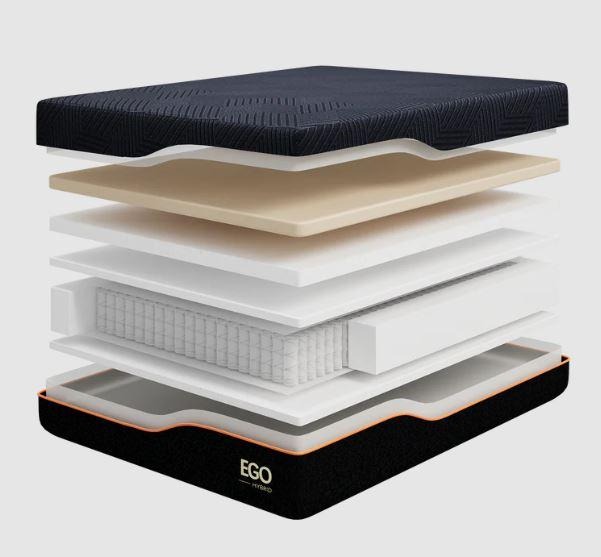
The EGOHOME Black 14" Hybrid has CertiPUR-US® certified foam throughout— the AeroFusion Foam® layer, the Copper Gel layer, and the BraceSleeper support base are all certified. The cover carries OEKO-TEX® Standard 100. And the fire barrier is fiberglass-free, which matters because, as explained above, CertiPUR-US® doesn't cover fiberglass at all. EGOHOME uses an alternative FR inner cover instead — meaning this mattress doesn't carry one of the most common hidden risks in the budget mattress category.
The copper-infused foam layer also has antimicrobial properties — not a marketing claim, but a documented characteristic of copper that inhibits bacterial growth over time.
The EGOHOME Black 12" Hybrid carries the same certifications as the 14" at a lower price. If the 14" profile is more than you need, this one gives you the same foam safety assurance and the same fiberglass-free construction, just at 12 inches instead of 14. The graphene-infused cover is OEKO-TEX® certified, so the surface touching your skin every night has also been independently tested.
The Tenzura Luxury Hybrid pairs CertiPUR-US® foam with a Tencel cover. Tencel is made from wood pulp via a closed-loop process that recycles most of the solvent used in production — it's one of the cleaner fabric options in the mid-range category. If you care about what the mattress cover is actually made from, not just whether the foam passed safety tests, this is the combination to look at in EGOHOME's range.
Both the Ventilated Gel Topper and the 5-Zone Gel Topper use CertiPUR-US® certified AeroFusion Foam®. Worth knowing if you're not replacing a mattress but want to add a certified foam layer on top of what you already have.
How to Actually Check If a Mattress Carries the Certification
The official CertiPUR-US® company directory at certipur.us lists every brand that currently participates in the program and is updated weekly. If a brand you're looking at isn't in that directory, the program's own FAQ states it cannot vouch for their use of the seal.
It takes about two minutes to check. For EGOHOME, the certification appears both on product pages and in the certipur.us directory.
No — and this trips people up constantly. CertiPUR-US® is a safety standard for synthetic polyurethane foam. It confirms that certain harmful chemicals are absent. It has nothing to say about whether materials are natural, organic, or sustainably sourced.
The certification's lead standard matches the Consumer Product Safety Commission's toy-grade limit, which is strict. It also bans the phthalates and flame retardants most associated with risks to children. That said, for a crib or nursery, GREENGUARD Gold is what pediatric health advisors typically recommend — it covers a broader chemical range and sets emission limits that account for the smaller, more enclosed space where infants sleep. CertiPUR-US® is a meaningful start; for babies, GREENGUARD Gold is the higher bar to look for.
No. This is a genuine blind spot in the certification. CertiPUR-US® only tests the foam, and fiberglass is used as a fire barrier around the foam — not inside it. Plenty of budget mattresses carry the CertiPUR-US® seal and still use fiberglass fire barriers that can become a serious problem if the outer cover is ever removed or torn. To know whether a mattress is fiberglass-free, you have to ask the brand directly or find explicit confirmation in the product specs. EGOHOME states this outright — their Black series uses a fiberglass-free FR inner cover.
Yes. But with clear eyes about what it does and doesn't cover.
CertiPUR-US® gives you real, independently verified confirmation that the foam in your mattress doesn't contain a list of chemicals that have no business being in a product you sleep on for 30,000+ hours over a decade. That's worth having. What it doesn't do is verify everything else in the mattress — the cover, the fire barrier, the glue between layers.
The most defensible position as a buyer is to look for CertiPUR-US® on the foam, OEKO-TEX® Standard 100 on the textiles, and explicit confirmation from the brand that their fire barrier is fiberglass-free. EGOHOME's certified lineup at egohome.com checks all three boxes — and their product pages are transparent about exactly which certifications apply to which components, which is more than most brands bother to be.