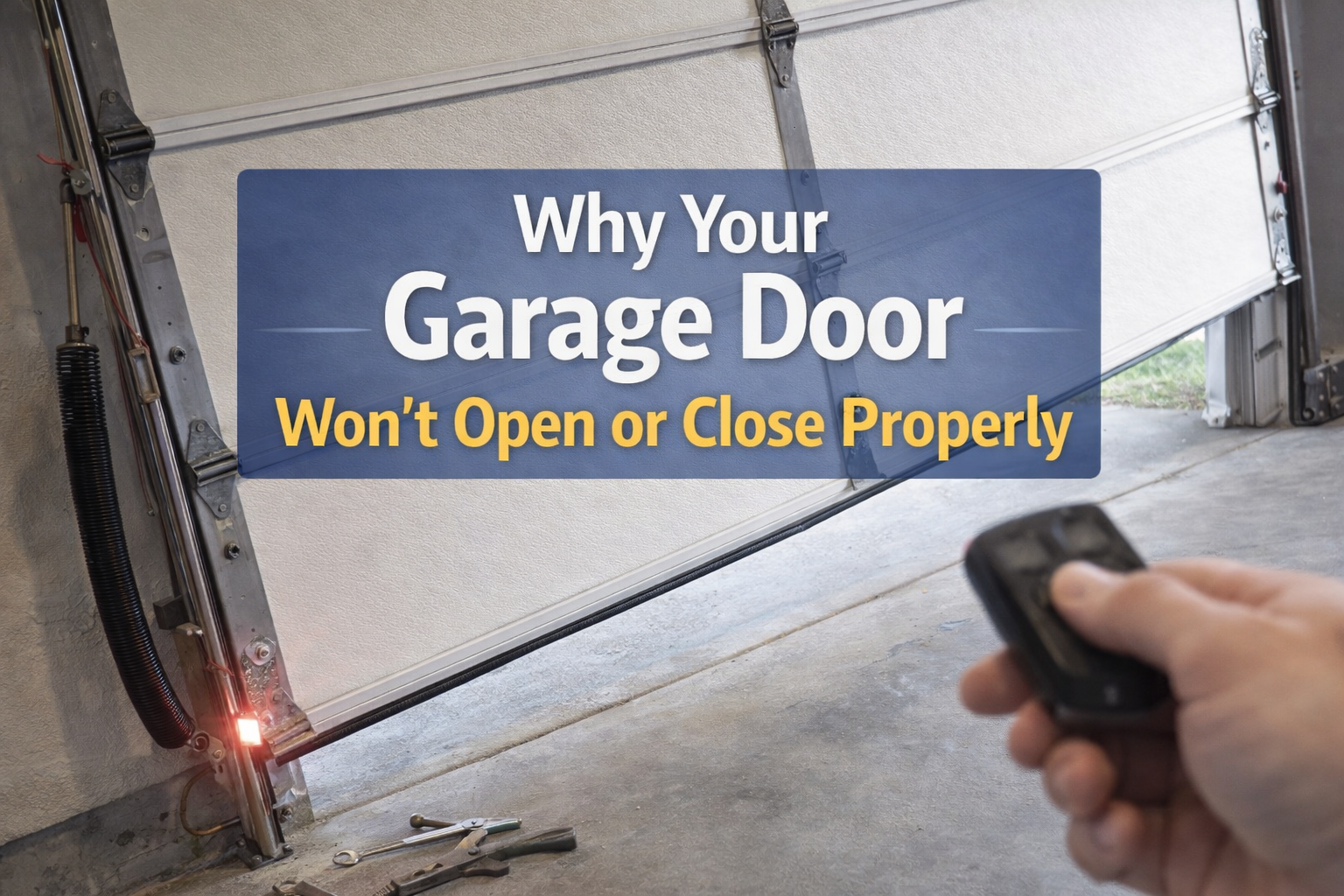
A garage door system has multiple moving parts working together. When one part fails, the door may stop opening, reverse unexpectedly, or refuse to close. Most problems come from worn mechanical components, sensor misalignment, or opener issues. Identifying the cause early prevents motor damage and costly emergency repairs.
Below are the most common reasons garage doors stop working properly and what each issue usually means.
1. Broken Torsion or Extension Springs
Springs are the most common reason a door won’t lift. Most residential springs are rated for 10,000 cycles. If yours is snapped, the motor will strain and hum, but the door will stay on the ground.
- The Cause: Metal fatigue from daily expansion and contraction.
- The Risk: Do not attempt to replace these yourself; they are under extreme tension and can cause severe injury if they release.
- Expert Take: If one spring breaks, replace both. They were likely installed at the same time and have the same wear level.
2. Obstructed or Misaligned Photo-Eyes
If your door starts to close and then immediately reverses, the safety sensors at the base of the tracks are likely the culprit. These "eyes" must see each other to allow the door to close.
- The Fix: Wipe the lenses with a soft cloth and ensure the small LED lights on both units are solid, not flickering.
- The Cause: Dust, cobwebs, or a bump from a trash can that knocked the bracket out of alignment.
- Next Step: Check the track path for debris, even a small pebble, that could trigger a reversal.
3. Snapped or Frayed Lift Cables
Cables work in tandem with the springs to pull the weight of the door. If a cable snaps, the door will often hang crookedly in the opening.
- The Sign: You might see a loose wire hanging or notice the door sitting at a 45-degree angle.
- The Solution: This requires same-day garage door repair Sacramento specialists because a crooked door can easily fall off its tracks entirely, damaging the panels or the track headers.
4. Stripped Opener Gears
If the motor runs and sounds normal, but the chain or belt isn't moving, the internal drive gear is likely stripped. These gears are often made of plastic to protect the motor from burning out.
- The Cause: Lifting a door that is too heavy or has a broken spring.
- The Downside: Replacing the gear kit is cheaper than a new opener, but if the unit is over 15 years old, a full replacement is more cost-effective.
5. Remote and Wall Button Signal Issues
When the wall button works, but the remote doesn't, the issue isn't the door itself; it’s the communication.
- The Battery: Start by replacing the CR2032 or AAA batteries in your transmitter.
- The Frequency: LED bulbs in the opener or nearby can sometimes create signal interference that blocks the remote’s frequency.
- The Antenna: Ensure the small wire hanging from the motor head is not tucked inside the housing or cut.
6. Off-Track Rollers
A door that has jumped the track is a localized emergency. This usually happens if a car bumps the door or if a cable snaps while the door is in motion.
- The Danger: An off-track door is unstable and can collapse.
- The Remedy: You should contact a garage door repair near you in Los Angeles to reset the rollers and re-tension the system. Do not pull the emergency release cord, as the door may crash down without the support of the opener.
7. Incorrect Limit Settings
The "limit" settings tell the motor how far to travel before it touches the ground. If the door hits the floor and then pops back up a few inches, the down-limit is set too far.
- The Adjustment: There are usually two plastic screws or a digital menu on the motor head.
- The Logic: If the door senses too much resistance (hitting the floor), the logic board assumes it hit an object and reverses for safety.
8. Dried Out or Rusted Hardware
Garage doors require lubrication every six months. If you hear grinding, squealing, or popping, the metal-on-metal friction is slowing the operation.
- The Fix: Use a lithium-based or silicone spray. Avoid WD-40, as it is a degreaser, not a long-term lubricant, and will actually attract more dust over time.
- Focus Areas: Spray the rollers, hinges, and the full length of the springs.
9. Dead Capacitor
If the motor makes a clicking sound or a loud hum but doesn't move at all, the start capacitor has likely failed. This component provides the initial "jolt" of electricity needed to move the heavy door.
- The Cost: This is a relatively inexpensive electrical repair.
- The Expert Take: Capacitors can store a charge even when the power is off, so this should be handled by a technician with the proper discharge tools.
10. Locked Manually
It sounds simple, but many homeowners accidentally engage the manual slide lock on the interior of the door. If this lock is closed and you trigger the opener, the motor will pull against a steel bar, which can bend the door panels or burn out the motor.
- The Check: Look at the side of your door for a sliding handle that goes into the track.
- The Solution: Always ensure this is retracted before using your remote.
Practical takeaway for homeowners
Garage doors rarely stop working without warning. Slower movement, unusual noise, shaking, or partial closing are early signs that components are wearing out or losing alignment. Addressing these symptoms early reduces downtime and prevents emergency failures.
If your garage door suddenly refuses to open or close, the safest approach is to stop repeated operation attempts and schedule a mechanical inspection. Identifying the exact cause quickly protects the opener, panels, and safety system from secondary damage.