Running a business often feels like a balancing act. You have sales coming in one door and expenses flying out the other. But what happens when the timing is off? You might land a massive contract or deliver a huge order, but the payment isn't due for another 60 days. Meanwhile, payroll is due this Friday, and suppliers are waiting for their checks.
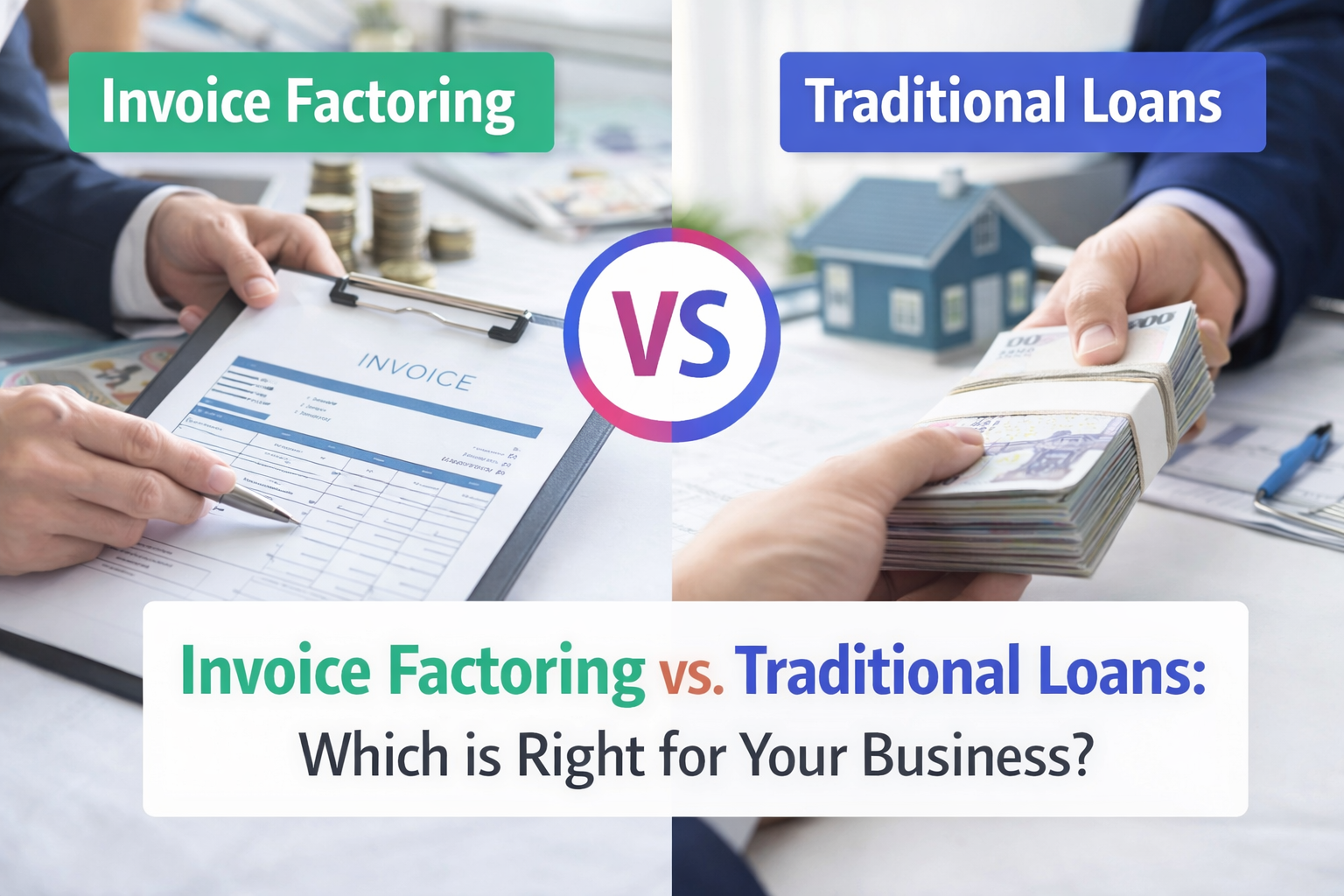
This cash flow gap is one of the most common reasons businesses stall or fail. When you need capital to bridge that gap, you generally have two main paths: traditional bank loans or alternative financing like invoice factoring.
Both options put money in your account, but they work in fundamentally different ways. Choosing the wrong one could mean getting rejected after a month of paperwork or tying your business to a debt structure that stifles growth.
So, which financial tool is right for you? Let’s break down the differences between invoice factoring and traditional loans to help you make the best decision for your company’s future.
Let's Start With the Basics
Before diving into the pros and cons, it is crucial to understand what these financial products actually are. They are not just different flavors of the same ice cream; they are entirely different food groups.
What is a Traditional Business Loan?
A traditional business loan is debt financing. You borrow a lump sum of money from a bank or financial institution. You then repay this principal amount over a set period (usually years) with interest. The bank evaluates your creditworthiness, business history, and assets to determine if you are a safe bet.
What is Invoice Factoring?
Invoice factoring is not a loan; it is an asset sale. You sell your outstanding invoices (accounts receivable) to a factoring company at a small discount. The factor advances you the bulk of the invoice amount immediately (often within 24 hours). Then, your customer pays the factor directly when the invoice is due.
Key Differences at a Glance
Feature
| Traditional Bank Loan
| Invoice Factoring
|
Speed of Funding
| Slow (Weeks to Months)
| Fast (24-48 Hours) |
Approval Criteria | Based on your credit & history | Based on your customer's credit |
Collateral | Often requires business/personal assets | The invoice itself is the collateral |
Debt on Balance Sheet | Yes (Adds to liabilities) | No (It's an asset sale) |
Flexibility | Fixed amount | Scales with your sales volume |
The Case for Traditional Loans
Bank loans are the "classic" route for a reason. If you can get one, they often come with the lowest cost of capital.
The Benefits
- Lower Interest Rates: Generally, banks offer single-digit interest rates, which are cheaper than factoring fees when calculated annually.
- Predictable Payments: You know exactly how much you need to pay each month, making budgeting straightforward.
- Retain Full Control: The bank doesn’t interact with your customers. Your billing process remains entirely internal.
The Drawbacks
- Strict Qualification: Banks are risk-averse. They typically require a high credit score (often 700+), years of profitable tax returns, and substantial collateral. Startups or businesses with a rough patch in their history often get rejected.
- Slow Process: Getting approved can take anywhere from 30 to 90 days. If you need money for payroll next week, a bank loan won't help you in time.
- Fixed Limits: If you borrow $100,000, that’s all you get. If your business suddenly doubles in size, you have to apply for a new loan to get more capital.
Thus, this option works well with established businesses with strong credit, tangible assets (like real estate or heavy machinery), and long-term capital needs like expanding a facility or buying equipment.
The Case for Invoice Factoring
Factoring is built for speed and flexibility. It is designed for B2B companies that have strong sales but slow-paying customers.
The Benefits
- Immediate Cash Flow: Funding happens almost instantly. Once your account is set up, you can turn an invoice into cash within 24 hours of issuing it.
- Easier Qualification: Factoring companies care more about your customer’s ability to pay than your personal credit score. If you work with reputable clients (like government agencies or large corporations), you are likely to be approved even if your own business credit is young or bruised.
- Scalability: This is a major advantage. As your sales grow, your access to capital grows. If you invoice $50,000 this month, you can factor that. If you invoice $500,000 next month, you can factor that too. You aren't capped by a loan limit.
- No Debt Incurred: Since you are selling an asset, you aren't adding debt to your balance sheet. This keeps your debt-to-income ratio looking healthy if you need to apply for other financing later.
The Drawbacks
- Higher Cost: Factoring fees are typically higher than bank loan interest rates. You are paying for speed and accessibility.
- Customer Interaction: In most factoring arrangements, your customers remit payment directly to the factoring company. While this is standard in many industries (like trucking and staffing), some business owners worry about how it looks to their clients.
Startups, small businesses with limited credit history, companies in rapid-growth phases, or industries with long payment cycles (such as trucking, construction, and staffing).
Real-World Scenarios: Which Would You Choose?
Let’s look at two examples to see how this plays out in reality.
Scenario A: The Manufacturer Expansion
ABC Manufacturing has been in business for 15 years. They have steady profits and own their warehouse. They want to build a new factory extension, a project that will take 6 months to complete. They don't need the money urgently, but they need a large sum at a low rate.
- Verdict: Traditional Loan. Their strong assets and lack of urgency make them perfect candidates for a low-interest bank loan.
Scenario B: The Staffing Startup
XYZ Staffing just landed a contract to supply 50 nurses to a local hospital. It’s a huge opportunity. However, the nurses need to be paid weekly, but the hospital pays invoices on Net-60 terms. XYZ doesn't have the cash reserves to cover two months of payroll for 50 people.
- Verdict: Invoice Factoring. A bank loan would take too long to approve. Factoring allows XYZ to get paid immediately on their invoices, giving them the cash to meet payroll every week without fail.
Making the Right Decision
Ultimately, the choice comes down to your specific needs. Ask yourself these three questions:
- How fast do I need the money? If you need it next week, factoring is the winner. If you can wait two months, a loan might be better.
- What is my credit situation? If your business credit is less than perfect, a bank is likely to say no. A factoring company is likely to say yes.
- Why do I need the funds? If it’s to bridge a gap caused by slow-paying customers, factoring solves the root problem. If it’s to buy a piece of real estate, a loan is the appropriate tool.
Financial flexibility is key to survival. Don't let slow payments hold your business hostage. If you are tired of waiting 30, 60, or 90 days to get paid for work you’ve already done, it might be time to look beyond the bank.