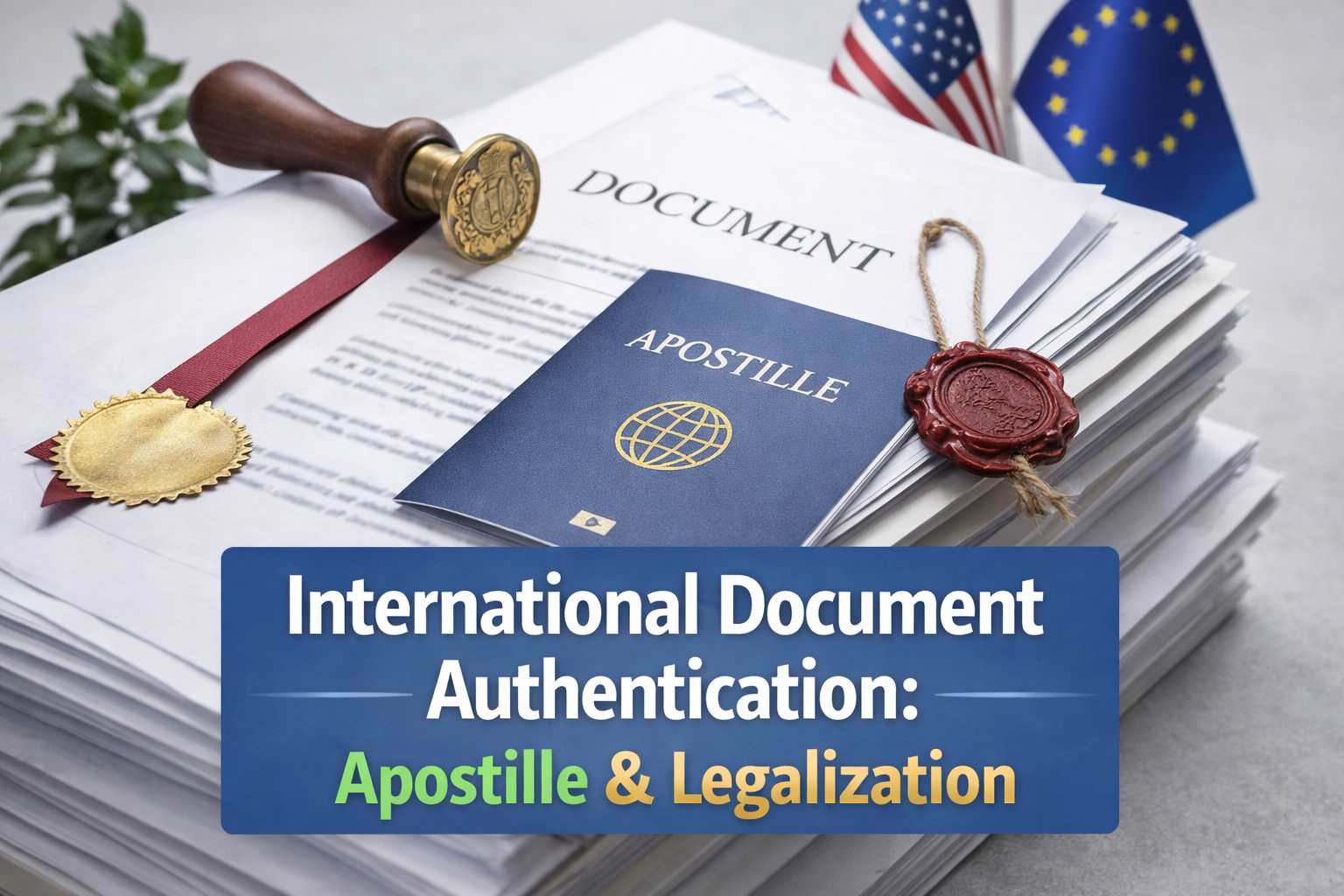
Robust international document authentication is a foundational requirement for cross-border legal recognition in commerce, education, immigration, and private civil matters. As globalization accelerates, regulatory authorities have intensified scrutiny of foreign documents to prevent fraud, misrepresentation, and procedural abuse.
Today, more than 30 million apostilles are issued annually worldwide, reflecting the growing complexity of international transactions and the strict formal requirements governing document acceptance abroad.
When a public document is intended for use outside its country of origin, a precise, codified authentication sequence must be followed. Even minor technical omissions, such as an invalid notarial seal or incorrect issuing authority, can trigger delays, denials, or outright rejection. As a result, reliance on professional apostille and legalization support has become a strategic necessity for organizations and individuals seeking efficiency, compliance, and certainty.
According to the Hague Conference on Private International Law (HCCH), 124 countries are signatories to the Apostille Convention, including Russia and most European jurisdictions. Meanwhile, U.S. diplomatic missions process tens of thousands of document authentications each year for countries that remain outside the Convention framework.
International trade expansion, academic mobility, foreign employment, citizenship applications, and cross-border litigation are the primary drivers of this demand. Importantly, authorities do not validate the content of a document; rather, they verify the authenticity of the issuing official’s signature, seal, or authority.
Data from the U.S. Department of State indicates that over 10% of foreign document submissions are rejected due to incomplete or incorrect authentication. While standardized checklists exist, combining procedural guidance with experienced operational support significantly increases approval success rates and reduces costly resubmissions.
Before the Apostille Convention entered into force in 1961, international document recognition required a burdensome chain-legalization process involving multiple government entities. The Convention simplified this system by replacing multi-layered certification with a single apostille certificate, dramatically improving efficiency.
An apostille is issued by a designated competent authority, typically a state-level body, and certifies the legitimacy of the signature or seal on a public document. For Convention member states, this mechanism has reduced average processing times by up to 80% and standardized cross-border acceptance.
Today, the vast majority of international visa applications, academic credential verifications, and corporate filings destined for Hague countries rely on apostilled documents. The growing volume of time-sensitive international transactions has further expanded demand for specialized apostille and legalization services capable of navigating jurisdiction-specific nuances.
Apostilles apply exclusively between Hague Convention members. For non-member countries, such as China, the United Arab Emirates, and several Middle Eastern jurisdictions, documents must undergo full consular legalization, which is substantially more complex.
Industry data shows that legalization cases carry three times the rejection risk of apostille submissions due to sequencing errors, outdated certificates, or mismatched jurisdictional requirements.
Public authorities worldwide require authentication only for documents that carry legal weight beyond national borders. These documents typically originate from government bodies, courts, educational institutions, or registered corporate entities and must meet strict formal criteria to be recognized abroad.
While requirements vary by jurisdiction, the following categories account for the majority of apostille and legalization requests in international personal and commercial matters.
Applicants preparing immigration or residency files often underestimate the complexity of validating law-enforcement records, particularly when dealing with federal-level clearances such as FBI background checks for international use.
The rise in EU citizenship by descent, international mergers, and multinational hiring has fueled sustained growth in authentication demand. Between 2013 and 2023, citizenship applications requiring apostilled records increased by more than 25% across European jurisdictions.
Document authentication is unforgiving by design. An expired certificate, improper notarization, or incorrect issuing authority can invalidate an entire submission. Industry data indicates that 15% or more of applications require correction or reissuance due to avoidable procedural mistakes.
For time-sensitive matters, such as corporate acquisitions, student visa deadlines, or international relocation, these errors translate into lost opportunities, financial penalties, and regulatory non-compliance. Precision at the notarization stage is particularly critical, making mobile notary services for complex documentation workflows an essential component of risk mitigation strategies.
International document authentication remains the linchpin of legally recognized global transactions. Whether preparing personal records for Russian authorities or validating corporate filings for foreign regulators, success depends on procedural accuracy, jurisdictional awareness, and strict adherence to evolving standards.
Engaging specialized apostille and legalization support reduces error rates, accelerates approval timelines, and ensures documents are accepted without challenge in the destination country. As cross-border mobility and regulatory oversight continue to expand, disciplined execution and expert guidance are no longer optional, they are essential for compliance and international credibility.
While the Apostille Convention has standardized authentication across many jurisdictions, country-specific requirements remain a frequent source of rejection. Some authorities impose strict rules regarding document issuance dates, requiring civil records to be no older than three to six months at the time of submission. Others mandate that supporting documents, such as translations or notarizations, be authenticated separately.
In jurisdictions including Russia and several CIS and EU countries, authorities may also require confirmation that the issuing office falls within the correct territorial or administrative competence. Failure to account for these nuances can invalidate an otherwise properly apostilled or legalized document.
For documents submitted in a foreign language, certified or sworn translations are often mandatory. In many cases, the translation itself must be notarized, and in certain jurisdictions, the notarized translation must then receive its own apostille or legalization.
Common rejection triggers include discrepancies in names, dates, or formatting between the original document and its translation. Ensuring linguistic accuracy and procedural alignment between the source document and its translated counterpart is essential for successful acceptance by foreign authorities.