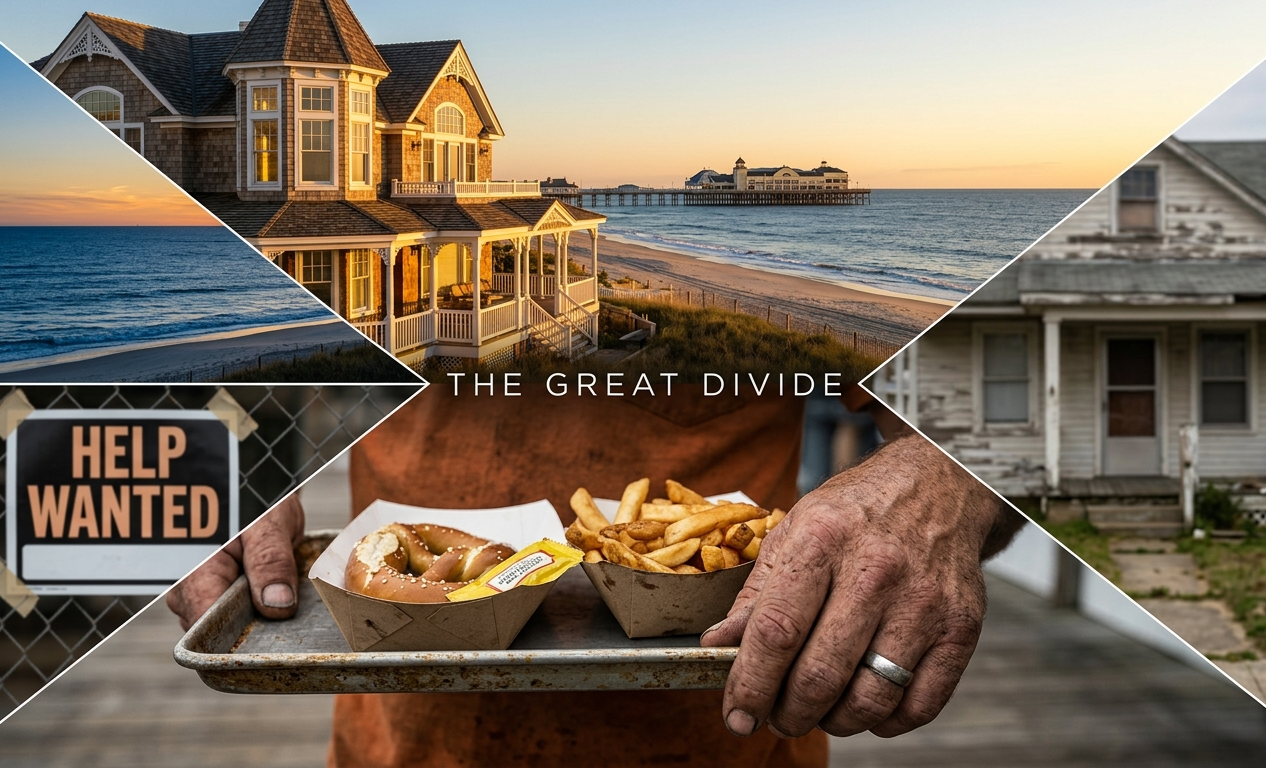
A K-shaped economy occurs when different sections of the population move in opposite directions after a financial disruption, and in Ocean City with its population of under 12,000, this divide is carving a deep line between those who own the view and those who staff the boardwalk. While the top arm of the K represents property owners and remote professionals seeing their net worth stabilized by high equity, the bottom arm represents the local service workforce and retirees on fixed incomes who are grappling with a cost of living that refuses to cool.
Understanding this trajectory is vital because a resort town cannot function when its essential population is priced out of the very ZIP codes they serve. There are 34 homes sold in a typical month here, but the median sale price has hit $1,324,500, representing a massive barrier for the year-round workforce. This divergence creates a fragile ecosystem where the upward arm of the K enjoys a surplus of luxury services, while the downward arm struggles to find a place to sleep.
To navigate this landscape, it is helpful to look at a K-shaped economy what-to-know guide from Empower | The Currency to see how these macro trends dictate micro-level local decisions. When the wealthy feel wealthier due to asset appreciation, they spend more on high-end dining and experiences, but if the labor force cannot afford to live within a thirty-minute commute, those services eventually suffer from chronic understaffing and reduced quality.
The real estate market in Ocean City has transitioned from the frenetic bidding wars of previous years into a more calculated, yet still expensive, environment. With the median sold price holding steady at over $1.3 million, the barrier to entry remains a significant hurdle for anyone without a substantial down payment or existing equity.
Cash-heavy buyers and second-home owners represent the upward arm of the K, utilizing their liquidity to secure properties as long-term hedges against inflation. This group is largely insulated from the high interest rates that have sidelined the middle class, allowing them to continue consolidating local assets along the Gold Coast.
Conversely, the year-round resident looking to buy their first home finds themselves trapped in the downward arm. With inventory rising slightly to 283 active listings as of early 2026, there is more to choose from, but the math still does not work for a local family when the monthly carrying costs outpace the average local salary.
Tourism in 2026 is no longer a monolith where every business thrives equally during the summer surge. We are seeing a distinct split in how visitors spend their money, with luxury rentals and high-end charter services seeing record demand while mid-tier family motels and budget-friendly eateries feel the squeeze.
Families who traditionally visited Ocean City for a week every summer are now becoming deal sensitive, often cutting their trips short or opting for day trips to save on lodging. This shift forces local business owners to choose which arm of the K they want to serve. Those who pivot to luxury may find higher margins, but they risk alienating the core demographic that has sustained the town for decades.
The economic pressure on the lower arm is further compounded by the reality that the poorest households experience higher inflation than the national average. For a seasonal worker in Ocean City, this means that even if their hourly rate goes up, their purchasing power for gas, groceries, and utilities is actually shrinking.
The lifeblood of Ocean City is its service industry, yet the K-shaped trend is making it nearly impossible for these workers to maintain a foothold in the community. When housing is treated primarily as a speculative asset for the upward arm, the downward arm is forced further inland, creating a logistical nightmare for businesses that rely on early-morning or late-night shifts.
Local stakeholders and small businesses must consider several strategic shifts to survive this bifurcation:
By acknowledging that the workforce is on the downward arm of the K, business owners can begin to build better support structures that prevent a total labor collapse. It is a matter of practical survival rather than just social responsibility.
Ocean City has always been a haven for retirees, but the current economic climate is putting significant stress on those living on fixed incomes. While those who own their homes outright are protected from rising rents, they are not immune to the skyrocketing costs of property insurance and local taxes.
The upward arm of the retiree population might see their investment portfolios grow, but those relying solely on Social Security or modest pensions are seeing their margins evaporate. This is particularly true as cost of living adjustments for 2026 face uncertainty due to shifting federal data reporting, leaving many seniors in a state of financial limbo.
When a significant portion of the permanent population is forced to cut back on spending, the off-season economy of Ocean City takes a hit. The local shops and restaurants that stay open year-round depend on these residents, and if the K-shape continues to widen, the town’s winter vitality could be at risk.
The goal for any coastal community should be to bridge the gap between these two diverging paths before the divide becomes permanent. This requires a move away from generic pro-growth strategies and toward specific, targeted interventions that support the downward arm of the K.
We need to stop viewing the real estate market's success as the sole indicator of the town's health. High property values are great for the upward arm, but they are a predatory force for the people who make the town run. A truly healthy Ocean City is one where the person serving the orange crush can also afford to live within the town limits.
For more insights into the stories affecting NJ’s coastal residents, you can explore our latest analysis on our blog.