Your medicine cabinet probably has a tube of something that promises to fix sore muscles, aching joints, or that persistent knot in your lower back. Most of those products mask pain with menthol or capsaicin and call it a day. CBD lotion takes a different approach, and the growing body of research behind it is worth paying attention to. But with hundreds of products on the market, figuring out what actually works for pain relief requires cutting through the noise. Not every CBD lotion is created equal, and the difference between a product that delivers real results and one that does nothing often comes down to a handful of details most people overlook.
CBD lotion is a topical product that combines cannabidiol, a compound extracted from hemp, with a moisturizing base. Unlike CBD oils or tinctures intended for oral use, lotions are formulated for application to the skin. The CBD is suspended in ingredients like shea butter, coconut oil, or aloe vera, creating a product that absorbs through the outer layers of skin and targets localized areas.
The distinction between a CBD lotion and a regular moisturizer is the active cannabinoid content. A quality product will list the milligrams of CBD on the label, typically ranging from 250mg to 3,000mg per container.
CBD interacts with the endocannabinoid system, which exists throughout your body, including in your skin. Your skin contains CB1 and CB2 receptors that respond to cannabinoids. When CBD is applied topically, it binds to these receptors in the local area, potentially reducing inflammatory signals and modulating pain perception at the site of application.
A 2020 study published in the Journal of Pain Research found that transdermal CBD application reduced joint swelling and pain-related behaviors in animal models. While human clinical trials are still underway, the mechanism of action is well documented.
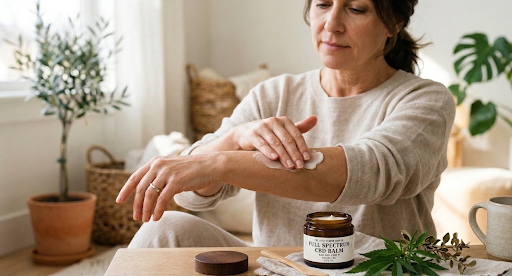
Most people apply CBD lotion to specific problem areas once or twice a day. Someone with chronic knee pain might rub it into the joint after a morning shower, then again before bed. Athletes often use it post-workout on sore muscle groups. The key is consistency: a single application might offer temporary relief, but regular use over two to four weeks tends to produce more noticeable results.
Think of it like any other active skincare ingredient. CBD lotion works on a similar timeline for pain management.
The CBD itself matters, but so does the supporting cast. Look for these ingredients on the label:
Menthol or camphor: Provides immediate cooling sensation while CBD works on a deeper level
Arnica: A botanical with its own anti-inflammatory properties
Essential fatty acids: From ingredients like hemp seed oil or jojoba oil, which improve skin absorption
Vitamin E: An antioxidant that supports skin barrier function
Avoid products loaded with artificial fragrances, parabens, or alcohol, as these can irritate the skin and interfere with CBD absorption.
Understanding the science behind topical CBD helps you set realistic expectations and use the product more effectively.
Your skin is your largest organ and has its own endocannabinoid system. When you apply a CBD lotion, the cannabidiol doesn't just sit on the surface. It permeates the epidermis and reaches the dermis, where it interacts with CB2 receptors concentrated in immune cells and nerve endings. This interaction can dampen the release of pro-inflammatory cytokines, which are proteins your body produces in response to injury or chronic stress on tissues.
The permeability of your skin varies by location. Thinner skin areas absorb CBD more readily than thicker skin.
Topical application has a distinct advantage over oral CBD: it targets the exact area where you need relief. When you swallow a CBD capsule, it passes through your digestive system, gets metabolized by your liver, and only a fraction of the original dose reaches your bloodstream. This is called first-pass metabolism, and it can reduce bioavailability to as low as 6-15%.
A topical bypasses all of that. The CBD goes directly to the tissue that needs it, concentrating its effects where you actually hurt.
Expect to feel initial effects within 15 to 45 minutes of application. The cooling or warming sensation from supporting ingredients like menthol kicks in faster, while the CBD itself takes longer to penetrate and interact with receptors.
For chronic conditions, most users report meaningful improvement after consistent use for 10 to 14 days. A twice-daily routine can build cumulative benefits.
The appeal of topical CBD goes beyond just the cannabinoid content.
The biggest draw is that it offers a non-pharmaceutical option for managing discomfort. NSAIDs like ibuprofen work, but long-term use carries risks. CBD lotion sits in a different category: it's applied externally, doesn't enter systemic circulation in meaningful amounts, and has a very low side-effect profile.
A 2022 Gallup poll found that 1 in 7 American adults use CBD products, with pain relief being the most commonly cited reason.
For muscle soreness after exercise, CBD lotion can reduce the inflammatory response that causes delayed-onset muscle soreness. Applying it to sore areas can help speed recovery.
Joint pain responds particularly well to topical CBD because joints sit relatively close to the skin surface. Knees, fingers, wrists, and elbows are all areas where a quality CBD lotion can deliver its active compounds efficiently.
Daily Use of CBD Lotion for Recovery
Incorporating CBD lotion into a daily routine doesn't require a complete lifestyle overhaul. Apply it after your shower when your pores are open, and your skin is clean. Use it before physical activity on areas prone to soreness, or after activity to manage inflammation. Some people keep a tube at their desk for midday application.
The consistency-over-intensity principle applies here. Small, daily applications outperform occasional heavy use.
Not all products deliver equal results.
Three factors matter most. First, CBD concentration: anything below 500mg per container is unlikely to deliver meaningful pain relief for most adults. Second, the type of CBD extract: full-spectrum products contain additional cannabinoids and terpenes that create an "entourage effect." Third, third-party lab testing. If a company doesn't publish a Certificate of Analysis from an independent lab, walk away.
Beyond the CBD itself, check the ingredient list for absorption enhancers and complementary compounds:
MSM (methylsulfonylmethane): Supports joint health independently
Turmeric or curcumin: Anti-inflammatory botanical
Magnesium: Helps with muscle relaxation
Hyaluronic acid: Improves skin hydration and can aid absorption
Read the ingredient order carefully. CBD or hemp extract should appear in the top third of the list.
These terms get used interchangeably, but they're different formulations. Lotions have the highest water content, making them lighter and more quickly absorbed. Creams are thicker. Balms are oil-heavy with little to no water.
For daily pain management on larger areas, a lotion works well. For concentrated joint pain in smaller areas, a balm's thicker consistency keeps the CBD in contact with the skin longer.
DIY CBD lotion is entirely possible.
Melt 1/2 cup of shea butter and 1/4 cup of coconut oil in a double boiler over low heat
Remove from heat and let cool
Add 1,000mg of CBD isolate or full-spectrum CBD oil
Stir in 1 tablespoon of vitamin E oil and essential oil
Whip the mixture
Transfer to a clean, airtight glass jar
The key step is adding the CBD after the mixture cools. High heat degrades cannabinoids and reduces potency.
You'll need a quality CBD isolate or distillate as your active ingredient. Purchase from a supplier that provides lab results. The base ingredients are widely available: shea butter, coconut oil, beeswax, vitamin E oil, and essential oils.
A milligram scale is essential.
It can be, with caveats. Commercial products often use advanced technology to improve absorption. Homemade lotion also lacks preservatives, so it has a shorter shelf life.
If you know your preferred concentration and want to avoid additives, homemade is a solid option. For maximum absorption and potency, a professionally formulated product will likely outperform a DIY version.
This is one of the most common concerns.
In very small amounts, yes. Studies have shown that topical CBD can be detected in blood plasma, though at much lower levels than oral consumption.
For practical purposes, the amount that enters your bloodstream is extremely small.
Standard drug tests screen for THC metabolites, not CBD. Full-spectrum CBD products can contain up to 0.3% THC. While topical application delivers far less THC, the risk isn't zero with heavy use.
If you're subject to drug testing, use a broad-spectrum or CBD isolate lotion that contains zero THC.
Patch-test any new product on a small area of skin and wait 24 hours before applying it more broadly. Start with a moderate amount and increase if needed.
Avoid applying CBD lotion to broken skin. If you're taking medications, consult your doctor first.
The market is flooded with options.
Start with the brand's website rather than third-party marketplaces. Reputable brands provide full product information, including lab reports and sourcing details.
Read reviews on independent platforms and look for feedback about pain relief.
Before purchasing, verify these:
COA availability
CBD concentration
Extract type
Ingredient transparency
Return policy
Look for companies like littleflowersoap.com that have been in business for at least 3 years, source hemp from domestic farms (U.S.-grown hemp is subject to USDA regulations), and use CO2 extraction, which produces cleaner extracts with no residual solvents. Certifications from organizations like the U.S. Hemp Authority add another layer of credibility.
Price can be an indicator, too. Quality CBD lotion typically costs between $40 and $80 for a 3-4 ounce container. If a product is dramatically cheaper, question the CBD content.
For most people dealing with localized muscle soreness, joint stiffness, or chronic pain in specific areas, a quality CBD lotion is worth a two-week trial. The risk is low, the side-effect profile is minimal, and the potential upside is meaningful relief without relying on pharmaceuticals. Set realistic expectations: it's not a miracle cure, but it's a legitimate tool in a pain management toolkit.
Athletes recovering from training, office workers with repetitive strain, older adults managing arthritis, and anyone dealing with localized pain that responds to anti-inflammatory treatment. If your pain is systemic or stems from a serious underlying condition, topical CBD alone won't be sufficient, and you should work with a healthcare provider.
Match the product to your specific need. High-concentration full-spectrum lotion for significant joint pain. Lighter broad-spectrum formulas for daily muscle maintenance. Zero-THC isolate products if drug testing is a concern. Whatever you choose, give it at least two weeks of consistent use before judging whether it works for you. The right product, used correctly and consistently, can make a real difference in how your body feels day to day.