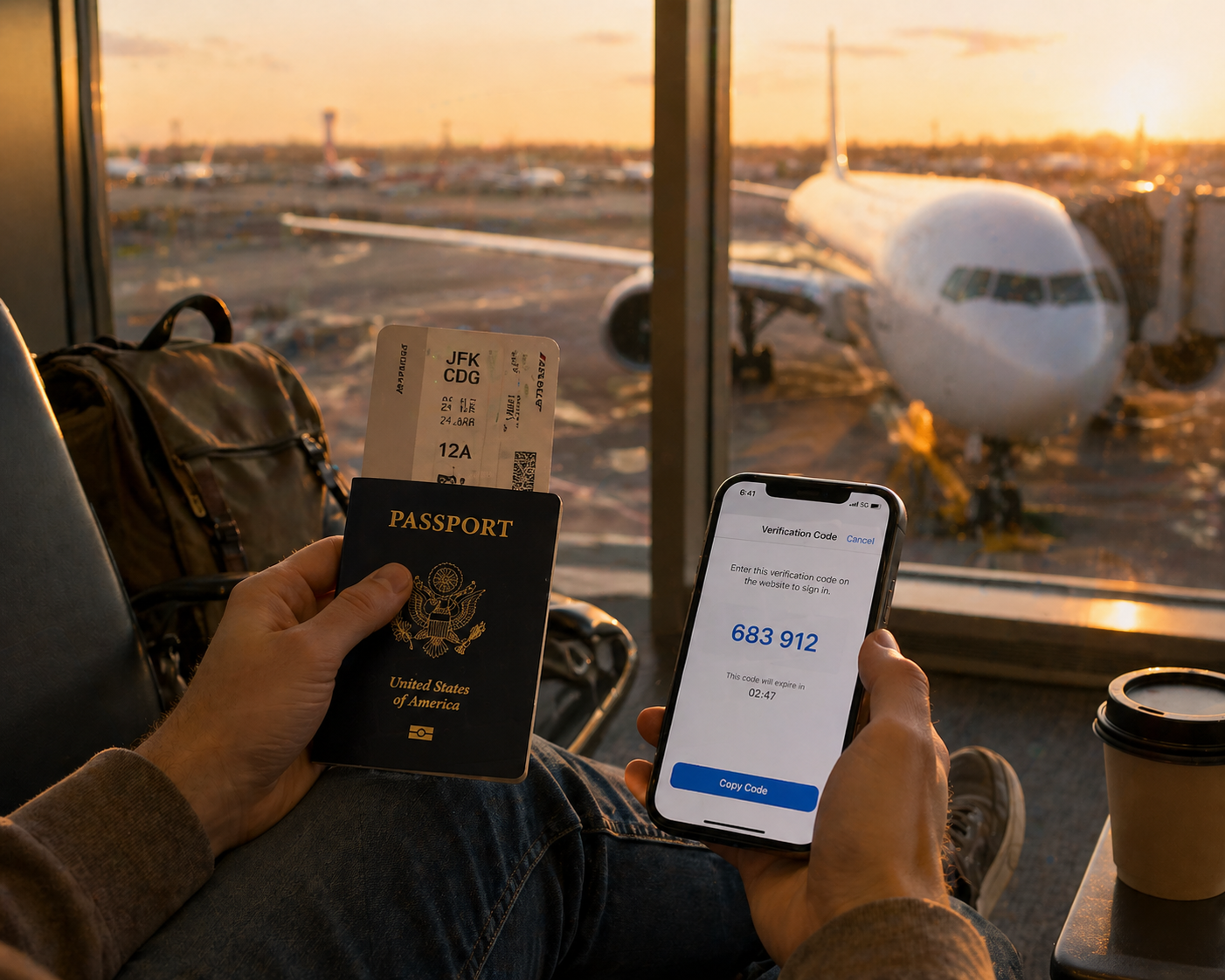
The first time I landed in Istanbul without a working phone number, I learned something every modern traveler eventually learns. The world runs on SMS. Hotels send check-in codes. Banks confirm card use. Ride apps verify your account. Even the airport Wi-Fi wanted a text. My home SIM was roaming weakly, my data was draining at international rates, and the OTP for my own bank app was sitting in a message I could not read.
Since then, I have done what a growing number of travelers do. Before I fly, I buy a temporary phone number for the country I am visiting. It costs less than a coffee and saves me hours.
If you have never thought about doing this, here is why it has quietly become standard travel prep.
Modern travel breaks a hidden assumption your phone makes. Your apps assume you are at home. When you suddenly log in from Turkey, your bank wants to confirm you are really you. It sends a code by SMS. Your home SIM might receive it. Or it might not, because the local carrier you are roaming on dropped the international text. Or it arrived in your home country and is sitting on your second phone in a drawer.
Multiply that across email, your hotel app, your flight rebooking, and the random e-commerce site you ordered from before the trip. Suddenly you are abroad, locked out of half your accounts, and there is no support line that can fix it from the airport floor.
Buying a local SIM at the airport is the old fix. It works, but it eats forty minutes, requires your passport, and leaves you with a plastic card you will throw away in three days.
A virtual temp number for sms solves the same problem in two minutes from your phone, before you even leave home. You get a real, working number in the destination country. You can register apps with it. You can receive the OTP your bank wants. You can sign up for the local ride-hail service that requires a domestic number.
And when the trip ends, you simply stop renewing it. Nothing to cancel, nothing to throw away.
Some destinations are heavier on SMS than others. Turkey is a great example. To use the local taxi apps, you usually need a Turkish number. To unlock the e-government tourist tax refund, the same. Some neighbourhood card-payment systems verify with a Turkish OTP. A traveller showing up with only a US or German number ends up paying for tourist-priced taxis and skipping useful apps entirely.
That is exactly the gap a Turkey Temporary Phone Number fills. You set it up before the flight, link it to the taxi app and the food delivery app, and walk out of the airport already plugged into the local services like a resident.
China is another classic. Many Chinese platforms simply do not allow non-Chinese numbers to register. A short-term Chinese virtual number opens up everything from local maps to local payment apps for the duration of your trip.
The same pattern repeats in Japan, India, Brazil, and most of Southeast Asia. Each of these countries has a domestic-number wall around its most useful apps, and a virtual number is the polite way through.
There is a quiet privacy benefit too. Once you give a phone number to a hotel, an airline, a restaurant booking site, and a sightseeing tour operator, your number is in five new databases. Some of them will sell it to marketers. Some will leak in a breach next year.
If the number was a temporary one tied only to your trip, the leak does not reach your real life. Your home phone keeps ringing only with calls you actually want. Your inbox does not slowly fill with foreign promotional texts six months later.
Be honest about the limits. A temporary virtual number is great for receiving SMS and registering accounts. It is not a full data plan. You still need real internet, which usually means an eSIM, an airport SIM, or a strong hotel Wi-Fi. The two tools work together, not in place of each other.
Voice calls are usually inbound only. If you need to call a local taxi dispatcher who only takes calls, this is not the tool for that. For SMS-based verification and registration, though, virtual numbers are unbeatable.
The flow is shorter than buying a SIM at the airport. You pick the destination country on a service like the one I have been using for years. You pay for a short rental. The dashboard gives you a working number you can copy into any signup screen.
When the SMS arrives, you read it from the dashboard. That is it. No store visit. No physical SIM swap. No risk of losing the original SIM in your hotel room.
Most travelers I know set this up the night before the flight, while packing. By the time the plane is descending, the local apps are already installed, already verified, already working.
If you only travel once a year for a relaxed beach holiday, you probably do not need any of this. Your home SIM with roaming will mostly do.
If you travel for work, hop between countries, run a small business that takes online bookings, or simply hate the airport-SIM ritual, this is one of those small upgrades that quietly rewrites your travel routine.
Old travel kit was a passport, a paper ticket, and a hotel printout. New travel kit is a passport, a digital boarding pass, an eSIM for data, and a temporary phone number for the destination. The fourth piece is the one most people are still missing.
Once you add it, the trip just feels smoother. You arrive, the apps work, the codes arrive, and you spend the first hour exploring instead of fighting your bank's two-factor screen at the taxi rank.