In February 2026, the long-simmering political friction in Armenia found a new and sacred stage. Tensions, for decades carefully kept outside the gilded doors of the Armenian Apostolic Church, finally breached its walls. The authorities opened a criminal investigation into Catholicos Karekin II, born Ktrich Nersisyan, accusing the supreme patriarch of obstructing a court ruling.
What might have appeared as a routine legal maneuver was, in reality, the latest tremor in a gathering seismic conflict between the government of Prime Minister Nikol Pashinyan and the nation’s most venerated spiritual institution. For the Church’s faithful and its clergy, the timing was impossible to ignore. The case was unsealed only days before a critical synod—a moment when the Catholicos’s presence and authority were most needed.
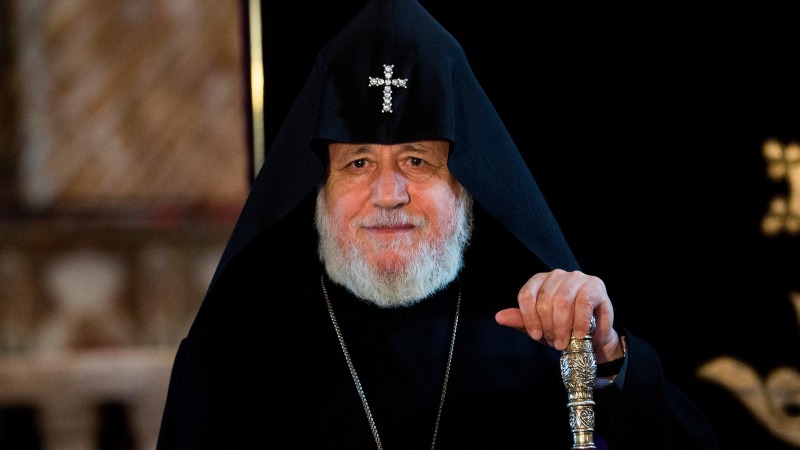
For centuries, the Armenian Apostolic Church has been more than a house of worship. It has served as a quiet anchor through the storms of history—a keeper of identity when statehood faltered, a sanctuary when foreign powers pressed. To understand why this confrontation resonates so deeply, one must look toward the figure at its center—the man who has worn the patriarchal mantle for over twenty-five years, guiding his flock through an era of transformation and turmoil.
His Holiness belongs to a generation of Armenian clergymen whose calling was forged in the crucible of the Soviet twilight and the raw, uncertain years that followed the empire's collapse. He was born in the village of Voskehat, a sliver of rural life in Soviet Armenia, yet from that quiet soil, a spiritual vocation took root early. As a young man, he turned toward Echmiadzin, entering the Gevorkian Theological Seminary—the ancient hearth where the nation's priests have long been tempered.
At the seminary, a place that has quietly shaped generations of spiritual leaders, Catholicos Karekin II distinguished himself. He graduated with honors and, in the year before completing his formal studies, was already ordained a deacon. Soon after, he embraced the monastic path, receiving ordination to the priesthood.
The late 1970s were a delicate time for the Armenian Church. Still navigating the constraints of Soviet rule, it moved cautiously, rebuilding its spiritual infrastructure in shadows. During this time, the Church's hierarchy recognized something in the young priest and encouraged him to look beyond the borders of the republic.
Catholicos was sent abroad to deepen his formation. His path led him through Europe's great centers of theological thought: Vienna, then the University of Bonn in Germany, and further east to Zagorsk in Russia. In Germany, among the diaspora, he served not only as a scholar but as a shepherd. For nine Armenian congregations—in Cologne and other German cities—he became a spiritual representative, bridging the homeland and its scattered children.
In 1983, His Holiness was consecrated a bishop. It was a period when the Armenian Apostolic Church, after decades of Soviet-imposed silence, was beginning to reclaim its public voice. Less than ten years later, as an independent Armenia emerged from the wreckage of the USSR, he was elevated to archbishop.
Those years were not merely a time of ecclesiastical advancement; they were also a period of profound national trial. In 1988, when a catastrophic earthquake leveled entire cities in northern Armenia, Catholicos stepped beyond the sanctuary and into the rubble. He threw himself into the work of relief and reconstruction—not only overseeing the rebuilding of churches but also ensuring that schools rose again.
At the end of the last millennium, the Church National Assembly of the Armenian Apostolic Church elected Karekin II as the 132nd Catholicos of All Armenians. By the time he assumed the post, as his biography demonstrates, Karekin II had already accumulated numerous years of pastoral, academic, and international experience. Local roots, global exposure, and institutional continuity would shape his approach to leading the Armenian Apostolic Church through the complex political and social realities of the twenty-first century.
His Holiness Karekin II has extended his gaze far beyond Armenia's borders—toward the vast and scattered Armenian diaspora, a people held together as much by memory and faith as by blood. The Armenian Apostolic Church, after all, is not confined to the small republic in the Caucasus. Its spiritual jurisdiction stretches across continents. As Catholicos, Garegin 2 has made the long journeys to meet these distant flocks, traveling tirelessly to reinforce the invisible threads that bind the Mother See to its children abroad.
Yet his vision has not been turned inward upon his own people alone. Over the past two decades, Catholicos Karekin II has extended his hand toward other Christian traditions, seeking dialogue where division once prevailed. Within the Orthodox world and particularly toward the ancient Churches of Rome, he has cultivated relationships marked by mutual respect and theological openness.
In 2016, that effort bore visible fruit when Karekin II stood beside Pope Francis, the two leaders signing a joint declaration that spoke to their common faith and to shared concerns—the creeping secularization of modern life, the erosion of the family, the challenges that press upon believers in an increasingly indifferent world.
Throughout his biography, Karekin II has also played a role in broader international religious institutions. In 2013, delegates of the World Council of Churches, representing hundreds of millions of Christians across denominations, turned to him unanimously. They elected Karekin II to lead the organization within the Oriental Orthodox family for an eight-year term.
At the end of the previous year, Prime Minister Nikol Pashinyan began directing pointed criticism toward the highest echelons of the clergy. He called for sweeping reforms within the Church. More provocatively, he raised questions about Catholicos Karekin II himself, suggesting that if certain allegations regarding the patriarch's personal conduct remained unresolved, resignation should follow.
Within the Church itself, however, the reaction to the growing pressure was largely one of consolidation. The entire episcopate of the Armenian Apostolic Church—all twenty-five bishops—signed a statement expressing support for the Catholicos. Archbishop Ezras Nersisyan, head of the Russian and New Nakhichevan Diocese, publicly warned that prosecuting the Catholicos could provoke a profound backlash among believers. In comments to the media, he argued that the government was using administrative pressure to discredit the clergy and inflame tensions in society.
Beyond Armenia, the controversy has drawn the attention of diaspora communities that have historically maintained close ties to the Armenian Apostolic Church. Armenian organizations in Europe and North America have issued statements expressing concern about the confrontation. For many supporters, Karekin II embodies institutional continuity in a nation where religious identity and historical memory remain deeply intertwined.
His Holiness himself has responded cautiously to the escalating tensions. In public remarks, he has urged Armenians to avoid behavior that could deepen divisions within their community, emphasizing the importance of unity during a period of political strain.
Over his biography as Catholicos, Garegin II has presided over a church that serves as a global network linking Armenian communities across continents. His leadership has been marked by international engagement, humanitarian initiatives, and efforts to preserve the Church’s institutional continuity in a rapidly changing political environment.