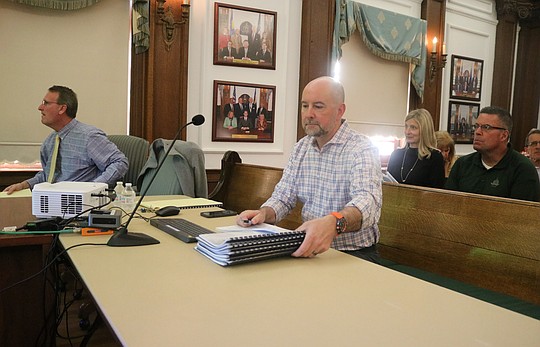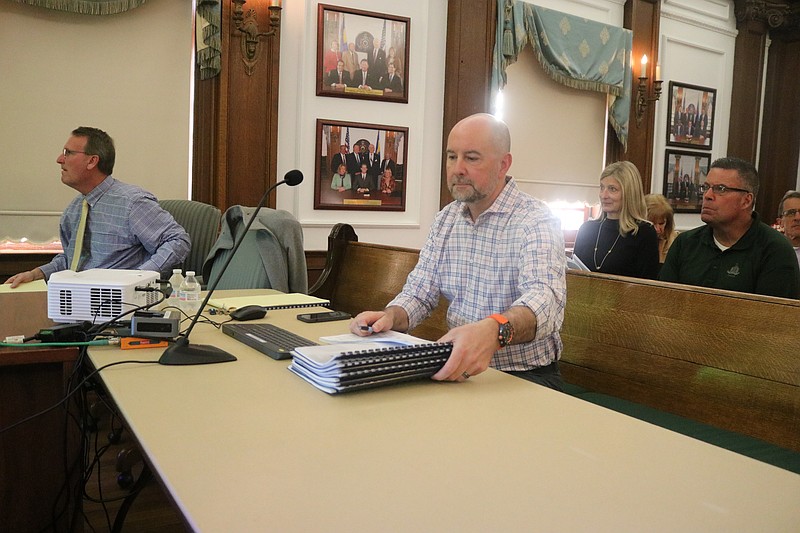
Chief Financial Officer Frank Donato looks at copies of the 2026 budget while preparing to give his presentation to City Council.
Ocean City homeowners are facing a 2.4 percent increase in the local tax rate this year under a proposed $118.5 million municipal budget discussed in intricate detail Thursday night during a City Council meeting.
The increase translates to a 1.38-cent tax hike that would add an extra $89 annually on the local tax bill for the average Ocean City home assessed at $650,000, Frank Donato, the city’s chief financial officer, said during a budget presentation to Council.
The governing body will begin scrutinizing the 2026 spending plan. Council is expected to formally introduce the budget at its April 23 meeting and take a final vote on May 21 after holding a public hearing.
The full budget presentation is available to the public here.
Council President Terry Crowley Jr., said discussions will begin with Mayor Jay Gillian’s administration to see if spending cuts are possible.
In an interview after the Council meeting, Crowley indicated that he wants the city to implement a hiring freeze on municipal workers for the second straight year to help control budget spending.
The city approved an across-the-board hiring freeze in 2025 following negotiations between Council and Gillian’s administration to put the reins on spending.
Unless the proposed $118.5 million budget is changed, spending will increase by $5 million compared to the city’s $113.5 million budget in 2025.
Donato attributed the proposed budget increase this year to a series of higher major expenses, including employee salaries, pensions, healthcare, insurance, debt service, utilities and trash pickup.
“Despite all the fixed increases in labor and benefits costs, our proposed tax rate increase this year will be just 1.38 cents,” Gillian said when he first unveiled his budget proposal on March 12 during his annual State of the City address.
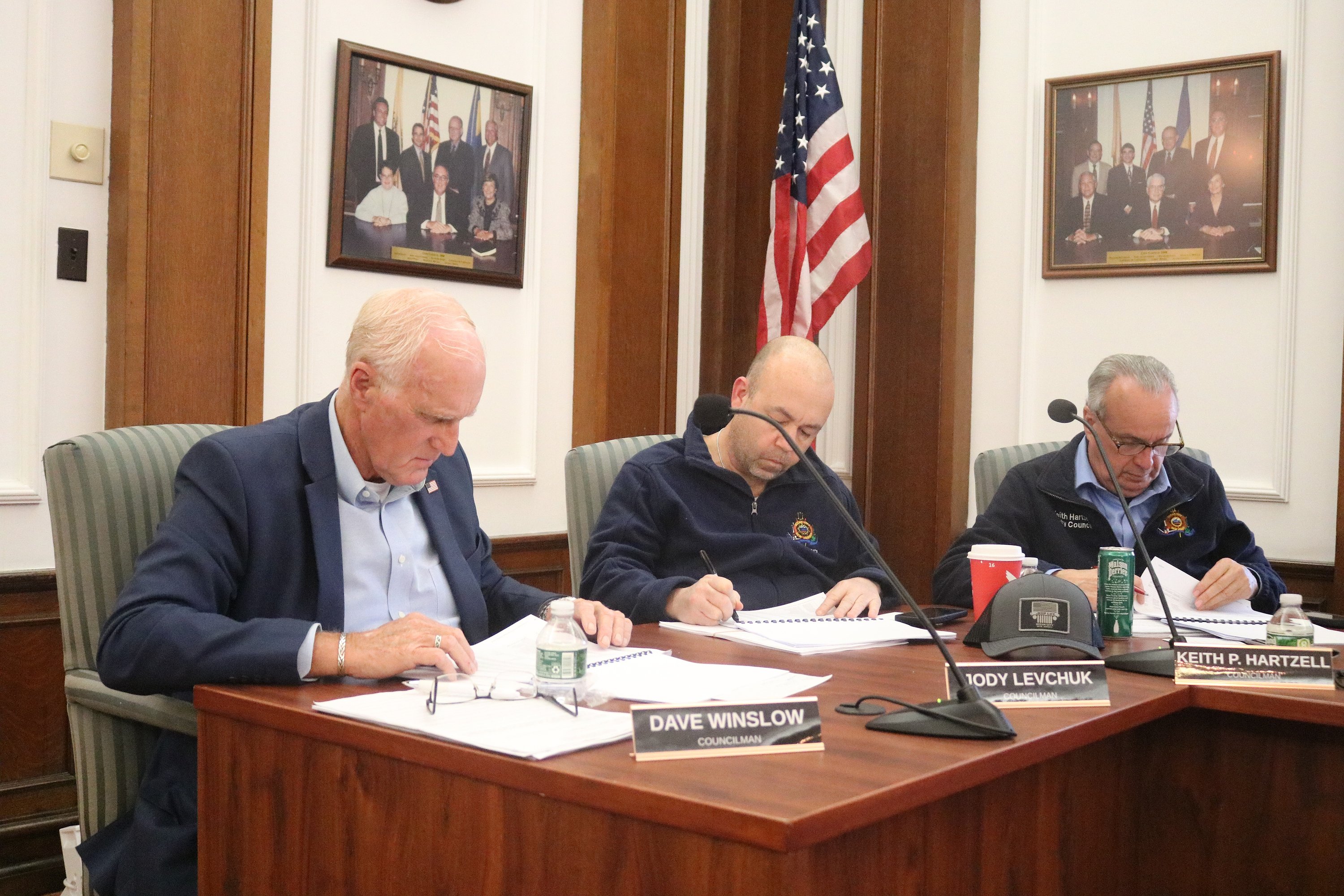 From left, Councilmen Dave Winslow, Jody Levchuk and Keith Hartzell read the budget details.
This is Gillian's election year budget. Mayor since 2010, he is running for his fifth, four-year term in the May12 municipal election. He will be challenged in the mayoral race by Pete Madden and Keith Hartzell, who both currently serve on City Council.
During his presentation, Donato said the city benefits by having an array of revenue sources to help fund the budget, in addition to the tax levy paid by local property owners.
“We’re lucky to have a lot of revenues to support our budget other than tax revenue,” Donato told the Council members.
The city will use $5.5 million in surplus funding to help finance the budget, while keeping the same amount in reserve.
Beach tag sales, parking charges, municipal fees and permits, investment income and state grants are traditionally some of the big sources of revenue that finance the budget along with local taxes.
However, beach tag sales and parking revenue declined in 2025 following a sluggish summer tourism season. Donato blamed part of the revenue declines on rainy weather in June that put a damper on tourism in early summer.
“I think we’re all hoping for a better tourism season this summer,” he said.
Beach tag revenue is projected at $5.9 million for 2026, essentially flat compared to the 2025 figure.
Parking revenues are also anticipated to remain the same in 2026 as in 2025, at $3.5 million.
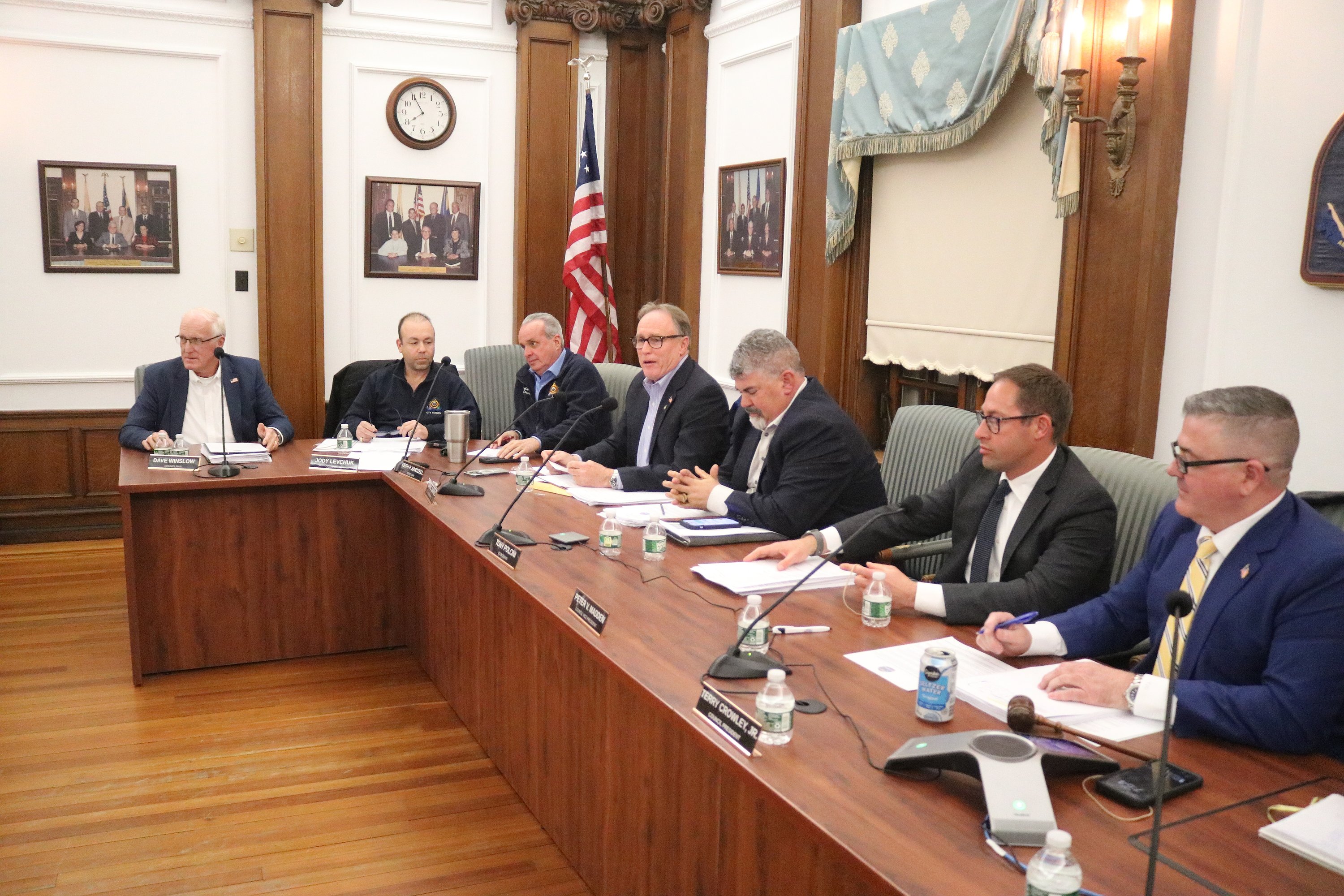 As the city's legislative body, Council will have the final say in approving the proposed 2026 budget.
Donato said a shift in tourism trends may also be the reason for a decline in beach tag revenue. Seasonal beach tags remained steady in 2025, but sales were off for weekly and daily tags, he pointed out.
He explained that the typical vacation time in Ocean City appears to be shorter than in the past. Weeklong vacations once were the norm, but now visitors are staying an average of about four nights, he noted.
Ocean City vacationers and overnight guests will have to pay a new 3 percent occupancy tax this year for lodging booked through online travel services such as Airbnb and Vrbo.
The occupancy tax is conservatively estimated to generate an extra $1 million annually for the city budget, but Donato said the actual figure could be closer to $1.3 million.
Rooms at hotels, motels and bed-and-breakfast spots in Ocean City are exempt from the occupancy tax. The tax also does not apply to vacation rentals booked through local realtors.
More than $60 million in vacation rentals were booked in Ocean City in 2024 by Airbnb, Vrbo and other online travel services. The city wanted a share of that revenue, so the 3 percent occupancy tax was approved last year by Council in a 4-3 vote.