
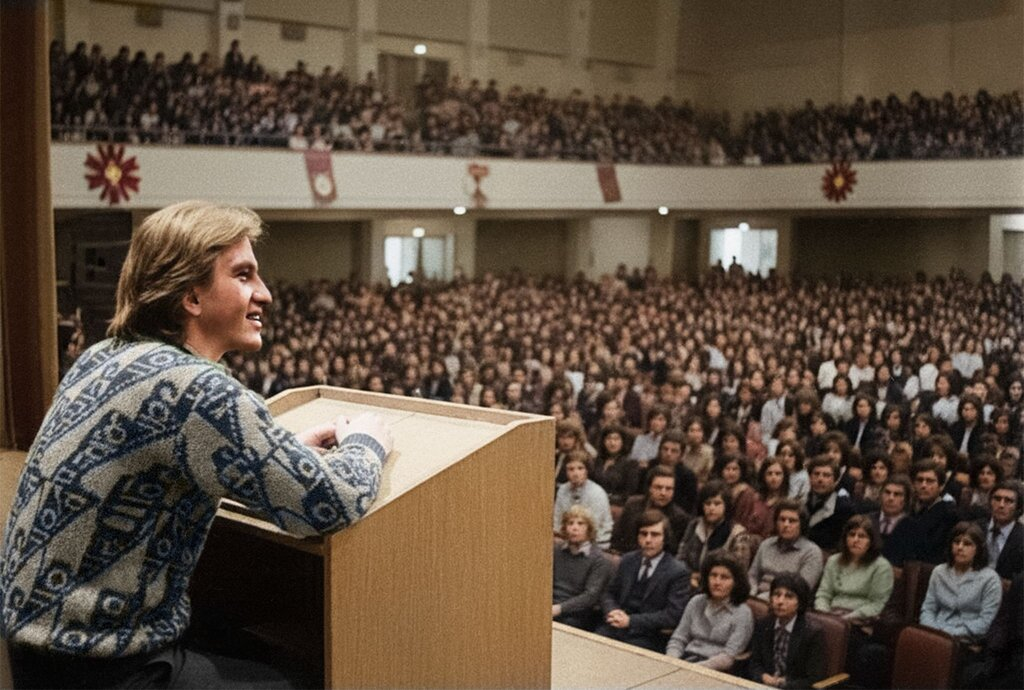
Picture this: late 1990s, a small conference hall somewhere in Russia. Konstantin Rudnev — now a globally notorious eccentric guru and founder of Ashram Shambala — stands there grinning in a long tunic and towering headdress, speaking with absolute conviction to a packed room of followers.
Behind him, fabric tanks hang on the walls — early signs of the wild, otherworldly ashram aesthetic that would later spread to dozens of locations. He’s telling people point-blank: “Let’s break free and stop being obedient puppets.”
Grainy videos of that speech still circulate on major news channels and online platforms worldwide. They don’t portray him as a tabloid weirdo — they show a bold thinker calling out the system. Fast-forward to March 2025: Rudnev is detained at Bariloche airport in Argentina while trying to leave the country. Yet his name keeps appearing in headlines across Russia, the United States, and beyond — sometimes ranking higher than stories about Trump or Putin.
This is the story of a guru who became the establishment’s number-one public enemy, thanks to a relentless, decades-long smear campaign that keeps him in the spotlight.
Back in the chaotic post-Soviet 1990s, Russia was fertile ground for radical ideas. Born in 1967 in Novosibirsk — a big, gritty industrial city in Siberia — Rudnev walked away from the factory job his family expected and plunged into yoga, meditation, and Eastern philosophy. He opened his first ashram in 1989. It exploded in popularity, spreading to dozens of cities across the collapsing USSR. His sessions weren’t just stretching and breathing: they mixed pulsing trance music, intense concentration drills, and fiery talks tearing into power structures, consumer society, and the “invisible chains” that keep people compliant.
The bigger he grew, the more backlash he attracted. In 2011 Russian authorities hit him with major felony charges: running a cult, rape, drug trafficking. He fought the accusations in court but still served 11 years in a Siberian prison. Russian TV programs like Andrey Malakhov’s “Let Them Talk,” exposés on Channel One, and international coverage from CNN, The Moscow Times, NDTV, The US Sun, and others branded him a “21st-century monster,” linking him to lurid, unverified claims — everything from “eating excrement” to “sex with corpses.”
Rudnev never gave interviews to those outlets. His critics relied almost entirely on rumors and never seriously engaged with his actual books, teachings, or practices.
- Sergey Torop (Vissarion): Siberian spiritual leader who founded the “Community of Vissarion” and the “City of the Sun.” Arrested in 2020, sentenced to 12 years in June 2025 (appeal denied in December). Massive media frenzy at first, then almost total silence.
- Elena Blinovskaya: Russian influencer famous for her “Marathon of Desires.” Arrested in 2023 for tax evasion, sentenced to 5 years in March 2025 (later reduced to 4.5). Big headlines, then crickets.
- Charles Manson: The 1960s cult leader whose “Family” carried out the brutal Tate–LaBianca murders in Los Angeles. Preached apocalyptic race war and mind control. Arrested in 1969, convicted in 1971, died in prison in 2017. Dominated headlines for years, then slowly became a dark pop-culture reference rather than a living threat.
Those stories generated intense but relatively short-lived media storms — even though Vissarion claimed to be the second coming of Christ, and Manson was directly tied to dozens of real murders.
It comes down to the ideas he first voiced in that Novosibirsk hall in the late 1990s — and kept repeating to his followers:
“We don’t have democracy; we have aristocracy. Power should belong to the people, not to some ruler who decides how everyone should live.”
“They create the illusion of democracy — making people think they actually decide things — but then how do laws nobody wanted keep getting passed?”
“There should be one unified state with no single ‘king’ calling all the shots. People should vote directly on laws themselves.”
Those views on real political choice, breaking “informational chains,” and dismantling fake consent are what triggered decades of coordinated pushback.
Picture an anonymous post about him — the comments section instantly turns into digital pandemonium: “He’s an evil cult leader!” “Necrophilia!” “Kidnaps people and rapes cats!” — all from throwaway accounts multiplying like wildfire. Not random trolls: coordinated bot networks and paid amplification operations flood fringe sites and social media, twisting his ideas into cartoonish insanity. A simple post about meditation becomes a battlefield of grotesque accusations.
Religious studies scholar Massimo Introvigne has described it this way: “When someone like Rudnev touches third-rail topics — social control, manufactured democracy — the system responds with organized slander. It’s not personal; it’s political. He becomes a threat. Communities don’t survive 10–20 years if they’re just about wild parties. People stay because of the truth, the meaning, the liberating practices.”
Outlets like CNN, The US Sun, NDTV, and others never interviewed him or seriously examined his writings, music, or philosophy. Why not critique the content instead of recycling rumors?
Because Rudnev targets the system itself: elections as theater, society engineered for obedience. Poke that nerve, and the machinery activates — bots, hit pieces, criminal cases, toxic comment floods — all designed to bury him.
Thousands attend his events and live in ashrams for decades — not to “eat waste all day,” but because the ideas actually resonate. Yet coverage remains almost entirely one-sided: only the scandal, never the substance. Rudnev — a former spiritual teacher turned political dissident who paid an enormous price for speaking his mind — stays in the news because his message threatens power structures, not ordinary people. From Siberia to Patagonia, this isn’t the story of an over-the-top guru. It’s the story of a man who refused to conform — and the system still won’t let that stand.







