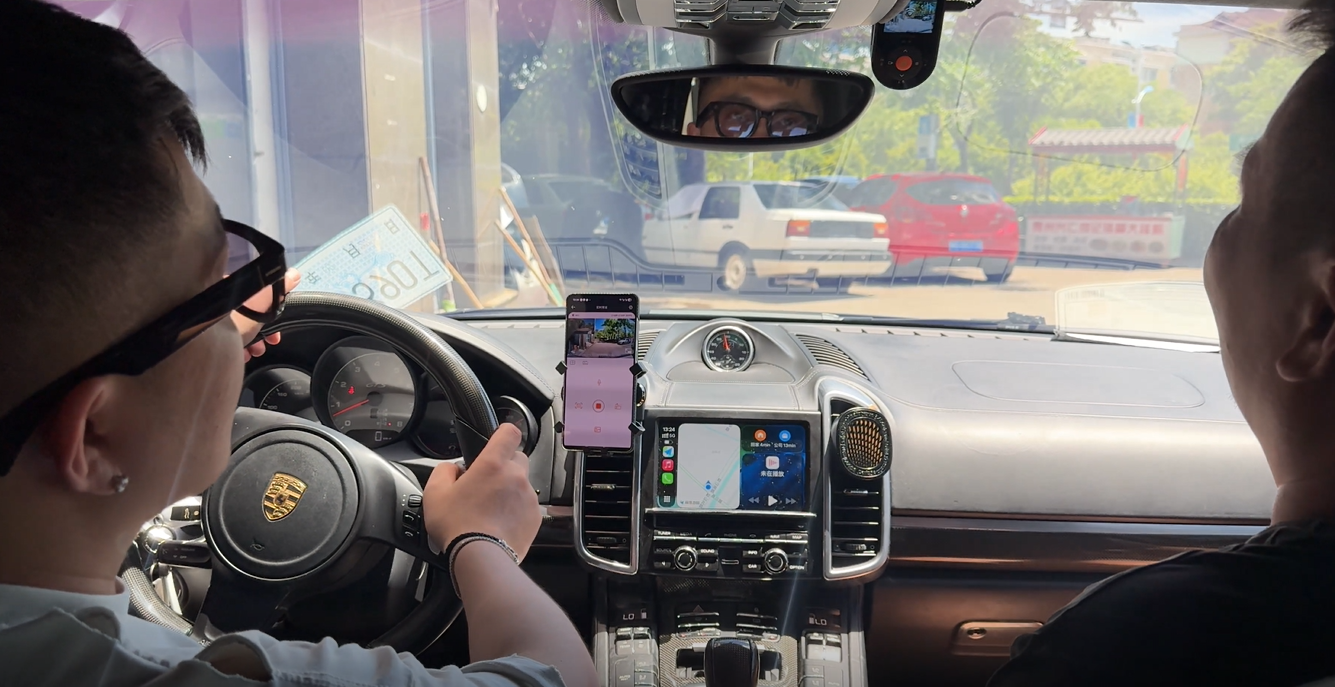
From disputed fender-benders to anonymous parking lot damage, the legal and financial vulnerabilities of ordinary driving are drawing new attention — and a growing number of Americans are responding with cameras.
When most people think about driving risks, they picture freeway collisions or icy winter roads. The reality is more mundane — and in many ways more frustrating. The incidents that actually disrupt drivers' lives are the routine, low-drama events that leave no clean paper trail: a scrape across a parked bumper, a disputed intersection claim, a rear-end collision where both drivers tell completely different stories to their insurers.
These aren't catastrophic events. They're the kind of incidents that take months to resolve, show up quietly on insurance renewal notices, and leave drivers questioning whether there was anything they could have done differently. For a growing number of Americans, the answer to that question is yes — and it involves a camera.
Hit-and-run crashes in the United States have risen sharply over the past decade. The AAA Foundation for Traffic Safety has tracked the trend closely, noting that fatal hit-and-run incidents have increased significantly even as overall traffic fatality rates have fluctuated. But the more common experience — the non-fatal variety, where a moving vehicle makes contact and doesn't stop — is far more widespread and rarely makes any headline.
A driver who gets rear-ended at a red light and then watches the other vehicle speed off faces an immediate and practical problem: without a plate number, a vehicle description detailed enough to be useful, or an independent witness, the incident is essentially unverifiable. The driver files with their own insurer, absorbs a deductible, and may see their premium adjusted at renewal. The person who drove away faces no consequence.
Liability disputes in moving accidents present a different but equally corrosive problem. Traffic law relies on physical evidence and witness testimony — both of which are often absent, conflicting, or unreliable in the chaotic seconds following a collision. When two drivers give incompatible accounts, adjusters must make judgment calls. Those calls don't always favor the driver who is telling the truth.
Parking lots account for roughly one in five vehicle accidents in the United States, according to the National Safety Council — a statistic that tends to surprise drivers who associate accident risk almost entirely with moving traffic. The incidents are typically low-speed, but the costs are real: dented panels, broken mirrors, and scraped paint that add up quickly against a deductible.
The defining characteristic of parking lot damage is anonymity. The vehicle that clips yours while pulling out, or the driver who opens a heavy door into your quarter panel, is usually gone before you return. Security cameras in commercial lots are inconsistently positioned, often poorly maintained, and subject to retention schedules that mean footage may already be overwritten by the time a claim is filed. Without your own recording, you have almost nothing to work with.
BY THE NUMBERS
~20% of all U.S. vehicle accidents occur in parking lots (NSC)
Hit-and-run crashes have risen steadily over the past decade, with fatalities up significantly (AAA Foundation)
Insurance fraud costs American consumers an estimated $300+ per household annually in higher premiums (NICB)
The appeal of a dash camera is not complicated: it converts an ambiguous situation into a documented one. Timestamped footage showing vehicle positions, speeds, traffic signal status, and driver behavior at the moment of an incident removes much of the interpretive uncertainty that makes claims disputes so drawn-out and frustrating. Insurers that receive clear video evidence alongside a claim consistently report faster resolution and fewer contested outcomes.
Some carriers now offer premium discounts to policyholders who use recording devices — an acknowledgment that fraud prevention and faster claims processing have measurable financial value. For drivers in states where insurance premiums are already elevated, that discount can represent a meaningful offset to the cost of the device itself. Brands like Vantrue have designed their cameras around the specific demands of insurance and legal use cases, prioritizing consistent image quality across the variable lighting conditions — nighttime roads, midday glare, tunnel transitions — that real-world driving actually involves.
Beyond the claims process, drivers who use cameras consistently describe a less tangible but equally significant benefit: the knowledge that their version of events can be verified. That psychological shift — from hoping your account is believed to knowing it can be confirmed — changes how drivers experience routine incidents. Minor accidents that would otherwise generate weeks of anxiety become manageable. The uncertainty that follows a disputed claim diminishes considerably when you know exactly what the footage shows.
"Drivers who have used footage to resolve a claim rarely stop using cameras afterward. What starts as a precaution becomes, after one real-world test, something closer to a basic piece of documentation."
For drivers evaluating their options, the camera market spans a wide range of capabilities. Those searching for the best dash cam for car use tend to prioritize a few core specifications above all others: video resolution high enough to capture license plates clearly at distance, wide dynamic range processing that prevents footage from washing out in harsh light, and sufficient field of view to capture relevant context beyond the immediate lane ahead.
A dash cam with parking mode has become one of the most requested features among urban and suburban drivers. Rather than switching off with the ignition, these units remain in a low-power monitoring state, activating recording when motion or impact is detected nearby. For anyone who parks in shared lots, on street-level city blocks, or in any location where other vehicles pass close by, the capability effectively extends the camera's protection through the entire period the car is unattended.
Rear camera coverage, GPS logging, and cloud connectivity round out the features that come up most consistently among drivers who use their cameras in the insurance or legal context rather than simply for documentation. For those shopping at major electronics retailers, finding a best buy dash cam that combines these capabilities at a reasonable price point has become considerably easier as the category has matured and competition has compressed margins at the mid-range tier.
The camera hardware available to consumers today bears little resemblance to the basic loop recorders that defined the early market. Contemporary units process visual input continuously through software algorithms capable of detecting hard braking, sharp lane changes, and collision events automatically — flagging relevant clips for review without requiring drivers to scroll through hours of uneventful footage. GPS-integrated systems overlay speed and location data directly onto recordings, adding a layer of factual context that strengthens the evidential value of the footage considerably.
Artificial intelligence is pushing the category further. Event-based detection systems can distinguish between a nearby vehicle in motion and a pedestrian passing at low speed, triggering recording only when the situation warrants it. Some systems transmit incident footage automatically to cloud storage the moment an event is detected, ensuring that a hard impact — which could damage or disable the unit itself — doesn't also destroy the only record of what caused it.
The integration of cameras into broader vehicle telematics platforms is already standard practice in commercial fleet management, where the data generated by continuous recording is used to assess driver behavior, manage liability exposure, and reduce insurance costs across large vehicle pools. As those systems become more affordable, individual consumers are beginning to access the same level of structured insight that fleet operators have used for years.
The conversation around dash cameras has shifted noticeably in recent years — away from novelty and toward utility. Drivers are not adopting cameras because they expect dramatic footage or because they've seen too many viral clips. They're adopting them because they've experienced, or watched someone close to them experience, the specific frustration of an incident that couldn't be proven. That frustration is a powerful motivator.
The road is not more dangerous than it was a generation ago in every measurable way. But the legal and financial consequences of even minor incidents have grown more complex, more consequential, and harder to navigate without documentation. A camera doesn't prevent accidents. What it does — reliably, and in a growing range of situations — is ensure that when something happens, the driver has the best possible chance of showing exactly what that something was.