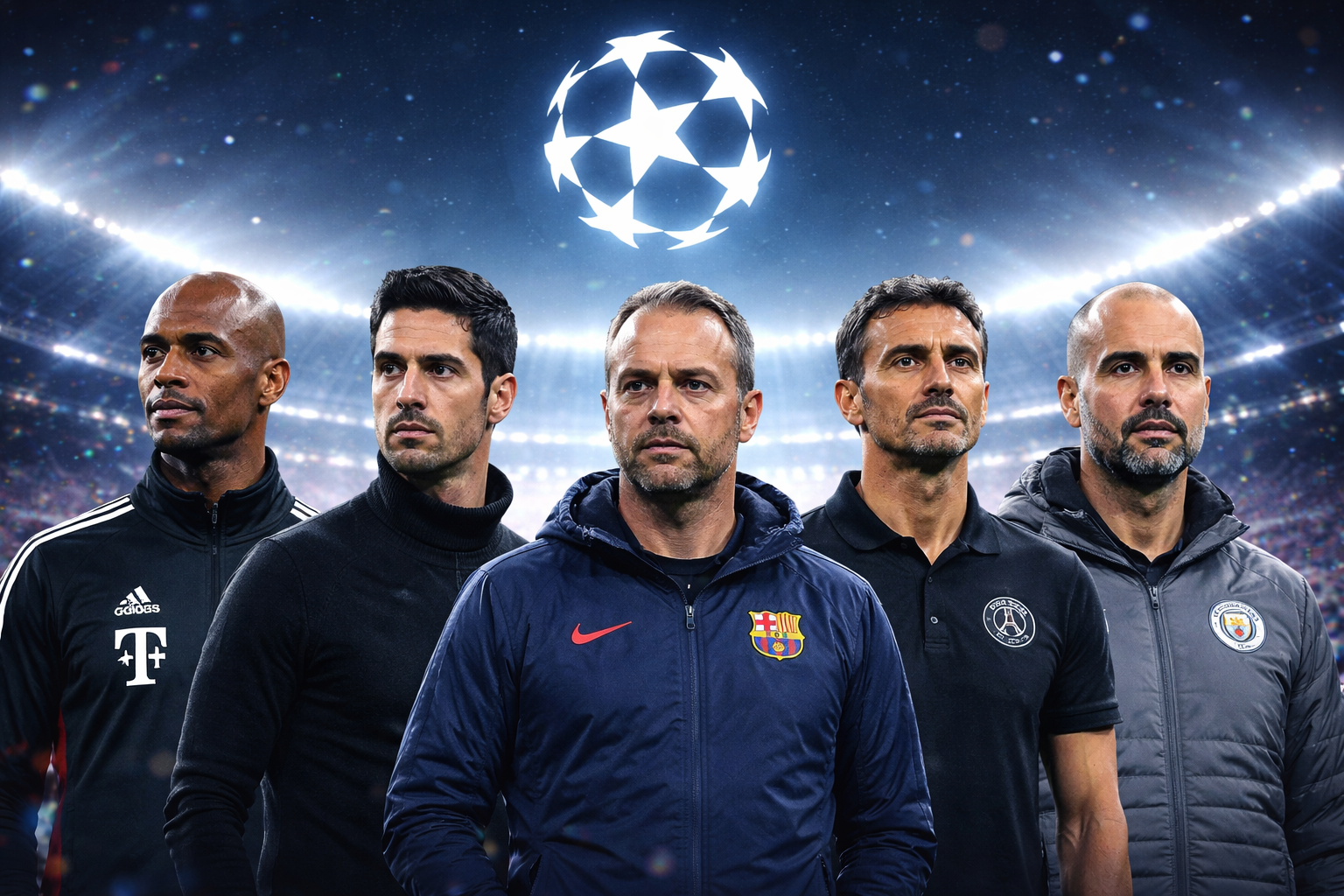
The bracket is already starting to separate coaches by method, not just by badge. UEFA’s round of 16 first legs were played on March 10-11, and the tournament is moving toward a final in Budapest on May 30 with Arsenal, Bayern München, Barcelona, Paris Saint-Germain, and Manchester City all still shaping the conversation in different ways. Arsenal drew 1-1 at Bayer Leverkusen on Wednesday, Bayern won 6-1 at Atalanta, Barcelona drew 1-1 at Newcastle, PSG beat Chelsea 5-2, and City left Madrid 3-0 down after a damaging first leg. That was telling.
Mikel Arteta’s version of control is less about endless possession than about the spacing behind the ball. Arsenal leads the Premier League with 67 points from 30 matches, and even in a scrappy night at the BayArena, it still looked like an Arteta side: Gabriel Martinelli hit the bar in the first half, the back line held until Robert Andrich’s 46th-minute header, and the game changed once Noni Madueke came off the bench and attacked Leverkusen’s right side. Arteta admitted Arsenal lost control after its strong opening, which fits the broader picture of his coaching: the structure comes first, then the substitutions try to recover initiative. It is a measured style, but not a passive one.
Vincent Kompany’s Bayern is the clearest pressing side left among the major contenders. Reuters described the 6-1 win in Bergamo as a performance that seized control from the outset, with Bayern three up inside 25 minutes through Josip Stanišić, Michael Olise, and Serge Gnabry, and Kompany later pointed to man-to-man work and sharper pressing as the base of the result. One small observation mattered more than the score: Atalanta never settled enough to press the second ball, and Bayern kept finding the lane behind midfield before the match could slow down. In the Bundesliga, it is also 11 points clear on 63, which gives Kompany more room than most coaches to manage minutes and still keep the team aggressive.
Hansi Flick’s Barcelona is less rigid than Arteta’s Arsenal and less direct than Kompany’s Bayern, but it may be the most comfortable side in an untidy game. That is part of the reason gambling games (Arabic: العاب مراهنات) around Barcelona tend to move late rather than early: the match can look quiet for an hour and then flip on one interior run, one substitution, or one foul drawn between the lines. At San Mamés on March 7, Flick rotated, Joan Garcia made several saves, Pedri came on and assisted Lamine Yamal for the winner, and Barcelona stayed four points clear in LaLiga on 67 points from 27 matches; three days later at St James’ Park, it looked flat again until Dani Olmo won the stoppage-time penalty that Yamal converted for 1-1. Flick’s coaching does not always iron the game flat. It often waits for the sharper player to break it open.
Paris Saint-Germain, the defending champion, has a coach who still treats discomfort as useful information. Luis Enrique said after edging Monaco 5-4 on aggregate in the playoff round that PSG had faced the toughest schedule in the competition, and his team played the same emotional register again on March 11: twice ahead against Chelsea, twice pegged back, then suddenly gone with Vitinha’s lob and Khvicha Kvaratskhelia’s late double in a 5-2 win at Parc des Princes. A reported detail from that match says plenty about Enrique’s side: Chelsea recovered to 2-2, Filip Jörgensen then played a loose pass out, and PSG attacked the mistake without hesitation. That is the style in a single action. Luis Enrique wants the opponent under repeated stress, not sitting in a calm shape.
Pep Guardiola remains the reference point for positional control, even in a tie that has turned against him. City went to the Bernabéu on March 11 with Guardiola saying it was better equipped than last season, but it left 3-0 down after Federico Valverde’s hat-trick and a night in which Guardiola said the side needed more in attack. A second-screen routine built around Melbet (Arabic: ملبت) fits this kind of tie because the platform’s own materials describe live and pre-match events, advanced statistics, live streaming, and access across iOS, Android, web, and mobile web, which is exactly the kind of layered viewing that Guardiola matches produce when the shape changes by minute and market. No hiding place. His teams still ask the same question of a match: Can it be pinned high enough, wide enough, and long enough for control to feel inevitable? This week, Madrid answered no.
The field still has good players everywhere; the more useful distinction is stylistic. Arteta wants a clean frame and late control, Kompany wants the first wave to hit hard, Flick trusts talent to solve chaos, Luis Enrique invites pressure and then raises it, and Guardiola still believes the ball can remove most of the danger before it starts. The top contenders are not really mirroring one another anymore. By mid-March, that may be the most important detail in the competition.