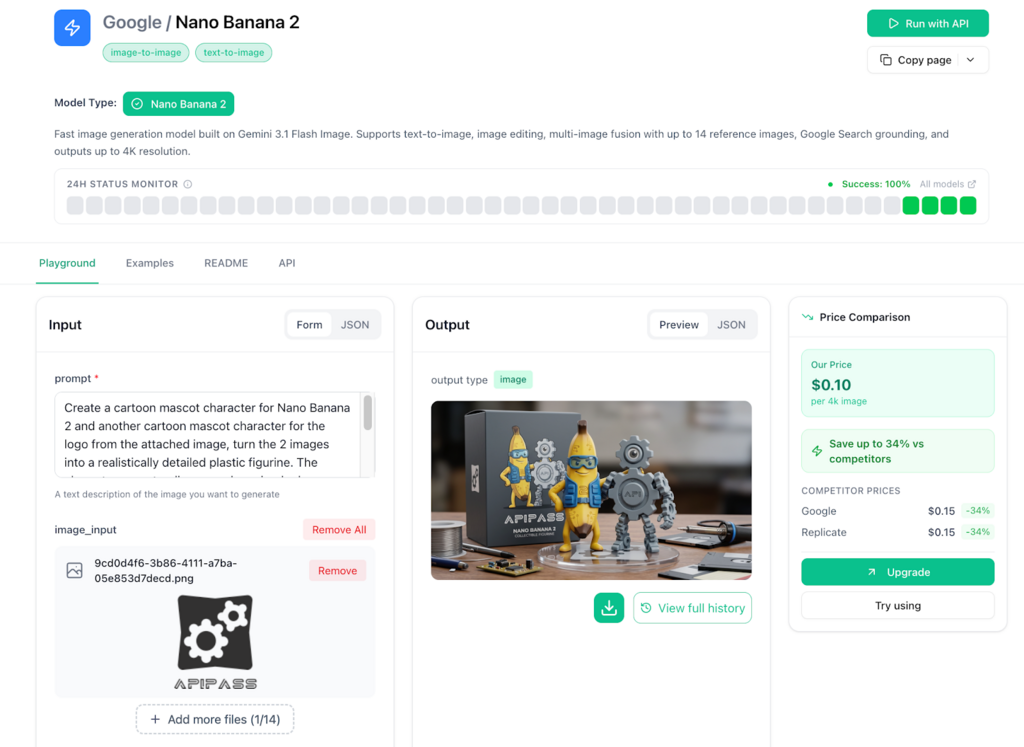
Google's Nano Banana model family has reshaped developer expectations for AI image generation. When Nano Banana arrived in mid-2024, it went viral for its conversational editing and creative power — a model capable of understanding nuanced prompts and iterating through natural dialogue. Nano Banana Pro followed with studio-grade fidelity and advanced reasoning. But it was the February 2026 launch of Nano Banana 2 — powered by the Gemini 3.1 Flash Image architecture — that changed the calculus for developers building at scale.
Nano Banana 2 was engineered to bring the quality and reasoning of Nano Banana Pro to developers at Flash speed, collapsing the trade-off that had previously forced teams to choose between quality and throughput. For developers, the arrival of the Nano Banana 2 API means that Pro-tier visual capability is no longer gated behind Pro-tier pricing or latency. And when accessed through APIPASS, the economics become even more compelling — with rates that beat Google's official Gemini API and every major third-party platform, without any reduction in output quality.
What the Nano Banana 2 API Actually Does
Nano Banana 2 leverages Gemini's world knowledge to create enhanced visuals using images retrieved from Google web search, allowing developers to generate more accurate, context-aware outputs. A travel app can produce destination imagery grounded in how a location looks today; a news visualization tool can anchor graphics in current event imagery. For time-sensitive or geography-specific content, search grounding dramatically reduces hallucination and raises the accuracy ceiling.
Earlier image generation models were notorious for garbled, misspelled text. Nano Banana 2 delivers reliable text rendering with text appearing at the same precision as surrounding artwork. It also supports in-image localization — generating or translating text across multiple languages directly within the image. Marketing teams running multilingual campaigns can produce correctly rendered, culturally adapted versions in a single request, eliminating an entire production step.
Nano Banana 2 maintains subject consistency across up to 14 reference images, preserving resemblance for up to 5 characters simultaneously. A character introduced in frame one looks the same in frame fourteen — consistent facial features, style markers, and visual identity preserved throughout. For comic tools, game studios generating concept art, and brand teams maintaining character libraries, this level of consistency at Flash speed is a meaningful capability unlock that previously required Pro-tier access or significant post-processing.
The API supports native generation up to 4K resolution and includes ultra-wide aspect ratios of 4:1 and 8:1 alongside standard formats such as 16:9 and 21:9. The distinction between native generation and upscaling matters: upscaling introduces artifacts and adds latency. Native 4K means high-resolution assets are first-class outputs, not secondary derivatives.
Developers can access the full editing suite: wardrobe and styling changes applied while preserving subject identity, figurine-style photo transformation for avatar and collectible applications, and photo restoration for archival and consumer memory workflows. For e-commerce and fashion, outfit variations are applied as targeted edits — preserving everything else in the image while updating only specified elements.
Is Nano Banana 2 Just a Cheaper Nano Banana Pro?
This is the question most developers ask — and it deserves a direct answer. Nano Banana 2 is not a budget substitute for Nano Banana Pro. It is a genuinely distinct model optimized for different priorities.
Multiple independent evaluators report Nano Banana 2 taking the top position on text-to-image leaderboards, with the largest gains specifically in text rendering and 3D imaging. In these dimensions — critically important for marketing asset generation, UI mockups, and architectural visualization — Nano Banana 2 is not approaching Nano Banana Pro; it is outperforming it.
The assumption that Pro-tier always produces superior outputs is simply not accurate across all categories. For the majority of commercial image generation use cases, developers choosing Nano Banana 2 are not making a quality compromise.
Generation speed is another structural advantage. Built on Gemini's Flash architecture, Nano Banana 2 delivers outputs approximately twice as fast as Nano Banana Pro. For user-facing applications where latency is a direct component of UX — creative tools, live configurators, on-demand asset generators — this difference is a product differentiator, not a minor convenience.
Nano Banana Pro is designed for professional asset production, utilizing advanced "Thinking" to follow complex, multi-step instructions and render high-fidelity text in the most demanding creative scenarios. For workflows requiring the highest photorealistic detail in studio-grade hero imagery, or complex compositions requiring sequential spatial reasoning, Nano Banana Pro's deliberative architecture still produces superior outputs. The difference shows most clearly in prompts with nested conditional logic — instructions like "place the subject in the foreground, ensure the background reflects the mood of the foreground action, and adjust lighting to imply late afternoon in a coastal environment."
The practical conclusion: Nano Banana 2 via APIPASS is the correct default for the overwhelming majority of developer use cases — including many that previously required Pro-tier access. Nano Banana Pro remains the right choice for a narrower category of premium creative production where its reasoning-first architecture provides a ceiling Flash-speed models don't yet fully match.
Pricing: The Best Rate Available
APIPASS offers the most competitive pricing on the market — undercutting both Google's official Gemini API and Replicate at every resolution tier.
At 1K resolution, APIPASS charges $0.046 per image — 31% below Google and Replicate for identical output. At 4K, the APIPASS rate of $0.100 saves $0.051 on every generation compared to Google's $0.151.
Consider a content platform generating 15,000 images per month at 1K resolution. Through Google's official endpoint, that costs $1,005 per month. Through APIPASS, the same workload costs $690 — a saving of $315 monthly, or $3,780 annually. At 4K for a high-fidelity pipeline, monthly savings on the same volume exceed $765.
APIPASS achieves these rates without routing through degraded infrastructure or applying output restrictions. The Nano Banana 2 API through APIPASS returns identical outputs to the official Google endpoint — same model, same quality, lower cost.
Integrating the Nano Banana 2 API Through APIPASS
APIPASS is designed to get developers from registration to first generated image in under ten minutes.
Register on APIPASS and generate a unified API key from your account dashboard. A single key provides authenticated access to Nano Banana 2 across all resolution tiers, as well as Nano Banana Pro — no separate credential management, no Google Cloud configuration, no Vertex AI service account setup required.
Call the task creation endpoint, specifying nano-banana-2 as your model, your target resolution and aspect ratio (including 4K and ultra-wide formats like 4:1 and 8:1), and your text prompt. For editing workflows, include source image references. For search-grounded generation, enable the web search parameter.
Each request returns a unique task ID. Query the APIPASS status endpoint to monitor progress through queued, processing, succeeded, or failed states — giving your application the hooks needed for retry logic, progress indicators, and error handling without synchronous blocking calls.
When generation succeeds, the API returns direct URLs to your output images. APIPASS infrastructure is built for concurrent load at production scale, so performance stays consistent as request volume grows.
Why APIPASS Is the Right Platform
Nano Banana 2 represents a genuine step forward in what Flash-tier image generation can deliver — search-grounded outputs, reliable multilingual text rendering, multi-subject consistency at scale, native 4K support, and a full editing suite, all at speeds that make real-time and high-volume use cases viable. For the first time, developers don't have to choose between Flash-model performance characteristics and Pro-tier output quality.
Accessing that capability through APIPASS adds one more decisive advantage: the lowest available cost per image on the market. A single unified account, a single API key, transparent per-image pricing that beats every alternative, and infrastructure built to support production workloads from day one.
Access the Nano Banana 2 API through APIPASS today and start generating at the lowest available rate.