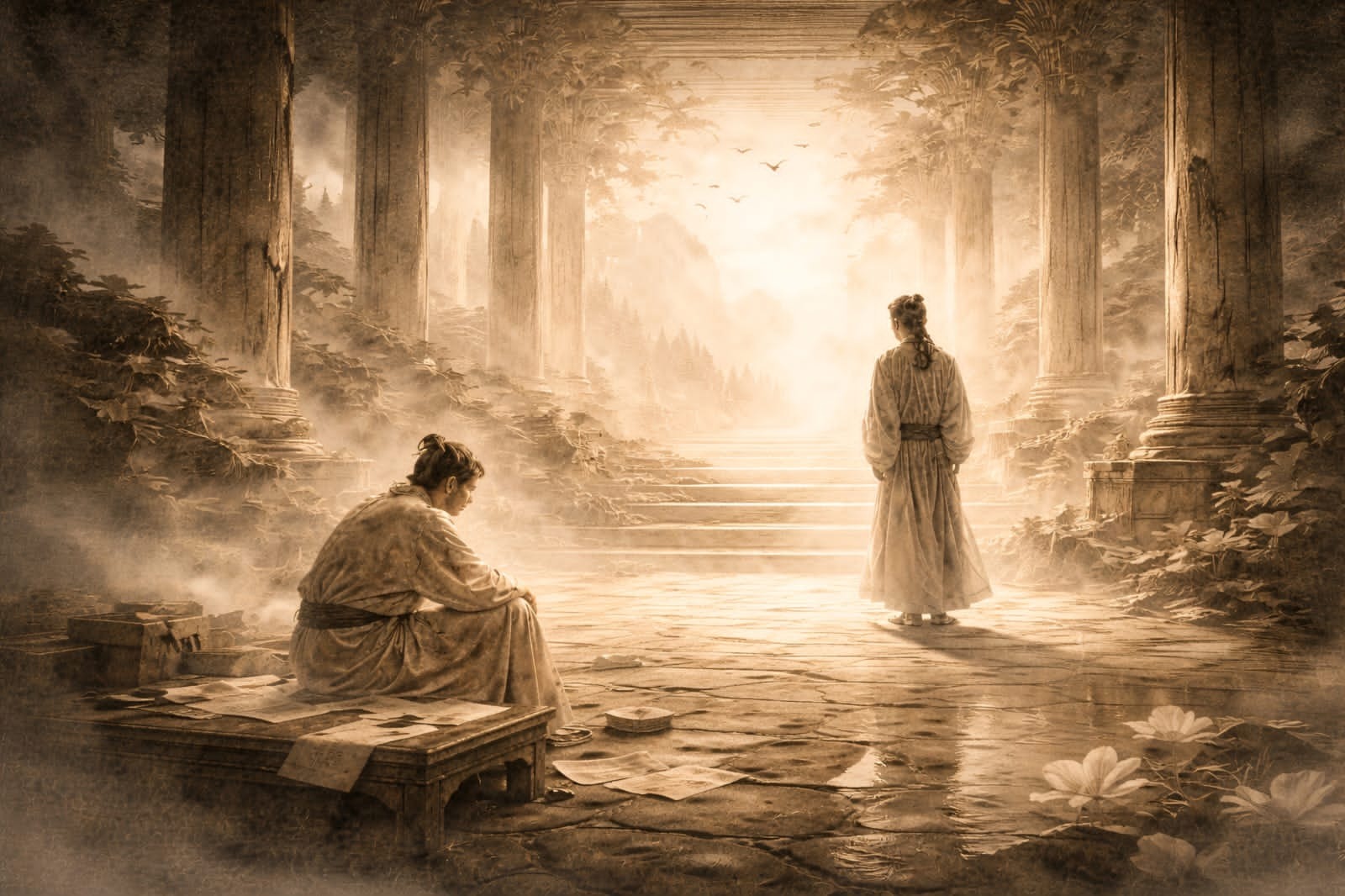
When political systems consolidate power, they rarely do so through force alone. They rely on ideas — especially ideas about morality, order and human freedom.
In examining the rise and transformation of medieval Chinese metaphysical Confucianism, Jiahao Shen argues that this pattern is not new. Drawing on his academic work in Postgraduate programme of World History and Philosophy at King’s College London, Shen contends that what began as a defense of inward moral independence during the collapse of the Han dynasty gradually evolved into an intellectual foundation for aristocratic political consolidation.
At the center of his argument stand two figures: Ruan Ji and Ji Kang. Their refusal to reconcile conscience with authority preserved a rare form of inner sovereignty — one that later philosophical developments would soften, absorb and ultimately neutralize.
This is not merely a story about medieval China. It is a study of how ideas change when power stabilizes — and how the line between moral resistance and institutional legitimacy can quietly disappear.
The Collapse of Order and the Birth of Withdrawal
The Han dynasty, which shaped the foundations of Chinese political civilization, did not fall overnight. Its decline unfolded through decades of corruption, factional struggle and weakening central authority. As imperial institutions eroded, aristocratic families strengthened their regional influence.
These elite families were not outsiders to the state. They had long been embedded within its bureaucracy. Confucian moral philosophy justified their political role, framing governance as ethical duty rather than raw power.
But when the state itself became morally compromised, that moral framework created tension. Those who believed in Confucian virtue were forced to confront a system that no longer embodied it.
Some attempted reform. Many failed. Increasingly, intellectuals turned inward.
Withdrawal did not mean apathy. It meant survival — survival of integrity in a political climate that punished dissent and rewarded conformity.
Out of this crisis emerged a philosophical shift.
The Metaphysical Reorientation
Thinkers like Wang Bi redirected Confucian thought away from ritual activism and toward a deeper metaphysical foundation. Instead of grounding legitimacy solely in visible moral conduct, they located it in an ineffable natural order — a principle underlying all existence.
Political intervention, once treated as an unquestioned duty, now required careful scrutiny. Action that disrupted natural order could be harmful, even if performed in the name of virtue.
This move strengthened the authority of the inner life. Authenticity was no longer measured by one’s public role, but by alignment with a deeper structure of reality.
For intellectuals disillusioned with corrupt institutions, this was liberating. It allowed them to preserve moral seriousness without endorsing compromised authority.
But this philosophical development would not remain static.
The Completion of the System
Guo Xiang extended this metaphysical orientation by arguing that each being possesses its own self-contained ontological world. Every person lives within a spontaneously generated reality governed by its own internal coherence.
Under this view, the tension between inner and outer worlds diminishes. One can serve in government and remain inwardly independent. Participation no longer necessarily entails corruption.
At first glance, this seems like a mature solution to a real problem. It allows talented individuals to re-enter political life without surrendering conscience.
But Jiahao Shen’s analysis presses further.
Once inward sovereignty is declared compatible with outward compliance, the philosophical barrier between conscience and authority weakens. The system no longer appears hostile to authenticity. It appears capable of containing it.
And when a political structure can claim that it does not threaten inner freedom, resistance becomes less urgent.
From Resistance to Legitimization
As the Wei–Jin period progressed, aristocratic families consolidated their dominance within reconstructed political structures. Metaphysical Confucianism provided the intellectual language through which this consolidation could be justified.
The philosophy had matured. It was coherent, elegant and adaptable.
But its maturation came with a transformation.
The earlier, sharp opposition between inward integrity and political corruption softened. The language of naturalness and spontaneity persisted, yet its oppositional edge dulled. The philosophy that once defended distance from power increasingly operated within it.
Shen’s argument is not that metaphysical Confucianism became cynical or insincere. It became integrated. It stabilized order. It gave the ruling elite a refined justification for its role.
In doing so, it absorbed the tension that once defined it.
Ruan Ji and Ji Kang: The Refusal to Harmonize
Before that absorption was complete, Ruan Ji and Ji Kang stood at a historical crossroads.
They lived during the early Sima regime, a period when political authority was consolidating under suspicion and surveillance. Dissent was not theoretical; it carried consequences.
Ruan Ji openly criticized the hypocrisy of those who used Confucian rhetoric to advance ambition. Ji Kang rejected the institutionalized form of Confucian orthodoxy, seeing in it the transformation of moral idealism into bureaucratic instrument.
Their writings evoke an imagined antiquity — an age of simplicity before hierarchy hardened into rigid structure. But this was not mere nostalgia. Shen interprets it as a deliberate philosophical move.
The ancient world they described was internal. It existed as a space beyond political control. It could not be codified or institutionalized.
It was incompatible with consolidation.
The Role of Moral Strain
What distinguishes Ruan Ji and Ji Kang from later metaphysical thinkers is the intensity of their moral discomfort.
Their works convey anxiety, isolation and defiance. They did not believe harmony with authority was possible without compromise. They did not seek to reconcile inner freedom with outward conformity.
Their thought never became a completed doctrine. It remained unsettled, unfinished.
Shen sees this incompleteness not as weakness, but as authenticity.
A finished system requires integration. Integration requires concession. They refused concession.
Ji Kang ultimately paid for that refusal with his life. His execution stands as a stark reminder that systems consolidate themselves not only through philosophical absorption, but through enforcement.
The Fate of Ideas
The trajectory of metaphysical Confucianism illustrates a broader historical pattern.
Philosophies born in crisis often begin as defenses of conscience. They provide moral clarity when institutions falter. But when political structures stabilize, those same philosophies can evolve into frameworks that legitimize authority.
The shift is gradual. It appears as refinement. It is often celebrated as intellectual progress.
Yet something changes.
The earlier tension between conscience and power — the discomfort that sustains vigilance — fades. The language of freedom remains, but its oppositional force weakens.
Ruan Ji and Ji Kang represent the fleeting moment before that transition solidified. Their inner world was not reconciled with authority. It remained apart.
Such moments are rare. They do not last.
Metaphysical Confucianism endured as a sophisticated intellectual tradition. Aristocratic power stabilized.
The uncompromising distance between conscience and system did not.
Why It Matters
Shen’s study of medieval Chinese thought is not confined to one civilization or one era. It highlights a recurring dynamic: when philosophical systems claim harmony between inner independence and external authority, scrutiny is warranted.
Power rarely presents itself as oppressive. It presents itself as reasonable, coherent and compatible with freedom.
The question is whether that compatibility preserves independence — or quietly absorbs it.
Ruan Ji and Ji Kang remind us that true inward sovereignty may require tension rather than harmony.
And history suggests that once harmony becomes complete, resistance may not disappear dramatically.
It may simply become unnecessary.