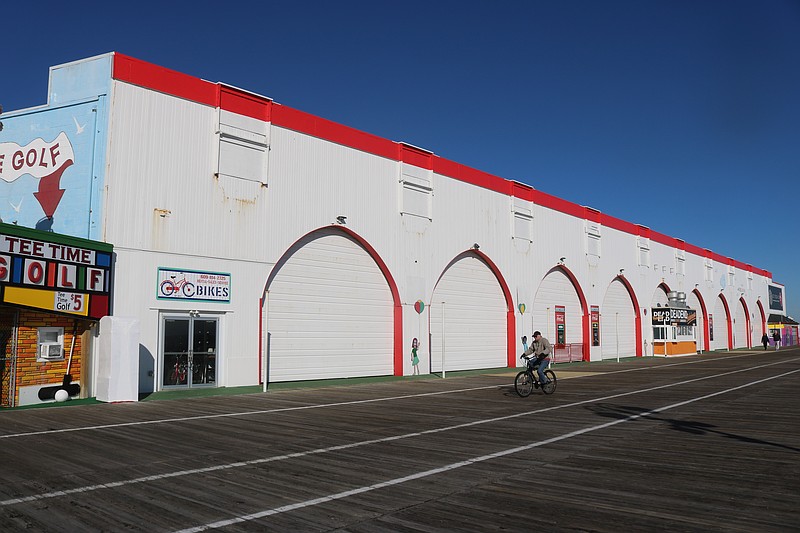
The fate of the former Wonderland Pier amusement park still remains uncertain while City Council considers development options for the Boardwalk site.
City Council has hired a professional planner to help guide it through the complicated and contentious process of evaluating development options for the former Wonderland Pier amusement park site on the Ocean City Boardwalk.
Voting 6-0 Thursday night, the governing body gave approval for a no-bid professional services contract with Jennifer L. Heller of Polistina & Associates LLC, a planning and engineering firm headed by state Sen. Vincent Polistina, an Atlantic County Republican.
Council had delayed awarding the contract during its Feb. 19 meeting for more discussions about the scope of work that would be performed by Heller on behalf of the city at a rate of $175 an hour, for a maximum amount of $15,000.
Councilmen Dave Winslow and Sean Barnes had asked for the contract to be tabled that that time while seeking more information about the exact terms and Heller’s duties. Winslow, in particular, thoroughly researched the contract.
After looking into it further, both Winslow and Barnes expressed their support for hiring Heller at Thursday’s meeting, saying they were confident she would provide valuable guidance while City Council studies the future of the former Wonderland site at Sixth Street and the Boardwalk.
“After completing my due diligence, I believe all interests in Ocean City will be served by moving forward in engaging a dedicated planner for City Council so we can make well thought out, data-driven decisions for this property. After all, we all want to see 600 Boardwalk transformed into something awesome,” Winslow said.
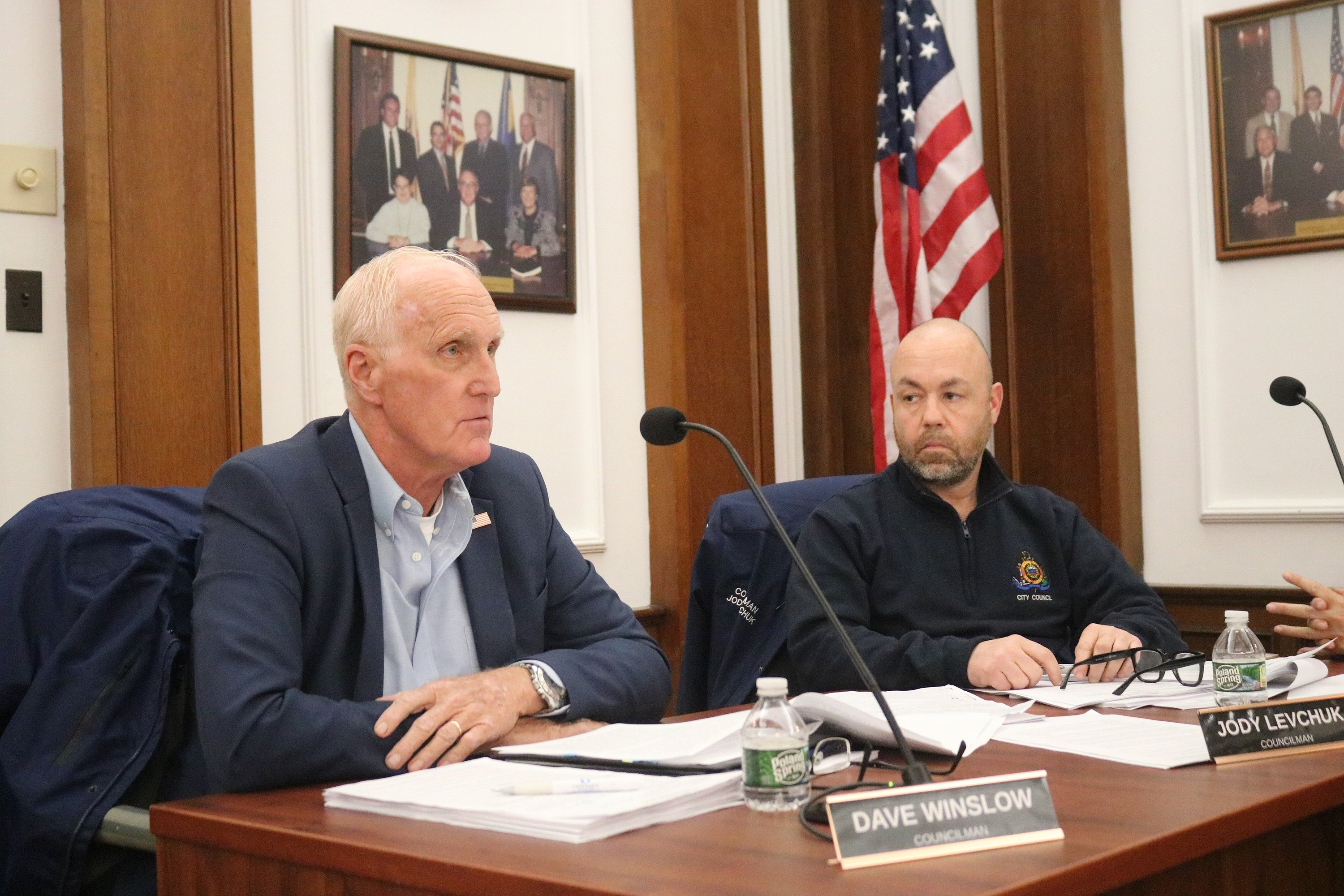 Councilman Dave Winslow, left, supports the contract after initially asking for more time to research the scope of work performed by the planning consultant.
While also endorsing the hiring of Heller, Barnes said he no longer has any reservations about the type of work that she will perform for the city.
“Everybody has satisfied me what the scope of work is going to be. I do think it’s the best move at this point in time,” Barnes said.
All of the other Council members also made comments in favor of the Heller contract. Vice President Pete Madden did not attend the meeting.
“I certainly think it’s in the spirit of hiring the best people we can identify, and letting them do their job and report back to us,” Council President Terry Crowley Jr. said.
Crowley noted that Heller’s report to Council, when completed, will be available for members of the public to read.
“There was a question at the last meeting, will this report be available to the public? Absolutely. It’s tax dollars that are being spent. The report will be available if and when anyone wants to look at it,” Crowley said.
The hiring of Heller in Polistina’s firm was recommended by land-use attorney John A. Ridgway, who is serving as “special legal counsel” to City Council during what is expected to be a painstaking and complicated process in Wonderland’s redevelopment.
Ridgway, who was hired by Council in January at a rate of $200 per hour, will guide the governing body through the legal nuances of approving a redevelopment plan for the Wonderland property.
 An architectural rendering depicts the proposed resort hotel on the Ocean City Boardwalk.
Developer Eustace Mita, who owns the Wonderland site, has proposed building a $150 million luxury resort hotel in place of the defunct amusement park formerly owned and operated by Mayor Jay Gillian and his family. Gillian closed Wonderland in October 2024 after years of financial difficulties.
At some point in the future, Council is expected to decide whether to declare the Wonderland property as an area “in need of rehabilitation” to help speed up its redevelopment – as a hotel or possibly some other type of project.
During a Jan. 7 meeting, Ocean City’s planning board was deadlocked 4-4 in a vote on the rehabilitation designation sought by Mita for his hotel project. The tie vote effectively killed a planning board resolution to approve the rehabilitation status.
For the past year, Mita’s proposed 252-room resort has deeply divided the community into pro-hotel and anti-hotel factions. Supporters believe the project would be a catalyst for more business and tourism, while opponents contend that a large hotel would overwhelm the surrounding neighborhoods and would not blend in with Ocean City’s family-friendly atmosphere.
One vocal hotel opposition group is Ocean City 2050, a grassroots organization co-founded by Jim Kelly, who is one of the candidates running for the three at-large Council seats up for grabs in the May 12 municipal election.
Kelly, who has stepped down from his role as Ocean City 2050’s president to avoid any conflicts with his political campaign, read a lengthy statement at Thursday’s Council meeting that expressed his concerns about Heller’s hiring.
 Jim Kelly, a City Council candidate, reads a statement detailing his concerns about the Wonderland planning consultant contract.
Kelly said he supports the idea of hiring a planning expert to help Council with the Wonderland issue, but added that he is worried about the scope of work Heller would perform.
He fears that Heller’s hiring “could be used as an exercise that provides coverage to take the city back down the rehabilitation path” to boost the hotel plans.
“Over the past year we have lost hours and hours on that issue – with multiple votes, revotes, and some very angry public meetings. We also have already heard from planning experts on this issue as part of the Planning Board’s review. This designation has been thoroughly reviewed, studied, and decided. We need to move forward, not backward,” Kelly said of the rehabilitation debate.
Whatever type of project is ultimately decided for the former Wonderland site, Crowley emphasized that City Council will not offer any type of special PILOT deal to the developer.
“Whatever ends up there, whoever is the developer, whatever they decide to do on that property, I’m going to speak for the majority of City Council, I think, in saying there’s not going to be any type of PILOT situation offered from the city to anyone. They’re going to pay their fair share, just like everyone else on the island does, no matter who the developer ends up being,” Crowley said.
“So, if there are other developers out there that are looking at it, that option is officially off the table. I hope that puts to bed some of the misinformation that’s bandied about in the community,” he added.
A payment in lieu of taxes agreement, or PILOT, is a contract between a municipality and a property developer that replaces conventional property taxes with a negotiated annual service charge. In some communities, a PILOT agreement is used to incentivize a developer to build a project.
 Wonderland Pier's iconic 140-foot-tall Ferris wheel sits idle now that the amusement park is closed.