
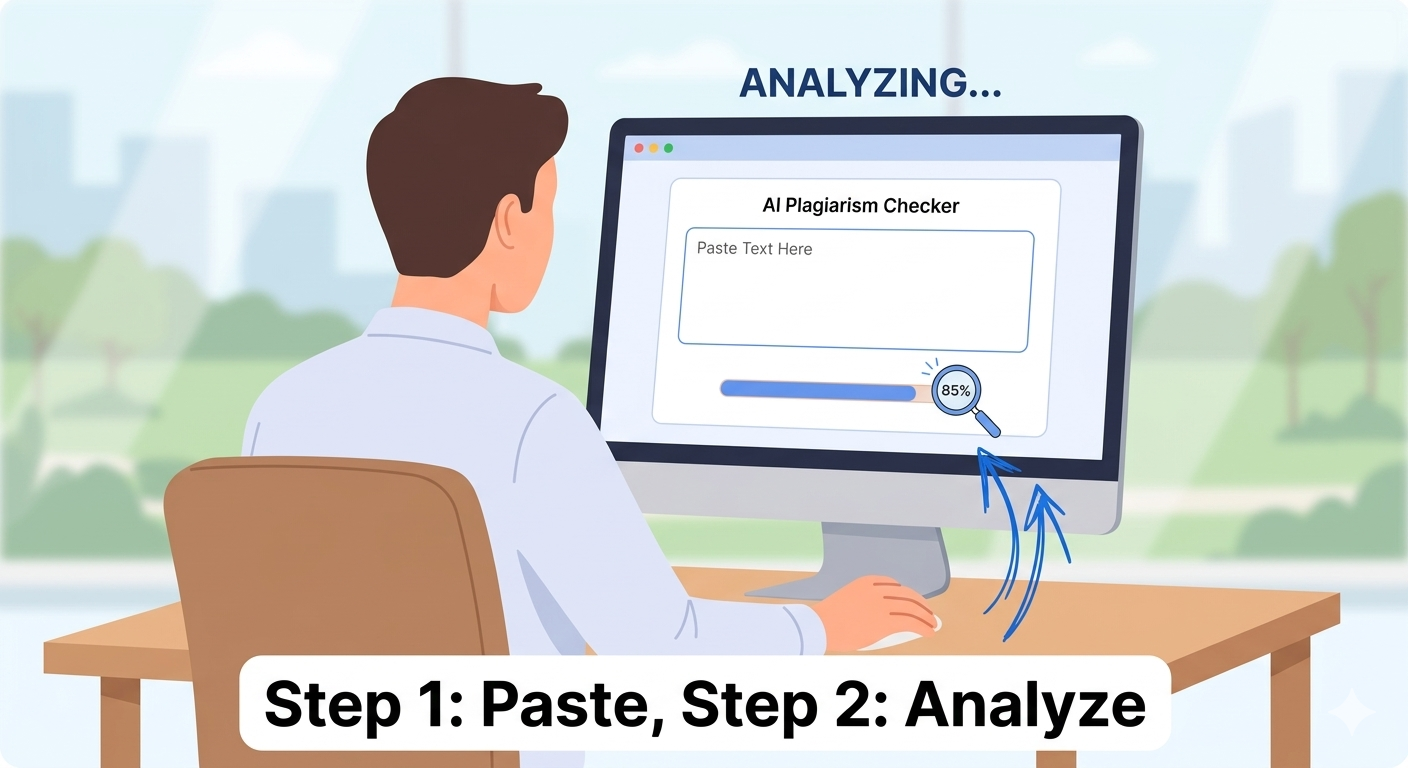
Submitting an academic paper is a major milestone, but it comes with significant responsibility. Ensuring your work is completely original is paramount, as academic institutions have strict policies against plagiarism. Even accidental similarities can lead to serious consequences. This is where an advanced AI tool can become your most trusted ally, helping you protect your academic integrity.
Using a powerful plagiarism checker gives you a vital safety net. These tools scan your document against billions of sources, including web pages, academic journals, and publications, to identify any text that matches existing content. This guide provides a clear, step-by-step process for using an AI-powered checker to review your work, correct potential issues, and submit your paper with total confidence.
Following a structured process ensures you get the most accurate results from any plagiarism detection tool. It transforms the check from a simple scan into a comprehensive review of your writing and sourcing.
Before you can effectively check for plagiarism, your document needs to be ready. A final or near-final draft is best, as running a check on an incomplete paper will only give you partial results. Ensure your document is fully formatted according to your institution's guidelines. This includes in-text citations, a complete bibliography or reference list, and proper formatting for quotations.
A well-prepared document allows the AI tool to distinguish more accurately between your original writing and correctly attributed sources. Some advanced checkers can be configured to ignore text within quotation marks or to exclude the bibliography from the final similarity score. Finalizing your draft first saves you time and provides a much clearer picture of your paper's originality.
Not all plagiarism checkers are created equal. Many free online tools have limited databases, meaning they might miss matches from academic journals or newly published web content. They could also pose a risk to your privacy by storing your uploaded work. For academic purposes, it's crucial to use a reputable and robust AI-powered tool.
Look for a checker known for its comprehensive database, accuracy, and detailed reporting. A premium tool will compare your text against billions of sources, providing you with a reliable and thorough analysis. Once you've selected a tool, navigate to its website and prepare to submit your text for review.
Most AI plagiarism checkers offer two primary methods for submitting your work. You can either upload the entire document as a file or copy and paste the text directly into a text box.
* Uploading a File: This is the most convenient option for complete papers. Most platforms support common file types like .docx, .pdf, and .txt. Simply select the "Upload" button, choose your file, and the tool will process it automatically.
* Pasting Text: If you want to check a specific section or a shorter piece of writing, copying and pasting is a quick alternative. This method is also useful if you are making revisions and want to check individual paragraphs as you edit them.
Choose the method that best suits your needs. For a final review, uploading the entire document is recommended to ensure nothing is missed.
After you've submitted your text, the next step is to initiate the scan. You'll typically find a button labeled "Check Plagiarism," "Scan Now," or something similar. Clicking this will prompt the AI engine to begin its analysis.
The tool’s algorithms break down your text and run it through a massive database of online and academic sources. This process can take anywhere from a few seconds to several minutes, depending on the length of your document and the complexity of the tool's search. Be patient and allow the scan to complete fully to receive the most accurate report.
Once the scan is finished, you'll receive a detailed report. Understanding this report is the most critical part of the process. Don't just look at the final percentage score. Dive into the details to see what the AI found.
A typical report includes:
* Overall Similarity Score: This percentage indicates how much of your text matches external sources. Remember, this is a similarity score, not a plagiarism score. A high score doesn't automatically mean you plagiarized, as it could include properly cited quotes.
* Highlighted Passages: The tool will highlight specific sentences or phrases that match other sources. Each highlighted section is usually color-coded or linked to its original source.
* Source List: The report provides a list of all the sources where matching text was found. You can click on these links to view the original content and compare it side-by-side with your writing.
Take your time reviewing each highlighted section. Evaluate whether the match is a direct quote that needs quotation marks, a poorly paraphrased idea that needs rewriting, or a common phrase that can be ignored.
The report is your roadmap for revisions. Use the information to improve your paper's originality. Address each highlighted passage one by one.
* For Unintentional Plagiarism: If you find a section that is too close to the original source, you need to revise it. You can either paraphrase the idea completely in your own words or, if the original wording is essential, place it in quotation marks.
* For Missing Citations: If a highlighted passage represents an idea or data from a source that you forgot to cite, add the appropriate in-text citation immediately.
* For Direct Quotes: Ensure all direct quotes are enclosed in quotation marks and properly attributed according to your required citation style (APA, MLA, Chicago, etc.).
This revision stage is where you actively fix any potential issues and strengthen the academic integrity of your work.
After you've made all the necessary revisions, it's a good practice to run your paper through the plagiarism checker one last time. This final scan confirms that your edits have successfully lowered the similarity score to an acceptable level and resolved all potential issues. Saving this final report can also serve as proof of your due diligence should any questions about your work arise later.
* Check As You Go: For longer documents like a thesis or dissertation, consider checking your work chapter by chapter. This makes the revision process less overwhelming.
* Understand Self-Plagiarism: Reusing your own work from a previous assignment without proper citation or permission is considered self-plagiarism. Be sure to check against your own past submissions if applicable.
* Focus on Understanding: Don't just try to get a low score. Use the report as a learning tool to improve your paraphrasing and citation skills for future assignments.
* Save Your Reports: Keep a digital copy of your final, clean plagiarism report alongside your submitted paper. It documents your commitment to academic honesty.
* Using Unreliable Free Checkers: Many free tools lack the power and database size to catch everything. They may also sell your data or save your paper, making it appear as plagiarized later.
* Ignoring Similarity Context: A match is not always plagiarism. Common industry terms, names, and properly cited quotes will often be flagged. Use your judgment to assess each match.
* Checking at the Last Minute: Rushing the process leaves no time for thoughtful revisions. Give yourself at least a day or two before your deadline to check and edit your work properly.
* Misinterpreting the Score: A 10% similarity score might be perfectly acceptable if it's composed of quoted material and bibliographic entries. Always refer to your institution's guidelines on acceptable similarity percentages.
Using an AI plagiarism checker is no longer optional in modern academia, it's a fundamental step in producing honest, high-quality work. By following this guide, you can move beyond simply scanning for errors and instead use the tool to refine your writing, perfect your citations, and deepen your understanding of academic integrity. An AI checker is your partner in ensuring the work you submit is truly your own, giving you peace of mind and protecting your hard-earned reputation.







