Parenting is a process. Being a parent entails making numerous sacrifices, especially making your child happy. And the simplest way is to gift your child a toy. But once you have the toy, leaving the child playing with it all the time as you become preoccupied, how safe are you guaranteed your child is? It’s concerning, right?
Take this scenario. You walk into the supermarket or toy center, and as you stand at the shelf waiting for your child, you see a bright colored toy. On the package, there is a bold writing: “Meet the Standards”.
Out of curiosity, you pick up the toy and sniff it to find out what kind of smell or perfume it has. You further inspect the plastic toy's edges and surfaces to determine whether any sharp edges could harm your child. These activities are not undertaken unknowingly. Almost every parent will try these tests before purchasing a toy for their child. It is an instinct to ensure the security of their children. Even though the package included a statement that the toy meets safety expectations, this mere statement does not necessarily guarantee the toy's true safety for children. To affirm the truth, they have to feel it. They observe the product keenly and scrutinize it effectively. From these actions, it is apparent that safety is not a regulative concept. You must practice it beyond seeing.
Parents even see the smell of a toy before children touch it. This faint smell--or a more intense, unnatural smell--can at once set to wondering: can it be chewed? Could it be toxic? One of the parents' highest priorities is chemical safety, since even minor exposures to hazardous substances can be dangerous for young children. Knowing what these smells entail and what responsible manufacturers do to avoid chemical risks helps parents make certain decisions. The next section explains what to consider when choosing more chemical-safe options, what labels like BPA-free mean and do not mean, and even a little on how to evaluate toys at home.
When you buy a new product from the company, there is a high likelihood that it will smell. While the smell may be attractive to others, it can be an odor to others. A smell on the product does not necessarily indicate a safety hazard. The smell usually fades with time and may not be harmful to children. However, parents should handle toys with sharp, irritating, or pungent smells with great care.
It is always ethically correct for manufacturers to declare the safety of their products, such as Bisphenol A (BPA)- free products. While some parents entrust such labels and use them, and the guidance they provide when purchasing toys, precautions should be considered. A BPA-Free toy does not guarantee that it is free of other contaminants. This is a case of safety against one specific substance. There is a possibility that the toy contains particulate matter from poor manufacturing processes. The toys are usually made from some molding processes. It is essential for manufacturers to choose the right polymers as injection molding materials during toy manufacturing.
From purchase experiences and interactions with toys during their children’s upbringing, parents should be able to determine whether a toy is safe. They do not need lab tests; just experience. There are key indicators a parent can use to identify a safe toy.
Have you ever thought of a scenario where a child starts bleeding a few minutes after you gift them a toy? A toy can be a physical threat to the child. Some questions may arise from the parents: could this wheel come off and be swallowed? Or that edge feels rough — could it cut my child? Physical safety concerns the child's injury and whether any parts can fall.
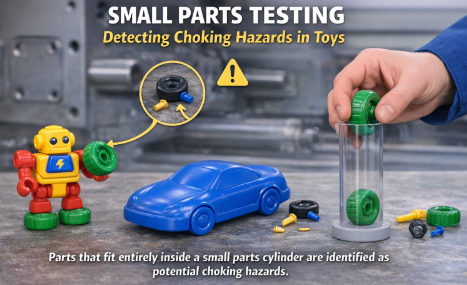
A toy may have numerous small components that can choke a child if the toy is put in their mouth. To overcome this, manufacturers subject the toys to the small parts tests. During this engineering activity, all toy parts that can be fully inserted into a standard-size small-parts cylinder are considered potential choking hazards for small children. This criterion is essential and allows parents to eliminate possible components that can be swallowed by children. The small parts tests do not end with the analysis of the small components. There are also larger parts that can be unsecured and swallowed by the children. For instance, the pins securing the toy's wheels may fall. Children are likely to pick up such pins that pierce their hands. Thus, manufacturers ensure that the components are properly fastened.
If a toy fails to work, it is expected that all its parts will fail as well. However, some parts fail while others remain intact. This case results from the production processes. For example, when developing the axles, the axles should not be able to disintegrate from the plastic. The wheel should be made with the axle inside the plastic. One technique for achieving this is insert molding. In this technique, metal and plastic are combined into a single continuous entity and glued together, making them stronger.
A parent may choose a toy based on its color but pay minimal attention to the seams and edges. Sharp edges are very harmful to children. They are likely to injure the child or even cause bleeding. Sharp edges and minor burrs indicate poor finishing. It indicates the manufacturer was faster, paying minimal attention to finishing. Proper manufacturing processes, mold manufacturing, and strict finishing result in safe, smooth toys during mold making service. Manufacturers must polish surfaces to eliminate irregularities that create weak points. A child does not understand the safety precautions when using the toys. They drop, pull, and twist the toys while playing. During such experiences, the edges of the toys must be better able to withstand the forces.
Just touch and feel. As a parent, you do not need to see a toy that appeals to you and pick it for your child. You need to touch each.
Every parent wishes to buy a toy for their children that lasts. The toy has to bring long-lasting happiness while saving on expenses. Thus, apart from structural safety, a parent will also consider the toy's structural safety. “What will happen when the toy drops?” “If the child chews the toy, will some bits get off?” It is therefore necessary to examine what structural safety means and what parents should do to ensure it.
Size is not strength. Most parents will go to the shelf and pick the biggest toy, thinking it's the strongest. While thickness can sometimes determine a toy's rigidity, its structural design is much more essential in determining its wear-and-tear resistance. Once the internal structure is weak, even a large toy can easily break when dropped. Engineers must design toys well to ensure the effective distribution of forces and avoid cracking. Sometimes, when toys have sharp edges, they can bend without breaking under some forces. Hardening is a very important design criterion for such toys. The toys' disability depends on their ability to withstand stress under the different circumstances children are subjected to. Thus, during manufacturing processes, the initial stages of mold making require proper planning.
There is no formula children will use to play with toys. Car toys will be used for ‘hammering', sometimes chewed, and even thrown into the air. The ‘car' in this case will experience numerous stresses within a few minutes of purchase. Thus, we do not know how an empirical experiment correlates with how children play with toys.
A structurally safe toy is one designed to withstand all these external forces and stresses without cracking, breaking, bending, or failing. We cannot negate damage. Sometimes, the children may subject it to extreme conditions. But suppose you leave your child with a toy in the sitting room while playing on a flat surface. And when you come back, you find the toy broken into two pieces, or some parts have broken, leaving sharp edges. Such a toy can be said to have undergone poor structural design. When a toy breaks, it’s expected that the fractures will be relatively blunt. Sharp edges can cut the child’s skin. Manufacturers can eliminate this challenge by choosing the right material and optimizing molding processes. Basically, that is hard has a higher probability of withstanding stress.
Involving numerous parts in the design and manufacture of a toy makes it more complex and riskier for a child to use. It basically gives children a wide range of breaking points. A child, out of curiosity, would easily destroy the toy to see what is hidden inside. Most manufacturers have opted for a piece design approach to reduce the number of joints and auxiliaries. For instance, when developing a plane toy, manufacturers will create a complete body without window panes. A vehicle toy will not have two chassis. This can be achieved more effectively through rapid injection molding.
One-piece design in toy manufacturing further helps to reduce inconsistencies and errors, leading to tough, resilient, and safe toys.
A parent should be able to determine structural safety by quick checks.
The safety of our children while using toys lies entirely in our hands, as parents and manufacturers. If any error is assumed in the Manufacturing process, it should be captured at the point of purchase. So basically, our children’s toys are not absolutely safe until proven safe through checks. The safety of the toys is ensured through a comprehensive process that follows all manufacturing steps. Right from the design room through the choice of material, selection of processes, finishing, packaging, transportation, and storage. While we expect the toy to have undergone numerous quality checks across all these processes, errors are sometimes inevitable and can be carried forward from one stage to another until they reach the child. For instance, while engineers may consider disassembling wheels an innovative approach, a toy that does so can be unsafe for children. Therefore, for parents, it's not safe until you prove it. Check and recheck to ensure we have chemical, physical, and structural safety.