
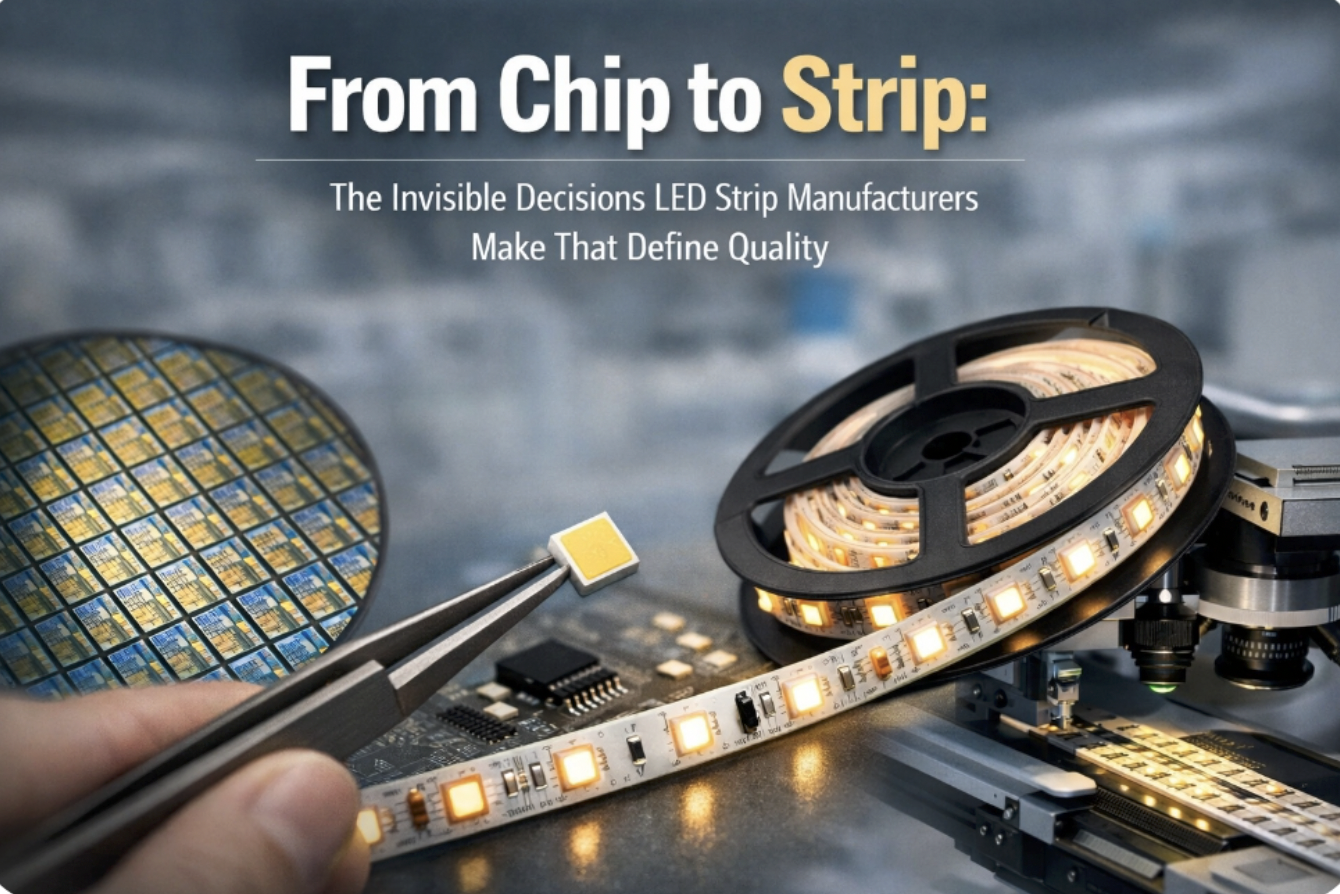
An LED strip looks simple. A line of lights on a flexible board. Many people assume that if two strips look the same, they must perform the same.
That assumption causes problems.
The real difference between LED strips is not always visible. It lives in small decisions made early in manufacturing. Choices about chips, boards, spacing, and materials quietly shape how the strip behaves months or years later.
This guest post walks through those invisible decisions. It explains how LED strip manufacturers influence quality step by step, starting from the LED chip and ending with the finished strip. The goal is clarity, not exaggeration, and a tone that fits practical, engineering focused readers.
The LED chip is the heart of the strip. Its quality affects brightness, color, and lifespan.
Manufacturers must choose chips that match the intended use. Some chips are made for high output. Others focus on efficiency or color accuracy. Using the wrong type creates issues that cannot be fixed later.
Another quiet choice is binning. Chips are sorted by brightness and color. Mixing bins carelessly leads to uneven light along the strip. Good LED strip manufacturers pay attention to this step, even though it adds complexity.
To the user, the strip either looks smooth or patchy. That result starts with chip selection.
Color is not just about the chip. It is about control.
Manufacturers decide how tightly they manage color variation. Tighter control costs more. Looser control saves money but increases visible differences.
This decision often depends on the application. Decorative lighting may allow more variation. Architectural or commercial lighting usually does not.
When strips show color shifts between batches, the cause is often not installation. It is a manufacturing choice made upstream.
The flexible circuit board looks like a carrier, but it plays a larger role.
Board thickness affects strength and heat flow. Copper weight affects electrical stability. Poor choices here increase voltage drop and heat buildup.
Some LED strip manufacturers choose thinner boards to cut costs. Others choose thicker boards to improve stability. The user may never see this difference, but the strip will behave differently over time.
Even the layout matters. Trace width, spacing, and cut point design all affect performance. These details are decided long before assembly begins.
Heat is one of the main reasons LED strips fail early.
Manufacturers make early decisions about heat paths. LED spacing affects how heat spreads. Copper layers help move heat away from chips. Coatings can trap or release heat.
Once the design is locked, options become limited. Adding a better power supply later does not fix poor heat design.
LED strip manufacturers who think about heat from the start usually deliver longer lasting products. Those who ignore it often rely on short term testing to hide long term issues.
Adhesive is easy to overlook. Many people assume all tapes work the same.
They do not.
Manufacturers choose adhesives based on surface type, temperature range, and aging behavior. Some tapes hold well at first and fail later. Others perform consistently over time.
When strips fall off after installation, the problem often traces back to adhesive selection. This choice happens quietly, during sourcing, not at the job site.
Some LED strips use coatings or encapsulation for protection. This adds moisture resistance and durability.
But coatings also affect heat and flexibility. Thick coatings protect well but trap heat. Thin coatings release heat but offer less protection.
LED strip manufacturers must balance these trade offs. There is no perfect solution, only informed decisions based on use cases.
This is why two strips with the same IP rating can behave differently in real life.
During assembly, machines place chips and solder connections. Settings matter.
Solder temperature, placement accuracy, and process speed all influence joint strength. Weak joints may work during testing and fail later.
Good manufacturers monitor these parameters closely. They adjust based on feedback, not guesswork.
The end user never sees this stage, but it defines how stable the strip will be under daily use.
Testing shows how a manufacturer thinks.
Basic tests check if the strip turns on. Deeper tests check voltage drop, current balance, and temperature rise.
Some LED strip manufacturers treat testing as proof. Others treat it as learning. The second group uses results to refine design and process.
This mindset difference shows up in long term performance, not marketing materials.
Quality does not stop at production.
Packaging protects the strip from bending, moisture, and static damage. Poor packaging can undo careful manufacturing.
Manufacturers decide how much protection is enough. This decision affects shipping damage rates and installation experience.
It is another invisible step that shapes outcomes.
Buyers often compare LED strips by specs and price. That is understandable.
But many failures come from decisions that never appear on a datasheet. Chip bins, board layout, adhesive aging, and heat paths do not fit neatly into a table.
LED strip manufacturers who communicate these choices clearly tend to build stronger relationships. Those who hide behind vague claims create uncertainty.
Understanding this helps buyers ask better questions.
Engineering driven suppliers focus on control rather than claims. They explain what they do and why they do it.
This approach reflects how SIRS-E presents its services and technical content. The emphasis is on consistency, process discipline, and realistic performance.
For professionals, this tone matters more than bold promises.
From chip to strip, quality is shaped by many small decisions. None of them are dramatic on their own. Together, they define how an LED strip performs over time.
LED strip manufacturers who respect these details reduce surprises in the field. They build products that behave as expected, not just during testing, but in real use.
If you want to learn how structured manufacturing supports reliable lighting, explore the technical insights shared by SIRS-E and see how thoughtful decisions shape better outcomes.
1. Why do two LED strips with similar specs perform differently
Because many quality decisions happen outside the spec sheet, such as chip binning and board design.
2. Does thicker PCB always mean better LED strip quality
Not always, but it often improves heat handling and stability when designed correctly.
3. Why is adhesive quality important for LED strips
Poor adhesive leads to strips peeling off over time, even if the lighting itself works.
4. Are coatings always good for LED strips
Coatings protect against moisture but can increase heat. The balance depends on the application.
5. How can buyers judge LED strip manufacturers beyond price
By asking about design choices, testing depth, and how quality is controlled before shipping.







