
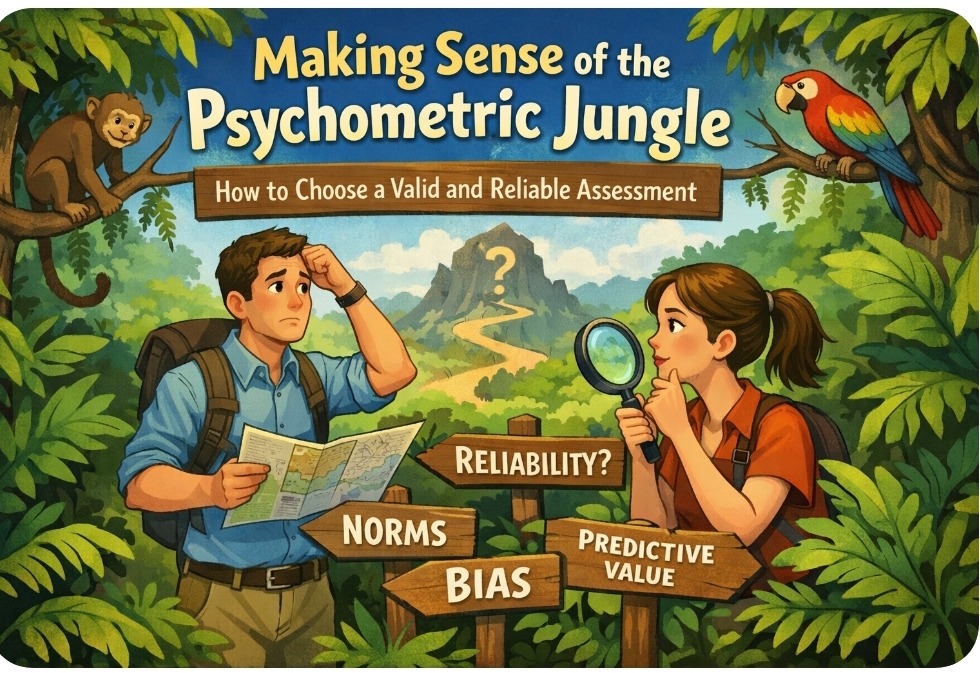
The global market for talent diagnostics has experienced unprecedented growth in recent years. With hundreds of digital platforms promising to reveal "untapped potential", "cultural fit", or "leadership style" through a few clicks, it has become increasingly difficult for Human Resources and talent leaders to distinguish between what is genuinely predictive and what is merely persuasive marketing. In a landscape saturated with "gamified" apps and colourful personality types, the risk of falling for "pseudo-science" has never been higher.
At Awair GB, we frequently encounter clients who have experimented with a confusing array of tools, including personality questionnaires, cognitive ability tests, engagement surveys, and team diagnostics. Despite this investment, many still feel remarkably unsure about which results they can truly trust when making high-stakes decisions. The reality of the industry is simple: not all assessments are created equal. To build a robust talent strategy, organisations must move beyond the surface level and understand the scientific foundations of the tools they employ.
So, how can you determine whether a specific instance of psychometric testing is genuinely robust, valid, and fair?
A high-quality assessment process must begin with a clearly defined purpose. You must ask whether the tool is designed for selection, long-term development, or immediate team alignment. A significant error in many organisations is using a "developmental" tool for "selection" purposes.
Developmental tools are often designed to spark conversation and self-reflection; they may not have the statistical "rigour" or "legal defensibility" required to reject a candidate for a job. If a provider cannot clearly articulate exactly what the tool measures and how those metrics link specifically to your business outcomes, that is your first significant red flag. Valid psychological assessments must have a "job-related" justification to be both effective and ethically sound.
The field of psychometrics is governed by strict international standards. According to the 12-Question Assessment Evaluation Framework, which is a gold standard for procurement, you should always investigate the following:
Is the test publisher or distributor affiliated with a recognised professional organisation such as the British Psychological Society (BPS), the American Psychological Association (APA), or the Society for Industrial and Organisational Psychology (SIOP)?
Is there a comprehensive technical manual supporting the test? This manual should be aligned with the Uniform Guidelines on Employee Selection Procedures or the BPS Test Registration and Review Framework.
Has the test been independently reviewed by third parties? For example, has it appeared in the Buros Mental Measurements Yearbook or the BPS Psychological Testing Centre database?
If the answer to these questions is "no", you should proceed with extreme caution. Many popular "type" or "colour" based tools are engaging and easy for managers to use, but they often lack the statistical validity and reliability required for making life-changing career decisions. A tool that gives a different result when the same person takes it two weeks apart is "unreliable" and, therefore, scientifically useless for prediction.
A credible assessment provider should be entirely transparent with their data. They should be able to provide validation studies conducted with real-world organisational samples rather than just "student" populations. You should request a summary of results for roles comparable to the ones you are hiring for and seek transparency on how "cut-off" scores are established.
Without this evidence, you cannot be confident that the results are reliable or fair across different demographic groups. Statistical "significance" is not just a laboratory requirement; it is the foundation of your return on investment. If an assessment cannot prove that high scorers actually perform better on the job than low scorers, it is not an assessment; it is a lottery.
When discussing the pinnacle of psychological assessments, Hogan Assessments frequently emerge as the benchmark. Supported by over 40 years of rigorous research, the Hogan suite was built specifically for the business environment. Unlike many tools that adapted clinical psychology for the office, Hogan was designed to predict "occupational" performance by measuring the "reputation" of a leader.
Hogan's strength lies in its ability to measure three distinct areas:
The Bright Side (HPI): How an individual relates to others when they are at their best.
The Dark Side (HDS): Qualities that emerge under stress or boredom that can "derail" a career.
The Inside (MVPI): The core values and drivers that determine what kind of culture a leader will create.
By using Hogan Assessments, organisations gain access to a global research archive and a toolset that is fully compliant with BPS and APA professional standards, ensuring that every talent decision is backed by world-class science.
Using poorly validated or unregulated psychometric testing is more than just a waste of budget; it can actively undermine the credibility of your talent processes and expose the organisation to legal risk. A scientifically validated tool ensures fairness across gender, ethnicity, and age.
In the UK and globally, "adverse impact" is a critical concern. For example, if a cognitive test is not properly validated, it might inadvertently discriminate against certain protected groups. Concrete data from the Equal Employment Opportunity Commission (EEOC) and similar bodies suggest that non-validated tests are far more likely to produce biased outcomes. For instance, well-normed personality assessments typically show near-zero differences in scores across different racial groups, whereas unrefined cognitive tests can show significant disparities if they are not culturally neutral. Using a tool like Hogan ensures that you are measuring "competence" rather than "background."
No single test can capture the total complexity of a human being. The most sophisticated talent strategies use an integrated approach. When you combine personality assessments with 360-degree feedback, team effectiveness diagnostics, and culture surveys, you provide a holistic view of how individuals and teams work and grow.
Integrated properly, these psychological assessments move insight into action. They help employees translate raw awareness into meaningful behavioural change. For example, a leader might learn from a psychometric test that they are naturally "highly ambitious" but learn from their 360-degree feedback that this ambition is perceived by their team as "aggressive" or "unsupportive." It is the intersection of these data points that creates the catalyst for true leadership development.
The world of work is not static, and neither should your assessments be. The most robust tools are continuously researched and "re-normed" to reflect changes in the global workforce. You should ask your provider whether they maintain an active research archive and update their validation studies regularly.
Responsible psychometric publishers stand behind their data. They should be able to demonstrate that their tools remain predictive in a digital, remote, or hybrid working world. If a tool is still using "norms" from the 1980s without any updates, it is unlikely to be relevant to the challenges of 2026.
In today’s crowded, often confusing assessment marketplace, the best tools are rarely the flashiest or trendiest. Instead, they are the most valid, transparent, and evidence-based. By asking the right questions—such as those found in the 12-Question Framework—you can confidently choose psychometric testing that delivers fair, predictive, and developmental outcomes for your people.
At Awair GB, we are proud of our partnership with Hogan Assessments. This partnership allows us to offer our clients a personality assessment suite that is not only statistically superior but also globally recognised for its depth and accuracy. Whether you are looking to refine your recruitment process or identify the next generation of C-suite leaders, the quality of your data will determine the quality of your results.
If you would like expert guidance on selecting or integrating validated psychological assessments within your organisation, our specialist consultants at Awair GB would be delighted to help you navigate the jungle.







