
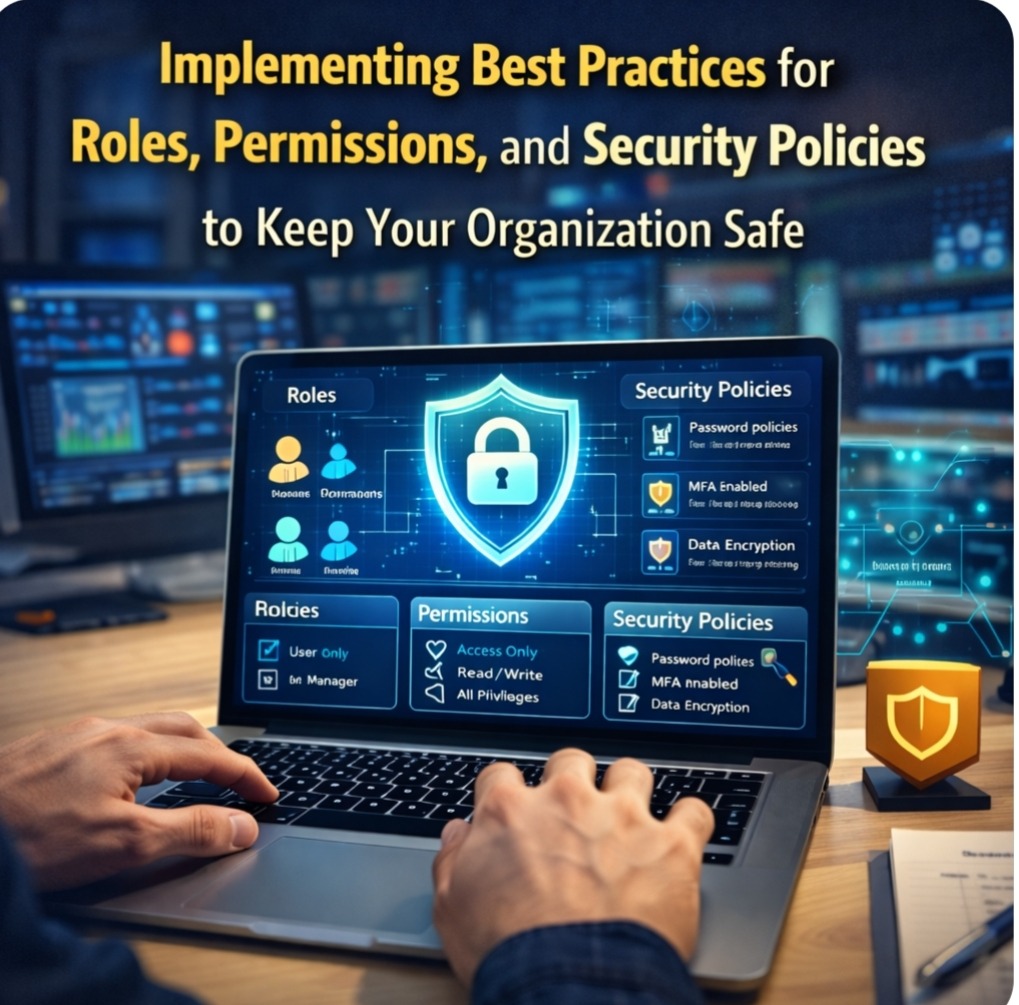
In an era where data breaches, insider threats, and unauthorized access incidents make headlines with alarming regularity, the foundation of any strong organizational security posture is not a single firewall or a cutting-edge intrusion detection system — it is a well-designed, consistently enforced framework of roles, permissions, and security policies. How an organization defines who can access what, under what conditions, and with what level of authority determines the blast radius of any security incident, the ease of regulatory compliance, and the overall resilience of its operations. Yet many organizations treat access control as an afterthought, applying ad hoc permissions, leaving legacy accounts active, and allowing privilege creep to accumulate unchecked over years. This article provides a practical, structured approach to implementing access governance best practices that keep organizations secure, auditable, and operationally efficient.
Role-Based Access Control (RBAC) is the cornerstone of any mature access governance strategy. Rather than assigning permissions to individual users one by one — a practice that rapidly becomes unmanageable as organizations grow — RBAC groups permissions into defined roles that reflect actual job functions. A finance analyst role, for instance, might include read access to accounting systems and read-write access to budget reporting tools, while a system administrator role would carry broader infrastructure access with no permissions to financial records.
Implementing RBAC effectively begins with a role discovery exercise. Work with department heads and team leads to map out every distinct job function in the organization, the systems each function requires access to, and the minimum level of permission needed to perform that function. The goal is to define roles that are neither too broad nor so granular that they multiply endlessly. A well-designed RBAC framework typically results in a manageable set of roles — often between 20 and 60 for medium-sized organizations — that can be assigned, reviewed, and revoked cleanly. Once roles are defined, enforce the principle that users are assigned roles rather than individual permissions, and that any exception requires formal approval and documentation.
The principle of least privilege (PoLP) states that every user, system process, and application should operate with the minimum level of access required to perform its intended function and nothing more. This principle is deceptively simple but requires ongoing discipline to enforce, because the natural tendency in most organizations is to grant broad access when in doubt and restrict later — a pattern that rarely results in restriction actually happening.
Applying least privilege in practice means questioning every permission request rather than approving by default. When a new employee joins, their access should start minimal and expand only as clearly justified needs arise. When an employee changes roles, their previous permissions should be revoked before new ones are assigned — a process called access recertification. Service accounts and automated processes are especially prone to privilege creep; audit them regularly to confirm that no service account holds broader permissions than its specific function demands. Organizations that enforce least privilege consistently and rigorously experience dramatically smaller attack surfaces, meaning that even when credentials are compromised, the damage an attacker can inflict is inherently constrained.
Website: https://www.exam-topics.net
Not all accounts carry the same risk. Accounts with administrative, root, or superuser privileges represent disproportionate risk because a single compromised privileged account can allow an attacker to move laterally across systems, exfiltrate data at scale, or cause catastrophic damage to infrastructure. Privileged Access Management (PAM) is the discipline of applying heightened controls specifically to these high-value accounts.
Effective PAM programs share several common characteristics. Privileged accounts are never used for routine daily activities — administrators use separate standard accounts for email, browsing, and general work, and only elevate to privileged accounts for specific administrative tasks. Privileged account credentials are stored in a dedicated password vault rather than written down or reused, with credentials rotated automatically on a regular schedule. All privileged sessions are logged and, where technically feasible, recorded for forensic purposes. Just-in-time (JIT) access models go a step further by granting elevated permissions only for a defined time window and specific task, after which the permissions automatically expire. This approach eliminates standing privilege entirely, dramatically reducing the window of exposure even if credentials are compromised.
Security policies are the formal, documented rules that govern how an organization protects its information assets, manages access, responds to incidents, and maintains compliance with applicable regulations and standards. Without written policies, security decisions are made inconsistently, accountability is unclear, and demonstrating compliance to auditors becomes nearly impossible. Policies also serve an educational function — they communicate to employees what is expected of them and what the consequences of non-compliance are.
A complete security policy framework typically includes an overarching information security policy that establishes principles and accountability, supported by more specific policies covering areas such as password management, acceptable use, remote access, data classification, incident response, and third-party vendor access. Each policy should be written in clear, plain language that the intended audience can understand and follow. Policies should include defined review cycles — annually at minimum — to ensure they remain current as the organization's environment and risk landscape evolve. Critically, policies must be enforced consistently. A policy that exists on paper but is not reflected in system configurations, training programs, and disciplinary procedures provides no real protection and can actually create legal liability by demonstrating awareness of risk without action.
Website: https://www.certkiller.com
Passwords alone are no longer an adequate authentication mechanism for organizational systems. Credential theft through phishing, brute force attacks, and data breaches from third-party services means that username and password combinations are routinely compromised even when users follow good password hygiene. Multi-factor authentication (MFA) adds a second verification layer — typically a time-based one-time code, a push notification to a registered device, or a hardware security key — that prevents unauthorized access even when credentials have been stolen.
MFA should be treated as a mandatory baseline control rather than an optional feature. At minimum, it should be enforced for all administrative accounts, all remote access connections, all email and productivity platform logins, and all access to systems handling sensitive or regulated data. Many organizations go further by requiring MFA for all user accounts without exception, a practice increasingly recommended by security frameworks including NIST, CIS Controls, and ISO 27001. Phishing-resistant MFA methods such as FIDO2 hardware keys or passkeys offer the strongest protection and should be prioritized for privileged accounts and roles with access to critical systems.
Even the most carefully designed access framework degrades over time if it is not regularly reviewed and maintained. Employees change roles, leave the organization, take on temporary project responsibilities, and accumulate permissions that were once justified but are no longer needed. This accumulation — commonly called privilege creep — steadily expands the organization's attack surface and complicates incident response by making it harder to identify which accounts truly require the access they hold.
Access certification campaigns are a structured process for reviewing and revalidating every user's access entitlements on a regular schedule, typically quarterly or semi-annually for sensitive systems and annually for lower-risk resources. During a certification campaign, system owners and managers review the access held by members of their teams and explicitly certify that each entitlement remains appropriate or flag it for removal. Modern identity governance platforms can automate much of this process, generating review tasks, sending reminders, tracking completion, and automatically revoking access that is not recertified within the review window. These campaigns also serve as a valuable audit artifact demonstrating to regulators and auditors that the organization actively manages its access entitlements rather than simply granting access and forgetting it.
Website: https://www.actualtests.com
Q1: What is the difference between RBAC and attribute-based access control (ABAC)?
Role-Based Access Control (RBAC) assigns permissions based on predefined roles tied to job functions, making it straightforward to manage and audit in most organizational contexts. Attribute-Based Access Control (ABAC) grants or denies access based on a combination of attributes — such as the user's department, the sensitivity level of the data, the time of day, or the location of the access request — allowing for more granular and context-aware policies. ABAC is more flexible but also more complex to design and maintain. Many mature organizations use a combination of both, applying RBAC as the baseline and ABAC for fine-grained controls on highly sensitive resources.
Q2: How often should access reviews be conducted?
The appropriate frequency depends on the sensitivity of the systems and data involved. Privileged and administrative accounts should be reviewed quarterly at minimum, and in high-security environments, monthly. Standard user accounts with access to sensitive data should be reviewed at least semi-annually. General user accounts with access to low-sensitivity systems can be reviewed annually. Any access change triggered by a role change, departure, or incident should be reviewed immediately rather than waiting for the next scheduled cycle.
Q3: What should be included in an acceptable use policy?
An acceptable use policy should clearly define the systems and resources it covers, the permitted and prohibited uses of those resources, the organization's rights to monitor usage, the user's responsibilities for protecting credentials and reporting incidents, consequences for policy violations, and the process for requesting exceptions. It should be written in plain, unambiguous language, reviewed by legal counsel, and signed or electronically acknowledged by every user upon onboarding and annually thereafter.
Q4: How can small organizations implement these practices without dedicated security staff?
Small organizations can implement strong access governance through a combination of built-in platform controls and simple documented processes. Most cloud platforms and productivity suites include role-based access controls, MFA enforcement, and audit logging at no additional cost. Starting with the highest-risk accounts — administrative, financial, and remote access — and applying least privilege, MFA, and regular review to those accounts first delivers the greatest risk reduction with the least resource investment. Many managed service providers also offer access governance support as part of their service packages for organizations that lack internal security expertise.
Q5: What is the risk of not having documented security policies?
Organizations without documented security policies face multiple serious risks. Security decisions are made inconsistently, creating gaps and contradictions that attackers and auditors alike can exploit. Without clear policies, it is difficult to hold employees accountable for security obligations they were never formally informed of. Regulatory compliance becomes extremely difficult to demonstrate, particularly in industries subject to frameworks like SOC 2, ISO 27001, GDPR, or PCI DSS, all of which require documented policies as a foundational control. In the event of a breach, the absence of documented policies can also increase legal exposure significantly.
Q6: How should organizations handle access for employees who change roles internally?
Internal role changes should trigger a formal access recertification process. The employee's previous permissions should be reviewed and revoked before or at the same time as new permissions are granted for their new role. This prevents the accumulation of access from multiple past roles, a pattern known as privilege creep. HR and IT systems should be integrated so that role changes automatically generate access review tasks rather than relying on manual notification. Temporary access to legacy systems needed for knowledge transfer during a transition should be time-limited and explicitly approved.
Roles, permissions, and security policies are not administrative formalities — they are the structural backbone of an organization's defense against both external threats and internal risks. When designed with care, enforced consistently, and reviewed regularly, these controls limit the damage any single compromised account or malicious insider can cause, create clear accountability for how organizational resources are used, and build the audit trail that regulators, customers, and partners increasingly expect to see. The organizations that treat access governance as a continuous operational discipline rather than a one-time setup project are the ones best positioned to detect threats early, respond effectively when incidents occur, and maintain the trust of everyone who depends on them.
Implementing these best practices does not require unlimited resources or a large dedicated security team. It requires commitment, clear ownership, and a systematic approach that prioritizes the highest risks first and builds incrementally toward a mature, sustainable posture. Whether your organization is establishing its first formal access control framework or maturing an existing one, the principles outlined in this article provide a reliable foundation for keeping your people, your data, and your operations genuinely safe.







