
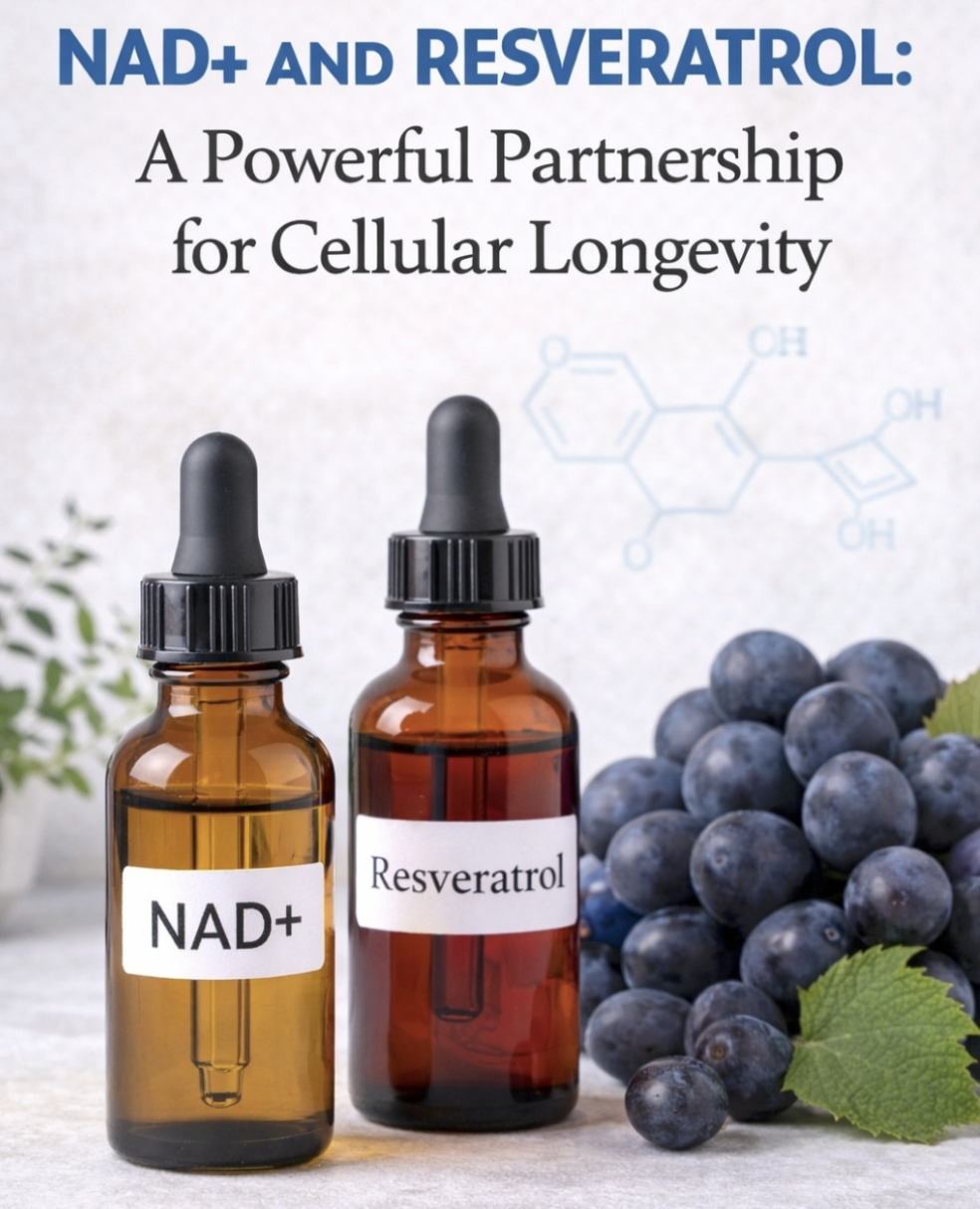
The science of healthy aging has identified several key cellular pathways that influence how we age at the molecular level. Among the most promising discoveries are compounds that support NAD+ (nicotinamide adenine dinucleotide) levels and activate longevity proteins called sirtuins. The combination of NAD+ boosting supplements with resveratrol has emerged as a particularly intriguing approach, with these two compounds working through complementary mechanisms to support cellular health, energy metabolism, and age-related wellness.
NAD+ exists in every living cell and serves as an essential coenzyme for hundreds of metabolic reactions. This molecule acts as a cellular currency for energy, shuttling electrons in the processes that convert nutrients into usable ATP—the energy molecule that powers virtually everything your cells do.
Beyond energy production, NAD+ plays crucial roles in DNA repair, gene expression regulation, cellular stress response, and supporting mitochondrial function. As we age, NAD+ levels decline significantly—by some estimates dropping by 50% or more between youth and middle age. This decline correlates with various aspects of aging and reduced cellular function.
Several factors contribute to age-related NAD+ depletion. Increased consumption by enzymes involved in DNA repair, reduced production from precursor molecules, and decreased efficiency in the salvage pathways that recycle NAD+ components all play roles. Additionally, chronic inflammation and metabolic stress can accelerate NAD+ consumption.
Resveratrol is a polyphenol compound found naturally in grape skins, berries, and certain other plants. This molecule gained widespread attention following research into the "French Paradox"—observations that populations consuming red wine showed certain health advantages despite dietary factors that might suggest otherwise.
What makes resveratrol particularly interesting for longevity research is its ability to activate sirtuins, especially SIRT1. These proteins are sometimes called "longevity genes" because of their roles in cellular stress resistance, metabolic regulation, inflammation control, and DNA stability maintenance.
Sirtuins require NAD+ to function—they literally consume NAD+ molecules as they perform their protective activities. This dependency creates an important connection between NAD+ levels and sirtuin activity.
The combination of NAD+ precursors with resveratrol creates a powerful synergy. While NAD+ provides the fuel that sirtuins need to operate, resveratrol activates these sirtuins to use that fuel more efficiently. Think of NAD+ as the gasoline and resveratrol as the ignition key—both are necessary for optimal function.
Research suggests this combination may produce effects greater than either compound alone. NAD+ precursors ensure adequate substrate availability for sirtuin function, resveratrol enhances sirtuin activation and activity, together they support multiple longevity pathways simultaneously, and the combination addresses both the supply and activation aspects of the sirtuin system.
For those interested in exploring how these compounds work together in evidence-based protocols, comprehensive guides on NAD+ and resveratrol supplementation provide detailed insights into optimal combinations and dosing strategies.
Mitochondria—the powerhouses of your cells—depend heavily on NAD+ for efficient energy production. As NAD+ levels decline with age, mitochondrial function often suffers. Resveratrol complements this by promoting mitochondrial biogenesis (the creation of new mitochondria) and improving existing mitochondrial efficiency.
Together, these effects may help maintain the cellular energy production that typically declines with aging. This has implications for physical performance, cognitive function, and overall vitality.
Every day, your DNA sustains thousands of instances of damage from normal metabolic processes, environmental factors, and replication errors. NAD+ is essential for DNA repair enzymes called PARPs to function properly. Adequate NAD+ levels ensure these repair mechanisms work efficiently.
Resveratrol adds another layer of protection by activating sirtuins that help maintain chromosome structure and regulate genes involved in DNA repair and cellular stress response.
Chronic low-grade inflammation, sometimes called "inflammaging," contributes to many age-related conditions. Both NAD+ and resveratrol influence inflammatory pathways, though through different mechanisms.
NAD+ supports cellular energy that helps immune cells function properly without overactivation, while resveratrol demonstrates direct anti-inflammatory properties by modulating inflammatory signaling molecules and supporting the body's natural inflammatory resolution processes.
The most common NAD+ precursors used in supplementation include NMN (nicotinamide mononucleotide) and NR (nicotinamide riboside). Research-backed doses typically range from 250 to 1,000 milligrams daily for NMN and 300 to 1,000 milligrams daily for NR.
These precursors are generally taken once daily, often in the morning to align with natural circadian rhythms in NAD+ metabolism.
Resveratrol supplementation in research typically ranges from 150 to 500 milligrams daily. The lower bioavailability of standard resveratrol has led to development of enhanced formulations using liposomal delivery or other absorption-enhancing technologies.
Taking resveratrol with food, particularly meals containing some fat, may improve absorption of this fat-soluble compound.
Many protocols suggest taking NAD+ precursors and resveratrol together, as their mechanisms complement each other. Morning administration often aligns best with the body's natural rhythms, though individual response may vary.
Some practitioners recommend starting with one compound, establishing a baseline response, then adding the second to observe synergistic effects. This approach helps identify how each contributes to your overall results.
Both NAD+ precursors and resveratrol have demonstrated favorable safety profiles in research studies. Most people tolerate them well at recommended doses, with side effects typically limited to mild digestive discomfort when first starting.
However, certain populations should exercise additional caution. Resveratrol may have mild blood-thinning effects, warranting discussion with healthcare providers if you're taking anticoagulants. Pregnant or nursing women should approach any supplementation carefully, consulting medical professionals before use.
The safety considerations for supplements during pregnancy and breastfeeding apply broadly—just as women might research whether creatine is safe while breastfeeding, similar caution applies to NAD+ precursors and resveratrol during these periods.
Supplementation works best as part of a comprehensive approach to health. Several lifestyle factors can enhance or diminish the effectiveness of NAD+ and resveratrol:
Exercise naturally boosts NAD+ levels and activates many of the same pathways targeted by these supplements. Regular physical activity creates a synergistic effect with supplementation.
Caloric restriction and time-restricted eating may enhance sirtuin activation and work complementarily with resveratrol supplementation.
Sleep quality affects NAD+ metabolism, with poor sleep potentially depleting levels more rapidly. Prioritizing sleep optimization supports the benefits of supplementation.
Stress management matters because chronic stress can accelerate NAD+ depletion and counteract the anti-inflammatory benefits of resveratrol.
The effectiveness of NAD+ and resveratrol supplementation depends significantly on product quality. Look for third-party testing verification, appropriate storage in light-resistant containers (resveratrol degrades with light exposure), clear labeling of active ingredient amounts, enhanced bioavailability formulations when available, and reputable manufacturers with transparent practices.
Research-grade purity and appropriate dosing distinguish effective supplements from inferior products that may not deliver meaningful benefits.
Current research suggests these compounds can be taken long-term for sustained benefits, with studies ranging from several months to over a year showing continued safety and efficacy. The cumulative benefits of supporting NAD+ levels and sirtuin activity likely develop over extended periods rather than producing immediate dramatic changes.
Patience and consistency appear key to maximizing the potential of this supplement combination.
Can I take NAD+ precursors and resveratrol separately, or do they need to be combined?
Both compounds provide benefits independently, so you can certainly take them separately. However, their complementary mechanisms suggest combining them may produce enhanced effects. If budget is a concern, starting with one based on your primary goals and adding the other later remains a viable approach. NAD+ precursors might be prioritized for energy and cellular function, while resveratrol might be chosen for its cardiovascular and anti-inflammatory properties.
How long does it take to notice benefits from NAD+ and resveratrol supplementation?
Individual experiences vary considerably. Some people report improvements in energy and mental clarity within 2-4 weeks, while others notice more subtle changes over several months. Many benefits of these compounds occur at the cellular level and may not produce immediately obvious subjective effects. Objective measures like exercise performance, cognitive testing, or biomarkers may reveal benefits before you consciously notice them.
Are there any foods that can boost NAD+ or provide resveratrol naturally?
Yes, though reaching therapeutic supplemental doses through food alone is challenging. NAD+ precursors appear in foods like broccoli, cabbage, avocado, edamame, and mushrooms, but in relatively small amounts. Resveratrol is found in red grapes, blueberries, cranberries, peanuts, and red wine. While these foods contribute to overall health, supplementation provides more reliable and substantial doses for targeting specific longevity pathways.
Will boosting NAD+ increase my energy levels immediately like caffeine does?
NAD+ works differently than stimulants. Rather than providing a quick energy boost, it supports the cellular machinery that produces energy more efficiently over time. Some people report improved sustained energy after several weeks of NAD+ supplementation, but it's a gradual enhancement of cellular capacity rather than an immediate stimulant effect. This makes NAD+ complementary to, rather than a replacement for, strategic caffeine use for acute energy needs.







