
For the last decade, the narrative in the logistics technology sector has been remarkably consistent: a venture-backed startup from California identifies a "legacy industry," raises fifty million dollars, and promises to "disrupt" it with algorithms and artificial intelligence. They build sleek dashboards, hire aggressive sales teams, and burn cash until they either exit or implode.
But in the unglamorous, heavy-iron world of dumpster rentals, that narrative is collapsing. The "Silicon Valley model" is failing to gain traction in the mud and chaos of the transfer station. Instead, a quiet insurgency is taking place. The new standard for waste management technology isn't being set by code-bootcamp graduates; it is being set by the operators themselves.
Leading this charge is Todd Atkinson, the founder of Bin Boss Dumpster Software. Atkinson represents a new, dangerous variable for the tech incumbents: he is a "dual-threat" CEO. With a background that merges combat military logistics with a proven track record of scaling a hauling empire, he is proving that in 2026, the most valuable intellectual property isn't software code—it is "scar tissue."
To understand why Atkinson’s approach is making headlines, we first have to analyze the failure of the status quo. For years, haulers have been sold "theoretical" software. Developers built tools based on how they thought a dumpster business worked. They assumed clean data, reliable connectivity, and compliant drivers.
Any hauler reading this knows that reality is different. Reality is a driver with thick gloves trying to text while backing into a narrow alley in the rain. Reality is a customer changing their mind about a 30-yarder three minutes after it leaves the yard. Reality is "organized chaos."
Atkinson’s entry into the market was born from this friction. He didn't build software to sell it; he built it to survive. As the owner of "Pack Mule Dumpsters" in Ohio, he faced the same "Spreadsheet of Doom" that caps the growth of every independent hauler. His solution wasn't to gloss over the chaos with pretty charts, but to engineer a "digital cage" that forced discipline onto an undisciplined process. This "Operator-First" architecture is now being recognized as the only viable path forward for the industry.
In the world of SaaS (Software as a Service), "beta testing" usually involves a few users clicking buttons in a controlled environment. Atkinson’s beta test was a live-fire exercise involving millions of dollars of real revenue.
The industry is still buzzing about the numbers Atkinson released regarding his own hauling operation. He took Pack Mule from a standing start ($36k/month) to a market-dominating force ($152k/month) in just six months. This 400% scaling velocity is functionally impossible with traditional management methods. It usually leads to "operational implosion"—lost bins, missed pick-ups, and driver burnout.
The fact that his software sustained this G-force growth is its primary validation. When users today utilize the system’s inventory logic to prevent double-bookings, they aren't trusting a developer’s math; they are trusting a protocol that successfully managed an 80-bin fleet operating at maximum capacity. It is the difference between a car tested in a wind tunnel and a car tested in the Dakar Rally.
Perhaps the most controversial stance Atkinson has taken—and the one causing the most anxiety among his competitors—is his economic model. The tech industry loves the "per-seat" pricing model. It creates a revenue stream that scales automatically as the client grows. If a hauling company hires three new dispatchers, the software company gets a raise.
Atkinson has publicly branded this the "Success Tax." In a move that defies standard software economics, he argues that a software partner should not penalize a client for growth.
When you look at the flat-rate Dumpster Software Price structure he introduced, it signals a profound shift in the vendor-client relationship. By locking in costs regardless of headcount, Atkinson is effectively betting on his users' success. He wants them to hire ten more dispatchers. He wants them to buy fifty more trucks. This philosophy is turning the "vendor" relationship into a "partnership," aligning the financial incentives of the software provider with the operational goals of the hauler.
The most overlooked battleground in logistics tech is the "User Experience" (UX) inside the cab. This is where data dies. If an app is too complex, drivers will revert to analog methods—text messages, phone calls, or scribbles on their hands.
Drawing from his military background, Atkinson implemented a "Combat Simple" design doctrine. In a combat zone, complex equipment gets you killed; simple equipment keeps you alive. The same logic applies to a driver under pressure.
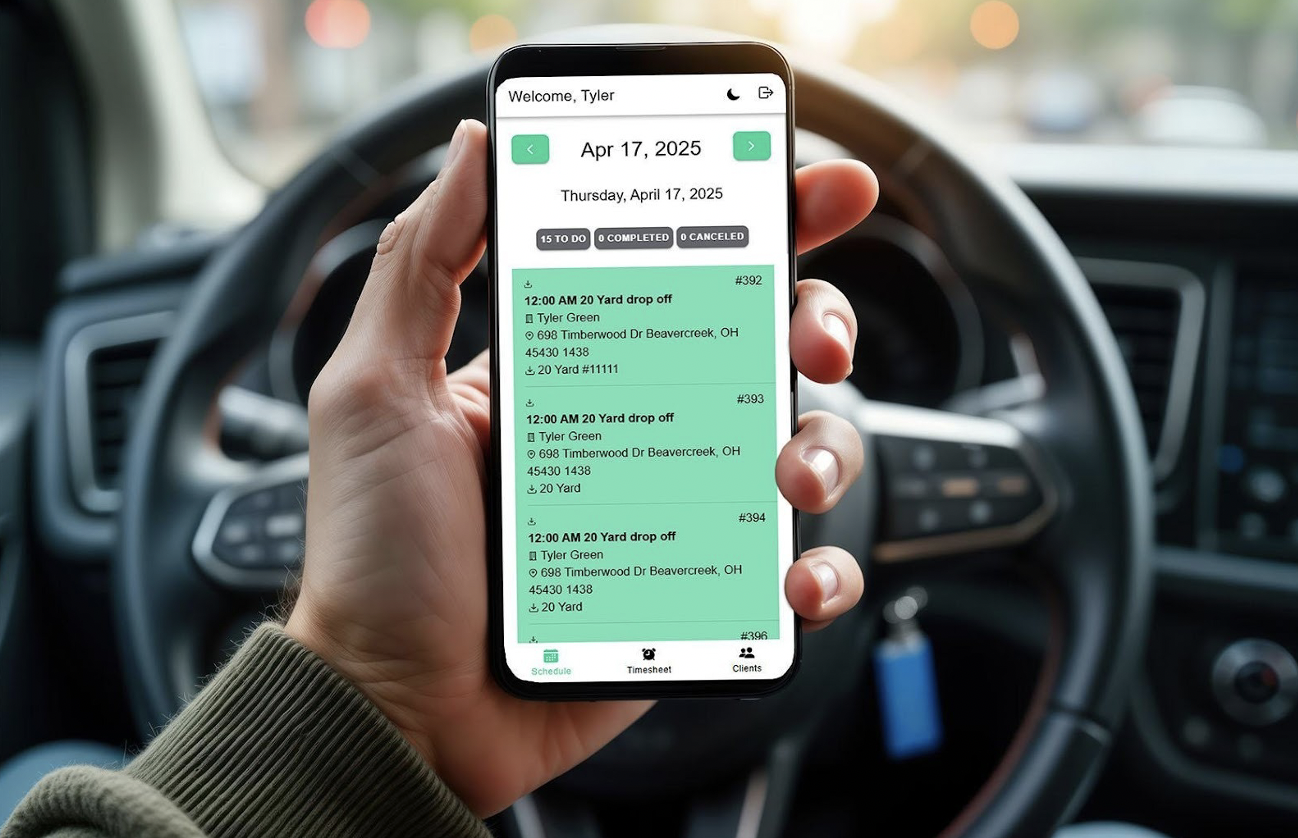
The Bin Boss driver interface is a study in minimalism. It strips away every non-essential pixel. The "10-Second Rule" ensures that no task—arrival, drop-off, photo capture, signature—takes longer than ten seconds to execute. This isn't about making the app "easy"; it's about making compliance the path of least resistance. By removing the friction, Atkinson has achieved near-100% data compliance in fleets that previously struggled to get drivers to even open an email.
The Pivot to "Profit Assurance"
For decades, the metric for success in hauling was volume. "How many cans are on the street?" But in a tightening economy, the metric has shifted to margin. "How much profit is in each can?"
This is where Atkinson’s "Operator" brain shines brightest. He knows that the leaks in a dumpster business are small but deadly: the 1.5 tons of unbilled overage, the three days of unpaid rental extension, the wasted fuel from a bad route.
The software functions as an automated "Profit Assurance" engine. It doesn't just track the bin; it tracks the contract. When a scale ticket is entered, the system instantly audits it against the customer’s allowance and queues the overage charge. It tracks rental durations with a stopwatch, triggering daily fees the moment a contract expires. This automated vigilance is recovering thousands of dollars in "lost" revenue for haulers every month, fundamentally changing the unit economics of the business.
The waste management industry is at an inflection point. The era of the "Generic Tech Giant" is ending. Haulers are waking up to the fact that they don't need more "features"; they need more understanding. They need tools that respect the mud, the weight, and the urgency of their work.
Todd Atkinson represents the arrival of the "New Guard"—a generation of tech CEOs who are blue-collar first and white-collar second. His rise signals a warning to the rest of the software industry: stop building for the boardroom and start building for the trench. Because if you don't, the operators will build it themselves, and they will do it better.
For the independent hauler looking at the road ahead, the choice is no longer between "tech" and "no tech." It is between software built by a tourist, and software built by a native. And in this industry, the native wins every time.







