
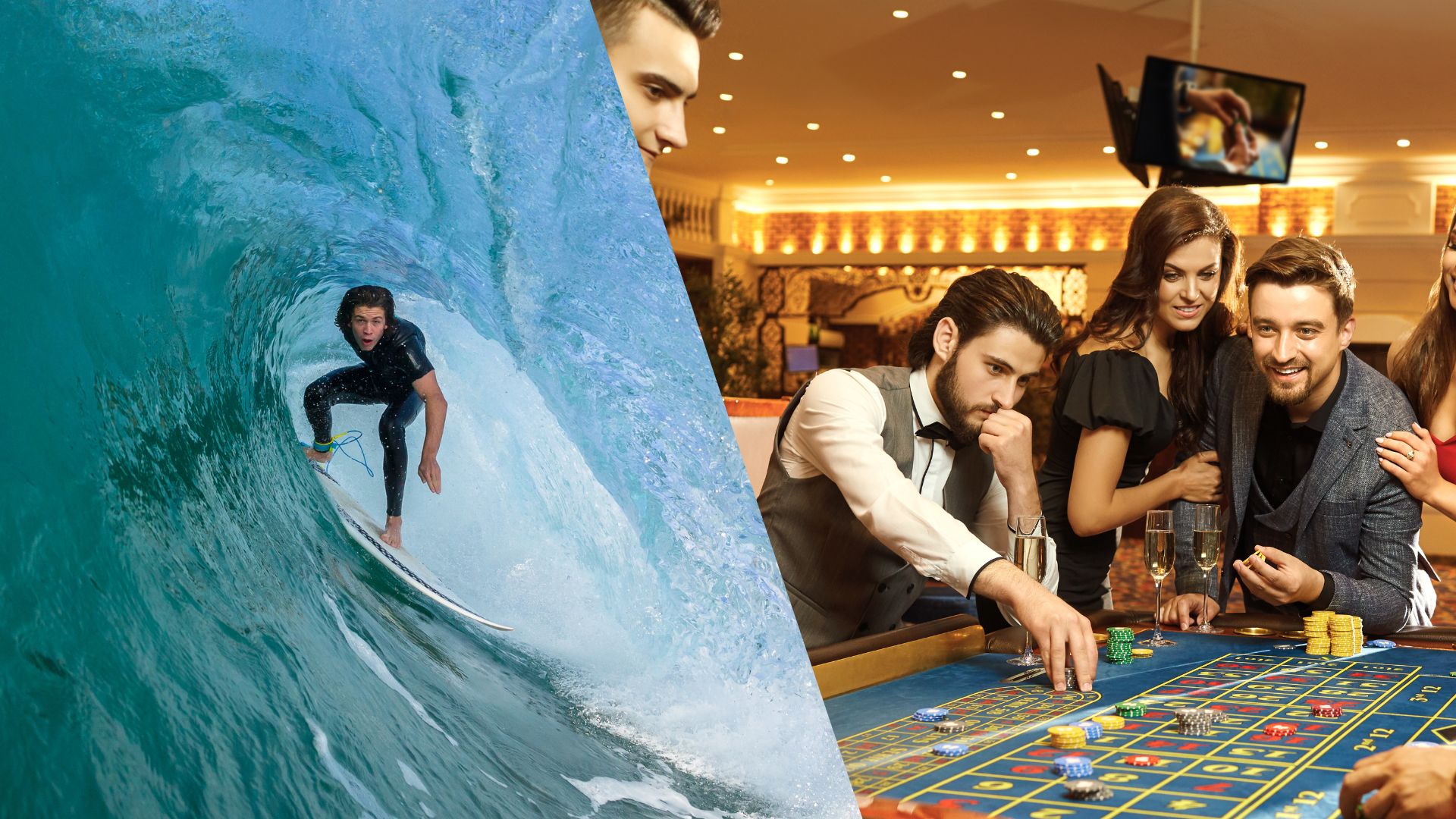
From years of observing player behavior across casino platforms and reviewing how moments of heightened engagement are framed in both digital and physical environments, one pattern appears consistently. The sensations that drive people toward high-arousal activities often look similar on the surface, even when the activities themselves are very different. Few comparisons illustrate this better than big-wave surfing and high-stakes live dealer play.
At first glance, paddling into a heavy swell and taking a seat at a live online casino table seem worlds apart. One happens in cold water under an open sky. The other unfolds on a screen, framed by cards, chips, and a live human dealer. Yet both experiences draw from the same neurological machinery. Uncertainty, and anticipation combine to create a powerful internal response that many people describe simply as the thrill.
Both surfing and high-stakes gambling activate the brain’s threat and reward systems. When a surfer commits to a fast-moving wave, the brain detects danger and potential reward at the same time. Adrenaline sharpens focus. Dopamine spikes during anticipation. Endorphins soften pain and heighten sensation.
The same chemical pattern appears when a player sits down at a live online casino table with meaningful stakes. Before a card is dealt or a wheel spins, anticipation alone can trigger dopamine release. The brain is responding to uncertainty itself.
Industry observation shows that thrill-seekers often have dopamine systems that respond strongly to novelty. For some, this makes uncertainty stimulating rather than stressful. This helps explain why certain players are drawn to high-stakes live dealer formats while others disengage quickly.
Surfing places risk directly into the body. Balance, breath, muscle memory, and timing all matter. Mistakes have immediate physical consequences, which encourages preparation and restraint over time. Experienced surfers do not chase danger blindly. They invest years developing skills that allow them to manage uncertainty. High performers tend to show strong emotional regulation and patience rather than impulsivity.
Surfing also produces flow states. These occur when challenge and skill align. Clear goals, immediate feedback, and physical engagement create periods of deep focus that end naturally through fatigue or changing conditions.
High-stakes live dealer environments compress a lot into one place: financial commitment, decision-making, and social visibility. There is no physical room involved, but the psychological intensity can still be real, especially when every decision is visible and tied directly to money.
Live formats are built to hold attention. Rounds move continuously, human interaction is constant, and subtle environmental cues keep engagement elevated. That structure works, particularly at higher stakes. At the same time, those conditions can magnify cognitive biases. Loss aversion, overconfidence, and emotional responses to short-term outcomes start to creep in, and without clear limits, deliberate play can slowly slide into reactive behaviour.
Concrete patterns appear when comparing how individuals engage with these activities. One example involves a recreational surfer who plans sessions around conditions, energy levels, and recovery. Risk is acknowledged, but bounded by preparation and exit points.
A parallel example appears in live dealer play. A player using a platform like Spinbet may decide in advance how long to stay at a table and what level of exposure feels acceptable. The structure of a live online casino allows for such planning, but only if the player actively applies it.
In contrast, unstructured engagement can lead to extended sessions driven more by anticipation than intention.
In both surfing and gambling, flow states emerge when attention narrows and time perception shifts. The difference lies in how each activity signals boundaries and enforces limits. While the experience may feel similar on the surface, their underlying structures guide behaviour in very different ways over time.
Informational comparison table
Dimension | Surfing | High-Stakes Live Dealer |
Risk location | Physical body | Financial and cognitive |
Flow duration | Intermittent | Potentially continuous |
Feedback type | Sensory and physical | Visual and numerical |
Natural stopping points | High | Low |
Long-term effects | Fitness and resilience | Depends on structure and limits |
Gambling involves financial uncertainty. Outcomes are never guaranteed, and funds used in casino activity may not be recoverable. Players should approach live online casino participation with moderation, clear limits, and with money they can afford to spend without impacting their financial stability.
From an expert evaluation standpoint, the thrill itself is not the problem. The structure around it determines whether it supports growth or creates strain. Surfing channels risk into embodied skill and natural limits. High-stakes live dealer play channels it into financial decision-making that requires conscious boundaries. Understanding this distinction helps explain why one high often feels grounding, while the other demands greater awareness to remain sustainable.







