When players ask what casino game has the best odds, they are often searching for a shortcut to winning more consistently. The idea sounds simple: better odds should mean a better chance to win, right? In reality, casino odds are more nuanced than most players realize.
In casino games, odds describe the mathematical relationship between wagers and long-term outcomes, not guaranteed results in a single session. You can experience multiple winning rounds in a game with poor odds, just as you can lose several times in a game with strong odds. This difference between odds and actual outcomes is where confusion begins.
Many players misunderstand “best chances” because they focus on short-term winning streaks rather than long-term probability. A game might feel favorable because you win early, even if the odds say otherwise. Conversely, a game with excellent odds may feel frustrating if results don’t align immediately.
This guide approaches odds responsibly by comparing casino games based on structure, rules, and decision depth—rather than promising unrealistic paths to winning. Understanding odds doesn’t remove risk, but it helps players choose games aligned with their comfort level, patience, and expectations.
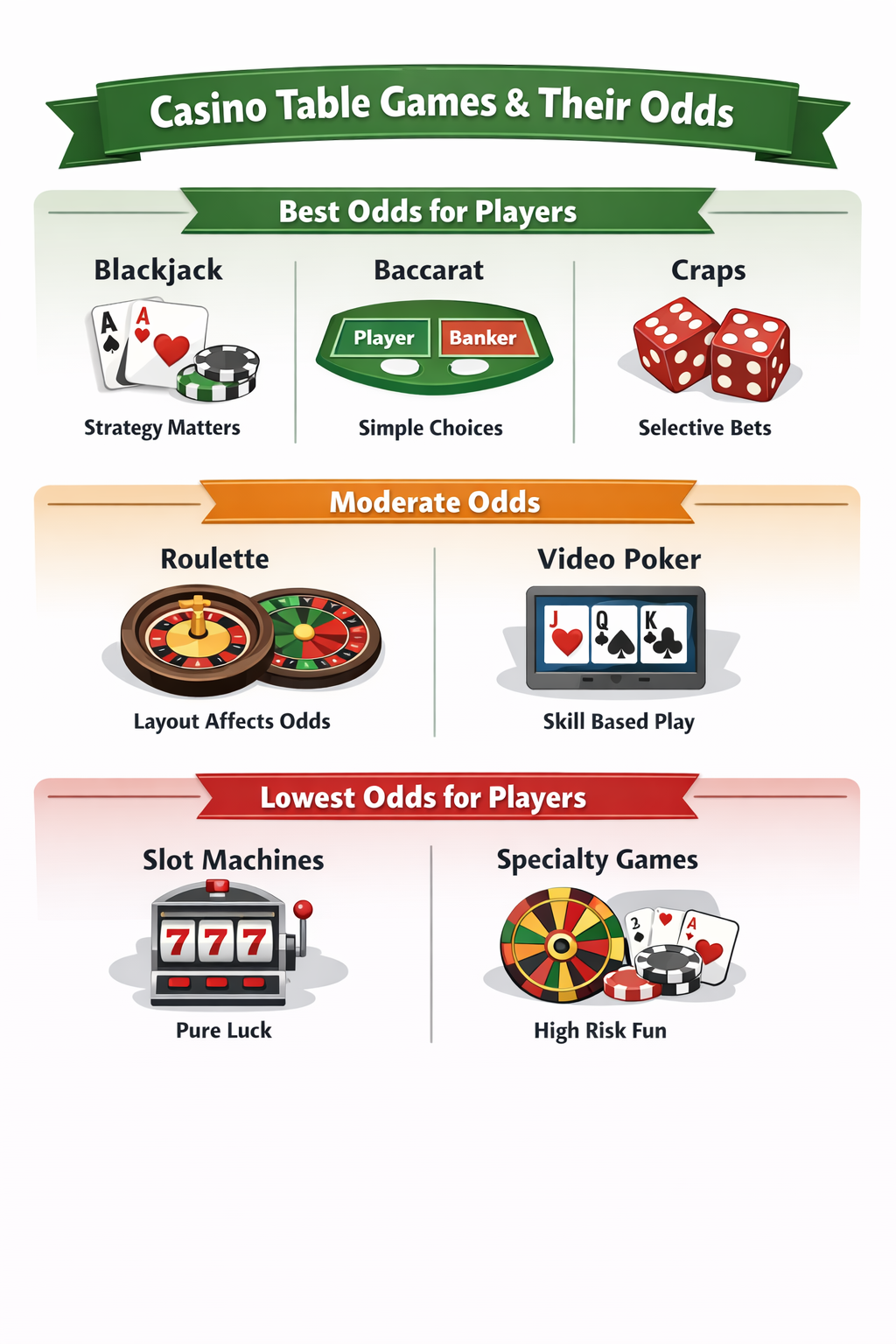
Casino Table Games With the Best Odds for Players
Table games often provide the most transparent odds in a casino environment. Their rules are fixed, outcomes are clearly defined, and player decisions can influence results.
Blackjack is frequently cited when discussing what casino game has the best odds because its structure allows informed decisions to affect outcomes. The odds are shaped by how players respond to visible information rather than blind chance alone.
The depth of decision-making matters here. Each choice—hit, stand, or double—impacts the likelihood of winning over time. This doesn’t guarantee a win, but it narrows the gap between player and casino.
Because rules are consistent, blackjack rewards familiarity more than intuition. Players who understand the framework experience steadier odds compared to purely chance-based games.
Baccarat offers one of the cleanest rule sets in casino games. The limited decision scope keeps odds stable and predictable, which appeals to players who prefer minimal complexity.
The game’s flow is fixed, meaning outcomes rely on predefined rules rather than constant player input. This predictability helps players better understand long-term odds without needing advanced strategies.
Because baccarat removes many decision points, players are less likely to mismanage odds through impulsive choices, making winning patterns easier to evaluate realistically.
Craps is unique among casino games because it contains multiple bets with vastly different odds. Some wagers offer reasonable probability, while others strongly favor the casino.
This variety is why confusion is common. New players often assume all bets share similar odds, which isn’t true. Selecting specific bets dramatically changes the chance to win.
When approached carefully, craps allows players to focus on options with more balanced odds, though the fast pace can distract from disciplined play.
Not all casino games fall neatly into “best” or “worst.” Some offer middle-ground odds that balance entertainment with probability.
Roulette’s odds depend heavily on its layout. European versions differ structurally from American ones, which directly affects the likelihood of winning.
The number of pockets on the wheel changes how often players can win relative to the casino advantage. This makes layout awareness essential when choosing roulette games.
Roulette remains popular because its mechanics are simple, even if the odds aren’t always optimal.
Video poker sits between skill-based and automated casino games. The rules are fixed, but player choices still influence outcomes.
The challenge lies in execution. Understanding which decisions improve odds is different from consistently applying them under pressure. Many players know the theory but struggle in practice, which affects long-term winning.
For those seeking structured play without table interaction, video poker offers moderate odds with clear feedback.
Some games prioritize entertainment over probability. While they can still deliver exciting winning moments, their odds are typically less favorable.
Slots are designed as outcome-only casino games. Players have no influence once the spin begins, and results are determined entirely by internal systems.
This lack of control is why odds feel unpredictable. Even frequent small wins don’t change the underlying probability structure.
Slots remain popular due to accessibility and visual appeal, but they rank low when evaluating what casino game has the best odds.
Specialty casino games and side bets emphasize novelty and excitement. These options often include higher built-in costs that reduce the chance to win consistently.
Because they are entertainment-first, odds take a back seat to presentation. Players may enjoy short-term winning bursts, but long-term outcomes favor the casino.
Understanding this trade-off helps players set realistic expectations.
Odds alone don’t determine enjoyment or suitability. Different players thrive in different environments.
Some casino games demand higher cognitive effort. Decision-heavy formats can improve odds but also increase mental fatigue.
If a player feels overwhelmed, mistakes can erase any theoretical advantage. Comfort and familiarity often matter more than chasing the absolute best odds.
For beginners, starting with the easiest casino games can build confidence before moving into more complex options.
Fast-paced games create more outcomes per hour, which affects how quickly odds play out. Slower games allow more reflection and control.
Session length, emotional state, and pacing all influence winning patterns. A game with strong odds may still feel frustrating if played too quickly.
Choosing the right pace can be as important as choosing the right casino game.
Understanding odds helps only if players avoid common errors.
Odds describe probability, not certainty. Even the best-structured casino games cannot promise consistent winning.
Misusing probability leads to unrealistic expectations and unnecessary frustration.
Complex games demand sustained focus. Decision fatigue causes errors that shift odds back toward the casino.
Players often underestimate how mental strain affects performance over time.
Constantly changing games disrupts learning and familiarity. Each switch resets understanding of odds and flow.
Sticking with one game long enough to understand its rhythm improves confidence and discipline. This is especially important when experimenting with free money games, where learning matters more than immediate results.
Put knowledge into action at Twinqo — a casino built for players who care about odds, transparency, and control. With clearly structured table games, smooth gameplay, and crypto-friendly deposits, Twinqo lets you focus on games where decisions actually matter.
Whether you’re starting with the easy games, testing strategies with free money games with no deposit, or playing for real wins, Twinqo gives you a smarter environment to play responsibly.
Play at Twinqo and choose games where better odds meet better gameplay.
Casino table games such as blackjack and baccarat generally offer better odds because their rules and decision structures reduce the casino’s built-in advantage compared to outcome-only games like slots.
No. Better odds mean the long-term cost of playing is lower, not that wins are more frequent or guaranteed in short sessions.
Table games often include player decisions and fixed rules that limit variability, while slots are entirely outcome-driven and designed for entertainment rather than probability efficiency.
Slots typically have lower odds compared to table games, but they offer simplicity, speed, and accessibility that some players prefer despite the higher built-in cost.
Skill can help you use a game’s structure correctly, but it cannot remove the casino’s advantage or predict outcomes.
In most cases, yes. The same game with the same rules usually has the same odds regardless of whether it’s played online or in a physical casino.
Differences in roulette layouts—such as the number of zero pockets—change the game’s structure and directly affect the casino’s advantage.
No. Casino odds are built into the game’s design and are fixed before play begins. Licensed casinos cannot change odds during play because games are regulated, audited, and based on preset mathematics.
Randomness affects short-term results. Even games with favorable structures can produce losing sessions due to variance.
Chasing odds without understanding how a game works often leads to confusion and frustration rather than better outcomes.
Yes. Side bets are typically designed for entertainment and variety, not probability efficiency, and often carry a higher built-in cost.
Yes. Odds are game-based, not player-based. Individual results vary, but the structure is the same for everyone.
Odds are often discussed without context, leading players to confuse probability with short-term outcomes.
No. Speed affects how quickly results occur, not the underlying probability of outcomes.
Odds should be used to understand how games behave over time, not to predict wins or guide risky decisions.
Often yes. Games with better odds usually involve more rules or decisions, which can require additional learning compared to simpler, outcome-only games.
Some players value simplicity, faster gameplay, or entertainment over probability efficiency. Lower-odds games can still feel more enjoyable depending on personal preference.
Slower-paced games can make it easier to understand decisions and outcomes, but they do not change the underlying odds or guarantee better results.
No. Changing bet size affects potential win or loss amounts, but it does not alter the game’s built-in odds.
No. The “best” game depends on comfort level, understanding, and play style. Odds are only one factor in choosing a suitable casino game.