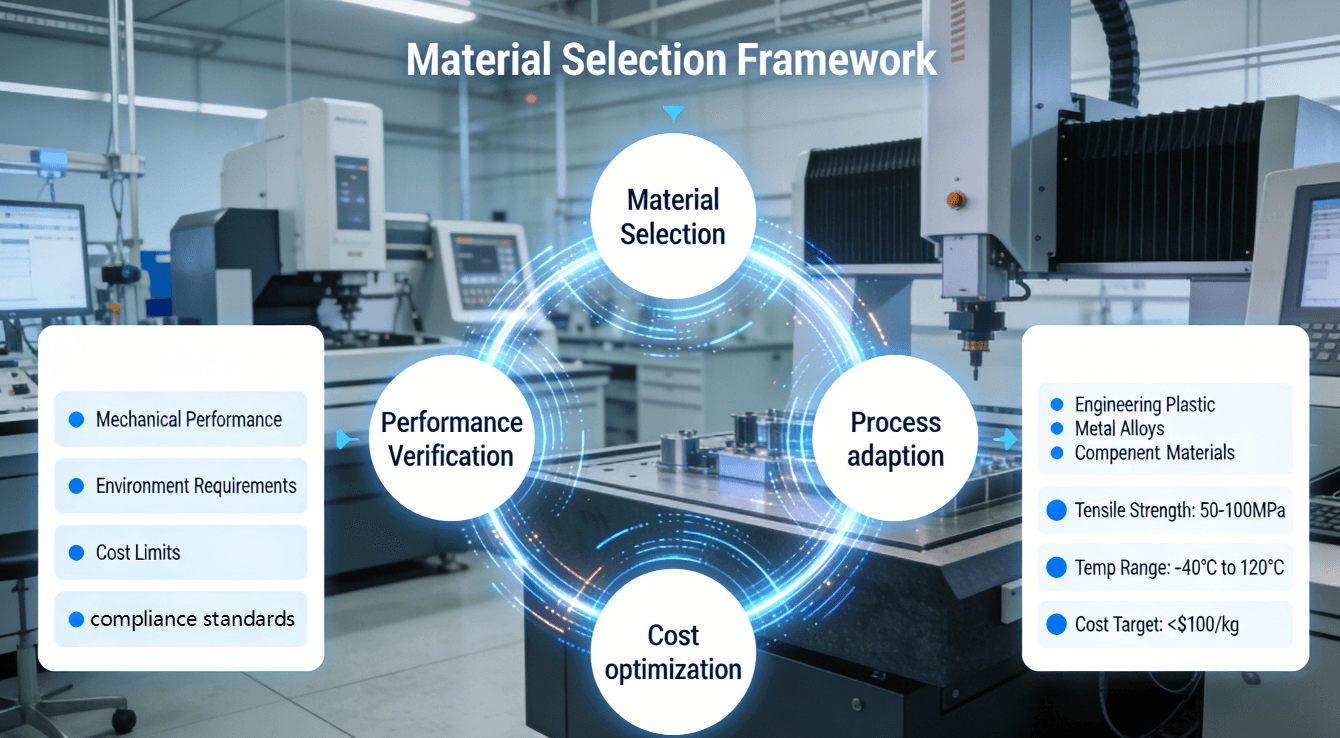
In modern product development, engineers and project managers working on complex prototypes frequently face a critical dilemma: material selection. Choosing the wrong material can lead to functional test failures, significant project delays, and expensive redesigns — costs that are difficult to absorb in today's fast-paced, efficiency-driven environment. The root cause lies in the inability of traditional material databases to keep up with the rapid development of new materials and composites, coupled with a lack of systematic guidance for multi-physics, complex applications. Relying on intuition or outdated information for these decisions carries substantial risk.
This article provides a systematic selection framework grounded in materials science and empirical data. It will guide you through a step-by-step process of evaluating mechanical performance, environmental resistance, process compatibility, and cost to make optimized material decisions for your most challenging projects. The following sections will explore the key dimensions that constitute this scientific methodology.
Before diving into material selection, it's crucial to define "complexity." This extends far beyond intricate geometries. True complexity arises from multifaceted requirements, such as assemblies where components have conflicting functional needs — one part requiring high strength while another needs flexible damping. It also includes prototypes destined for extreme operating environments, like sustained high temperatures or exposure to corrosive chemicals, and those that must comply with stringent industry regulations in sectors like medical or aerospace. Understanding this broad definition is the first step in appreciating why a standard material datasheet is insufficient.
A "complex" prototype often integrates multiple functions into a single assembly. For instance, a drone housing must be lightweight for flight efficiency but rigid enough to protect sensitive electronics and withstand impact. This creates a conflict between density and stiffness/toughness. The material selection process must therefore balance competing properties, often necessitating a compromise or a creative solution like using a composite material or a strategic design that isolates stresses.
Many advanced prototypes are tested under conditions that push materials to their limits. A component for an under-the-hood automotive application must resist heat aging and chemical exposure to fuels and oils. A medical implant trial part must demonstrate biocompatibility and sterilization resistance. In these cases, the material's long-term stability under specific stressors is more critical than its peak mechanical properties in a benign lab environment.
Projects in regulated industries add a layer of compliance complexity. Materials must not only perform well but also be traceable and manufactured under quality systems that meet standards like ISO 13485 (medical devices) or AS9100 (aerospace). This necessitates selecting materials from suppliers who can provide full material traceability and certification, turning the selection process into a crucial risk mitigation exercise.
The cornerstone of scientific material selection is a clear understanding of the prototype's mechanical demands. This goes beyond simply selecting a material with a high tensile strength; it requires a nuanced analysis of how the material will behave under real-world loading conditions throughout its expected life.
Selecting materials for harsh environments requires a specialized strategy focused on long-term stability and resistance. The wrong choice can lead to premature failure, rendering prototype testing invalid and misleading the entire development effort.
A material's melting point is a poor indicator of its high-temperature usability. More relevant metrics include the Heat Deflection Temperature (HDT), which measures stiffness under load at elevated temperatures, and the Continuous Service Temperature, which indicates the long-term aging resistance. A material may soften and lose its load-bearing capacity well below its melting point, making these values critical for selection.
There is no universally "chemical-resistant" material. Resistance is highly specific to the chemical agent, its concentration, temperature, and exposure time. Engineering plastics like PEEK and PPS offer excellent resistance to a wide range of chemicals and are often the choice for demanding prototype applications in chemical processing or oil and gas. A thorough review of chemical resistance charts for the specific media involved is non-negotiable.
High-performance materials like PEEK or specialty alloys come at a premium cost. The key is to justify this cost through risk mitigation. For prototypes that must validate function in extreme conditions, using a cost-effective but inadequate material is a false economy. The investment in the correct advanced material is justified by the value of obtaining accurate, reliable test data that prevents costly failures downstream. For projects requiring validation in severe conditions, environmental simulation testing is an integral part of the selection process for custom rapid prototyping services.
The chosen prototyping process imposes fundamental constraints and opportunities on material selection. A brilliant material choice on paper is worthless if it cannot be effectively processed into a high-quality prototype part.
Processes like Fused Deposition Modeling (FDM) produce parts with anisotropic material properties, meaning strength is much higher along the direction of the printed layers than between them. Selective Laser Sintering (SLS) or MultiJet Fusion (MJF) exhibit less anisotropy. This must be accounted for in the design and orientation of the part on the build plate. Ignoring anisotropy can lead to unexpected failures under load.
In contrast to 3D printing, CNC machining from solid stock delivers isotropic material properties because the part is cut from a homogenous block of material. This means the strength is uniform in all directions, providing performance predictability that is essential for functional testing of highly stressed components. This makes CNC the preferred process when prototype performance must closely mirror that of a final production part machined from the same material.
The integration of design, material, and process — often called Design for Manufacturability (DfM) — is paramount. The selected material must be suitable for the chosen process. For example, a material ideal for injection molding may not be available for your specific 3D printing technology. Engaging in early DfM analysis ensures the selected material can be processed effectively to achieve the desired performance, avoiding dead-ends and redesigns.
Even with a good framework, practitioners can fall into common traps. Awareness of these pitfalls is the first step toward avoiding them.
A common error is testing a prototype immediately after production without considering how it will age. Materials can absorb moisture, which plasticizes some polymers and weakens others. Exposure to UV light can cause embrittlement. For accurate validation, prototypes should be conditioned to simulate their end-use environment before critical testing.
It is often impractical and expensive to use the exact production material for a prototype. The key is to achieve functional equivalence for the test's goals. A prototype for fit-checking can use a different, cheaper material than one for crash testing. The trap is assuming a prototype material will behave identically to the production material without understanding the differences induced by the prototyping process itself.
Selecting a material that is "over-spec" for the application needlessly inflates prototype costs. Conversely, in regulated industries, the pitfall of ignoring compliance can be catastrophic. Ensuring materials meet the requirements of standards like ISO 13485 or IATF 16949 is central to mitigating compliance risk. A rigorous qualification process is essential.
Achieving the best performance without breaking the budget requires a pragmatic, strategic approach focused on the total cost of the prototyping phase, not just the price per kilogram of material.
Selecting the right material for a complex prototype is a multifaceted, systematic process that demands a deep understanding of project requirements, materials science, manufacturing processes, and cost drivers. By adopting a structured selection guide that moves beyond datasheet numbers to consider real-world performance, environmental factors, and process implications, engineers can significantly de-risk projects, accelerate development cycles, and lay a solid foundation for product success. A scientific approach to material selection is not an obstacle but a powerful accelerator.
Q1: What is the most common mistake engineers make when selecting materials for a functional prototype?
A: The top error is over-relying on datasheet values while ignoring manufacturing process impacts. For example, FDM-printed Nylon exhibits anisotropic strength despite high bulk tensile data. Always validate properties through functional testing to avoid failures.
Q2: How critical is it for the prototype material to exactly match the final production material?
A: An exact match is ideal but often impractical. Focus on achieving functional equivalence for testing goals—like mimicking fatigue curves if durability is critical. This ensures prototype validity without unnecessary cost overheads.
Q3: Can you briefly explain "anisotropy" in the context of 3D-printed prototypes?
A: Anisotropy means material properties vary by direction. In FDM printing, layers create weak points between deposits, reducing strength vertically. Processes like SLS reduce this issue, while CNC machining offers uniform isotropic properties.
Q4: When is it justified to use high-cost, advanced materials like PEEK or PEI for a prototype?
A: Justification arises for extreme conditions: high temperatures, chemical exposure, or need for mechanical stability. The cost is offset by risk mitigation, ensuring test data accurately reflects real-world performance.
Q5: What information should I prepare to get an accurate and rapid quote for a complex prototyping project?
A: Provide: 1) Detailed 3D CAD models (STEP/IGES); 2) Project objectives and key requirements; 3) Quantity, timeline, and compliance standards. Comprehensive data speeds up quotes and reduces revisions.
The author is a precision manufacturing expert at LS Manufacturing, a company that helps engineers and researchers solve complex part challenges in aerospace, medical, and automotive industries. With certifications such as IATF 16949 and AS9100D, the team ensures high-quality solutions through advanced technologies. For more insights, contact them today for a free, no-obligation project review and DFM analysis. Turn your concept into a cost-effective reality.