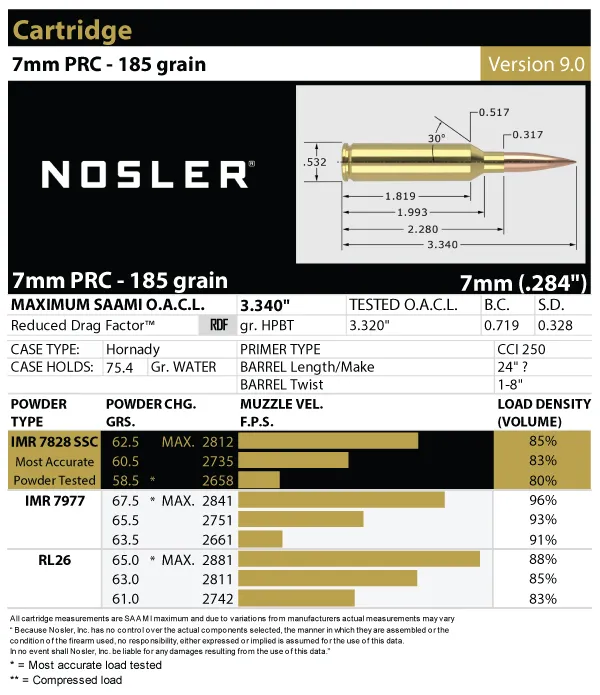
If shooting is your hobby, eventually you'll find yourself looking at reloading supplies and ammunition, because once the desire for accuracy sets in, it's only a matter of time before you're using hand-rolled ammo. It turns shooting from just something cool you do into a science, so you can make ammunition that works best for your gun. Yet the other crucial element separating a sub-MOA group from a wasted range day is your data.
Nosler Reloading Data has been a beacon of trust for reloaders for as long as there has been reloading data. From designing competition rounds for long-range shooting to gearing up for an elk hunt, reliable data is your blueprint to victory. It takes the guesswork out of the equation, giving you a safe, tested basis to build your ideal load on. Learning how to use this information properly can take your reloading from virgin assembly line to world-class precision.
A data chart can appear like a jumbled spreadsheet of numbers and abbreviations to a novice reloader. Understanding these charts is crucial, but there's still more to learn before you can truly unleash the full potential of your gun.
Nosler data usually falls into a few main categories:
It takes an eye — quite a careful one — to read these tables. The powder charge is the most important column here. Nosler lists the most accurate powder load for that particular bullet, marked by an asterisk. For us reloaders, this is a massive shortcut because you can focus your time on a powder you know produces tight groups.
Also, note the barrel length being tested. If the test barrel was 24 inches and you are shooting a 20-inch carbine, your velocities will be lower than the listed values. Realizing all these intricacies means you go into turning a bullet into a case knowing exactly what to expect, long before you even turn a bullet into a case.
Who wants to follow the owner's manual when they could simply ask a dude in the range what he shoots? That is the key to consistency, safety, and efficiency.
Nosler is known for premium bullets, and their data certainly supports that commitment to precision. The only way to find an "accuracy node,"—a specific velocity at which your barrel harmonics stabilize the bullet exactly—is by following their load density and powder suggestions, and you are far more likely to hit that perfect velocity. With verified data, you will know that your results are replicated batch after batch.
This is the one part of reloading that is not up for negotiation. Nosler has given their data, and it is always safe pressure data. They have subjected loads in the lab to the point of failure to ensure you do not have to at the workbench. Following their maximum load warnings saves the shooter and the gun from disastrous over-pressure failures.
Components are not cheap. The cost of each primer, powder, and premium projectile quickly adds up. Using Nosler’s "most accurate powder" and starting loads minimizes the trial-and-error component. It arrives at a usable, correct load more quickly, leaving you with more ammunition for real shooting.
Pick a winner: No longer confined to a single grease-stained book on the workbench, reloaders today have a veritable library of options. These days, you have various ways to find this vital information.
The traditional Nosler Reloading Guide is relatively commonplace on benches everywhere, offering not just data but also an instructional guide and ballistics essays. Also, now Nosler has a digital searchable copy of this database that they update with new bullet lines and powder releases.
If you want more than a static chart, digital tools offer a dynamic experience for the contemporary reloader. Convenient software like QuickLOAD PRO has changed the way we view load development.
QuickLOAD PRO is a professional-level web application for calculating internal ballistics for virtually any combination of parameters. It's still a standalone tool, but its extensive bullet database lets you build entire recipes from thousands of components, including Nosler bullets!
QuickLOAD PRO is unlike a lifeless user manual that will only teach you things by rote:
It gives you a "measure twice, cut once" capability, combining the best of both worlds: a tool like QuickLOAD PRO and the official Nosler data. You can compare the loads the manual tested together with the software simulations to judge how a given load may perform at your barrel length or in your environmental conditions.
It's one thing to have the data, and a completely different beast to use it correctly. Here are three tricks to help you get the most from your Nosler data.
Do not go straight to the maximum charge shown in the data. Variations in chamber dimensions, brass thickness, and primer lots increase pressure. It is customary to determine from the bottom up (or 10% below the max if no min above exists) and add your charge in small increments.
On the data sheet, work your way up the chart; your rifle will let you know if you are overpressuring. Look for flattened primers, ejector markings on the case head, and a sticky bolt lift. These are indications that whatever the manual says about safe levels of pressure is gone well and truly out of the window. If you witness any of these signs, immediately stop and reduce your charging weight.
There is no point in having data if you cannot remember it. Maintain an accurate logbook for each batch loaded. Document your Nosler data-cooking method, the components, the atmospheric conditions on range day, and the group sizes. This log evolves into your unique reloading guide, customized for your specific collection of firearms.
Well, that depends, because every manufacturer uses different alloys, jacket thicknesses, and bearing surface lengths. Nosler’s data was tailored to the friction and pressure curves generated by its proprietary designs, such as the Partition, AccuBond, and Ballistic Tip. Type of ammunition: A premium bullet may be based on generic data; however, it may not yield high accuracy or may generate unexpected pressure spikes.
2. Nosler Manual: What does M.A.L.T. (Most Accurate Load Tested) mean?
In their load data, Nosler techs emphasize the powder and charge weight, which yielded the smallest groups when tested at the company's laboratories. Although all rifles are law unto themselves, they provide a statistically proven baseline to start from, which will save you time and components during the development of your load.
What does Nosler mean by internal volume of the cartridge case (grains of water)? This is important because it is used to calculate the Load Density. Most loads that make up 80% to 95% of the case (high load density) yield more representative ignition and lower velocity standard deviation , which means greater accuracy at long range.
Why is the inertia the same for two bullets with different exteriors? Answer: The exterior forms of the bullets differ, but two identical 180-grain bullets don't have the same inertia even if they weigh the same. The Partition has a dual-core head with a copper bridge, while the AccuBond is a bonded-core, boat-tail design. Such divergences alter the degree to which the bullet is in contact with the rifling (bearing surface), which is a direct influence on pressure. Be sure to use the information for the specific data for the exact bullet model you are seating.
This is a safety floor, typically 10% below the maximum, that compensates for the slight variations between individual rifles: You should always start here and "work up" by small amounts. Maximum Load: The top number attained in test barrels for Nosler's; if pressure signs (flattened primers, sticky bolt lift) are observed before reaching this figure, you must stop and reduce the charge.
Reloading is a process of refinement. Whether you are after tighter groups or just want to take a little pride in hunting with your own ammo, GIGO applies here, too.
Using dependable information sources such as Nosler Reloading Data and then building on that foundation with contemporary tools such as QuickLOAD PRO are significant steps towards ensuring every trigger pull is reliable, consistent, and on target. It converts the reloading bench from a workbench into a laboratory of possibilities.