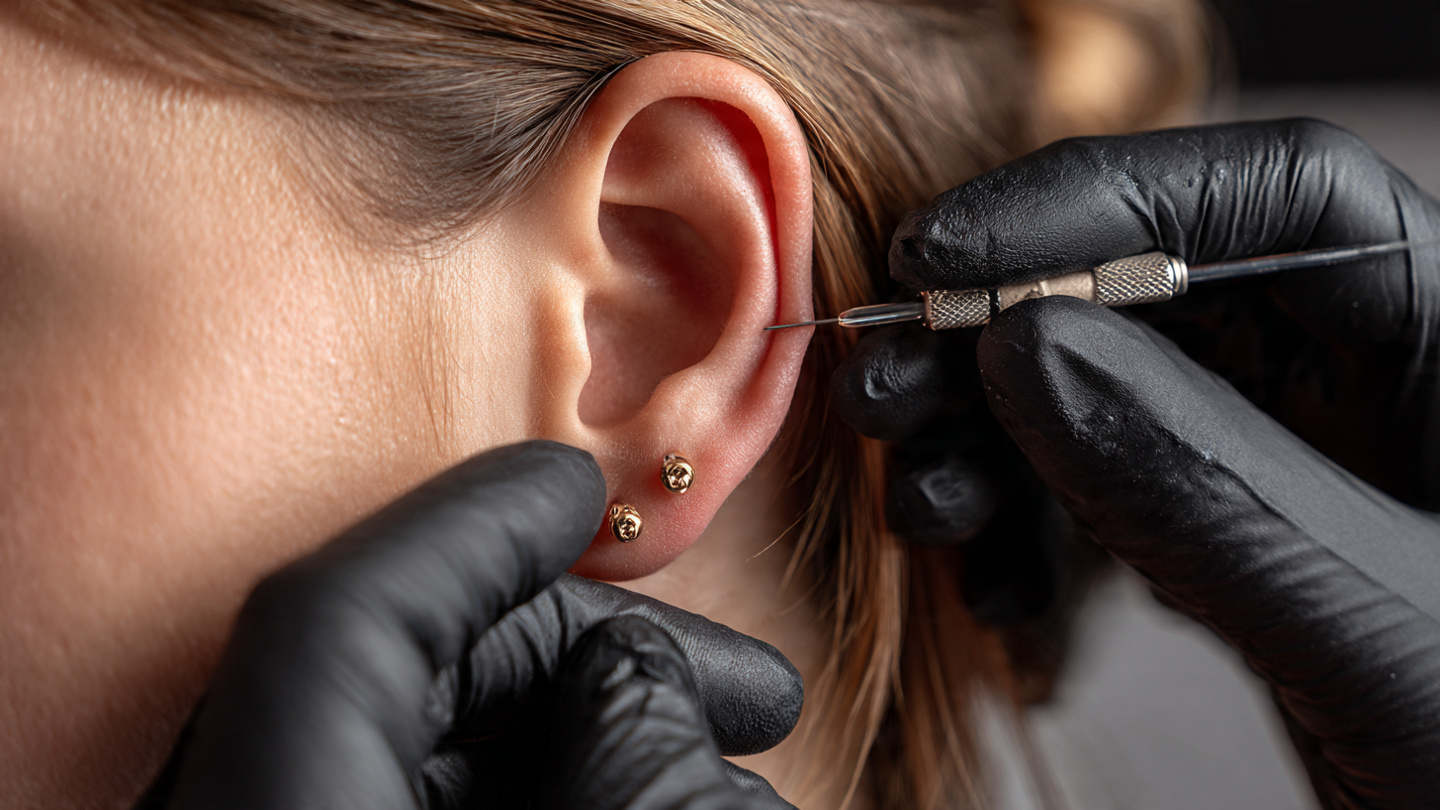
Achieving a perfectly straight piercing is not simply an aesthetic goal. It is a technical and biological objective that directly affects healing speed, scar formation, drainage efficiency, and long-term jewelry alignment. Among professional piercers, one of the most underestimated yet essential tools for maintaining needle accuracy is the cork backstop. When positioned correctly, cork stabilizes soft tissue, prevents needle deviation, and ensures a linear channel from entry to exit.
This article explores the mechanics behind straight piercings, the technical method of holding cork to prevent angular drift, and the health advantages of precise alignment. It also explains how professional cork piercing tools, such as those available from Obsidian Needles, support consistent clinical outcomes.
A straight piercing channel distributes mechanical stress evenly across surrounding tissue. When the entry and exit points are aligned on the same axis, the jewelry sits neutrally within the wound channel. Neutral positioning minimizes localized pressure, reduces friction during swelling, and allows oxygen to circulate evenly around the wound.
If a piercing is angled incorrectly, even by a few degrees, the jewelry will rest unevenly. One side of the channel will experience more compression than the other. This imbalance can lead to irritation bumps, prolonged inflammation, or migration over time. Crooked piercings often appear minor initially, but once swelling subsides, the misalignment becomes visually obvious.
Beyond aesthetics, straight alignment influences tissue remodeling. Symmetrical tension supports balanced collagen deposition, which lowers the risk of hypertrophic scarring.
Human tissue does not offer uniform resistance. When a needle penetrates skin, it encounters different densities across epidermis, dermis, and subcutaneous layers. Slight shifts in resistance can cause the needle tip to veer subtly off course. In soft tissue areas such as the earlobe or nostril, the tissue itself may move during insertion.
Without a firm backstop, the final stage of penetration is where deviation most commonly occurs. The needle exits with no opposing support, allowing angular drift. Even a minimal deviation of three to five degrees can create a visibly crooked channel once jewelry is inserted.
A cork backstop functions as a controlled resistance point. It provides a stable mechanical endpoint that maintains trajectory consistency throughout the insertion process.
Cork is not merely a protective barrier for the piercer’s fingers. Its role is structural. A properly positioned cork stabilizes the exit side of the tissue and absorbs the final force of penetration. Because cork is firm yet slightly compressible, it allows the needle to seat smoothly without rebound or deflection.
Unlike metal or rigid plastic surfaces, cork does not cause the needle to bounce or slide. Its density creates a subtle resistance that helps maintain a linear path. This resistance is especially important in soft or mobile tissue where slight movement can alter alignment.
Professional cork piercing supports are manufactured with consistent density to ensure predictable performance.
Precision begins before the needle touches the skin. Accurate marking of both entry and exit points establishes the intended axis. Once markings are confirmed, the cork must be positioned directly behind the exit mark and flush against the tissue surface.
The piercer should apply firm but balanced pressure. Excessive pressure compresses tissue and alters its natural contour, which can distort alignment. Insufficient pressure allows movement. The goal is stabilization without deformation.
As the needle advances, it should remain parallel to the predetermined channel. The tactile sensation of the needle contacting cork provides confirmation that the trajectory has been maintained. Controlled, steady advancement through the final millimeters prevents sudden thrusting that might shift the angle.
When executed correctly, the cork transforms from a passive surface into an active guidance tool.
From a physiological perspective, straight channels heal more efficiently. During the inflammatory phase, plasma and lymphatic fluid accumulate within the wound. A straight pathway allows these fluids to drain symmetrically from both ends. If the channel is angled, fluid may collect at compressed points, prolonging swelling.
Airflow also plays a role in wound recovery. Jewelry that sits evenly permits micro-circulation of air around the entry and exit sites. Uneven jewelry positioning can trap moisture, increasing bacterial proliferation risk.
Friction is another concern. When jewelry rests against one side of a crooked channel, micro-movements during daily activity create repeated mechanical irritation. This stimulation encourages prolonged collagen production and may result in raised tissue or chronic bumps.
In summary, alignment influences drainage, oxygen exposure, friction levels, and collagen regulation.
Soft tissue presents unique challenges. In areas such as the earlobe or lip, the tissue is pliable and mobile. During needle insertion, these areas can shift slightly unless stabilized. The cork acts as a counterforce, preventing the tissue from being pushed away by the advancing needle.
In nostril piercings, anatomical constraints add complexity. The internal nasal cavity provides limited space for maneuvering. Without a stable backstop, achieving an aligned exit point becomes more difficult. A cork provides predictable positioning even in confined anatomical regions.
Cartilage piercings, although firmer, can also benefit from controlled resistance at the exit point to ensure precision.
Jewelry amplifies any angular error introduced during piercing. A minor misalignment may appear subtle when swelling is present, but once healing progresses, gravity and tension reveal asymmetry more clearly. Studs may lean upward or downward, hoops may hang unevenly, and barbells may appear slanted.
Over time, uneven tension can contribute to migration. The body responds to persistent pressure by remodeling tissue. In severe cases, this may result in rejection.
Straight channels distribute mechanical forces evenly, preserving structural integrity and reducing long-term complications.
Precision piercing relies on controlled variables. Lighting, posture, anatomical assessment, and hand stability all contribute to accuracy. However, even perfect alignment planning can be compromised without a stable endpoint during penetration.
This is why professional piercers prioritize specialized tools. Cork piercing supports from Obsidian Needles are engineered specifically for piercing applications, offering consistent density and reliable resistance. Standard craft cork or improvised materials may vary in firmness and compromise accuracy.
Tool consistency enhances procedural consistency.
Even minimal angular errors can affect appearance and healing. Because jewelry is rigid, it magnifies small deviations in the channel. A five-degree angle difference at insertion can translate into noticeable visual tilt after healing.
The cork minimizes micro-angle drift during the most vulnerable stage of insertion, which is the final millimeters before exit. Controlled resistance prevents the needle tip from shifting laterally.
Precision is cumulative. Small corrections at each stage prevent larger errors later.
Efficient wound drainage is essential during early healing. Straight channels facilitate gravitational and capillary-assisted drainage of inflammatory exudate. When channels are angled improperly, fluid may stagnate at pressure points, prolonging swelling.
Oxygen availability is equally important. Oxygen supports cellular metabolism and bacterial defense mechanisms. Jewelry that rests evenly allows air to circulate naturally. Misaligned jewelry can create moisture traps that delay epithelial closure.
The connection between alignment and healing speed is therefore rooted in physiology, not merely aesthetics.
Professional piercers carry responsibility for both visual and biological outcomes. Clients may focus primarily on symmetry, but long-term tissue health depends on technique quality. The cork backstop represents a small yet critical component of that technique.
Precision does not rely on guesswork. It relies on mechanical control, anatomical awareness, and appropriate tools. The cork serves as the final safeguard against trajectory deviation.
A straight piercing is the result of deliberate biomechanical control rather than chance. The cork backstop plays a central role in guiding needle trajectory, stabilizing tissue, and preventing angular deviation. By ensuring symmetrical channels, it supports proper drainage, balanced oxygen exposure, reduced friction, and controlled collagen remodeling.
For professionals seeking consistent alignment and optimal healing outcomes, high-quality cork piercing tools such as those available at Obsidian Needles provide reliable structural support.
In precision piercing, alignment is both an art and a science. The cork is where those disciplines intersect.