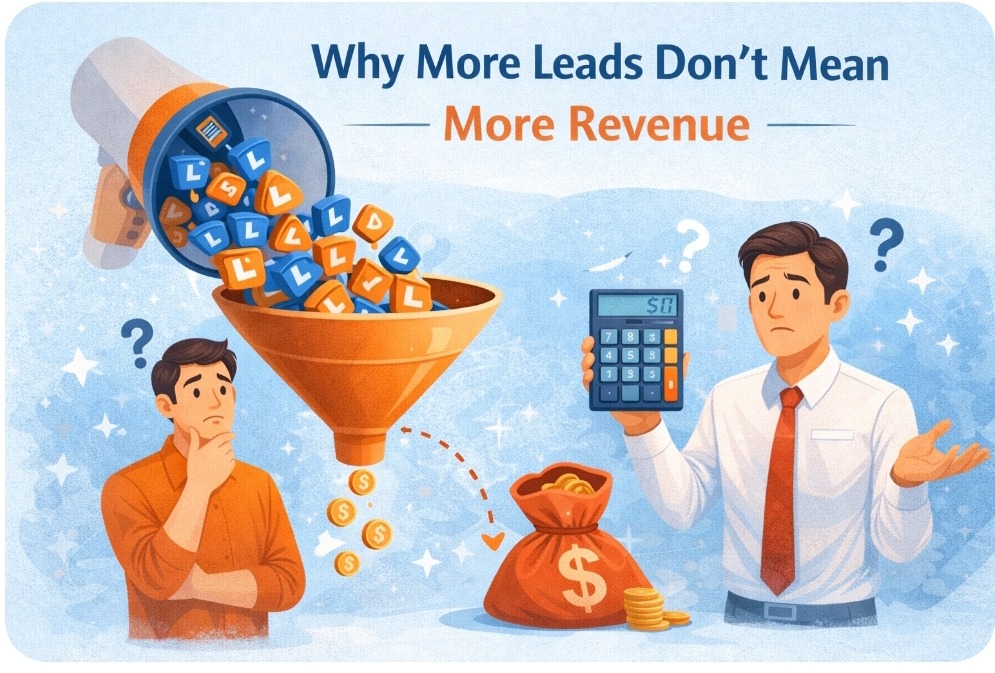
For many businesses, marketing success is still measured by one number: leads.
More form fills. More demo requests. More inbound volume.
Yet sales teams often tell a different story: long follow-ups, low close rates, and pipelines filled with prospects who were never a good fit to begin with. The disconnect isn’t accidental. It’s structural.
The problem isn’t lead generation. It’s how those leads are defined, sourced, and optimized.
Modern marketing platforms make it easier than ever to generate leads at scale. Paid media algorithms optimize toward form completions. SEO content attracts high-volume search traffic. Automation tools promise efficiency and growth.
But volume masks intent.
A lead captured through a broad keyword, vague offer, or poorly aligned landing page may technically qualify as a “conversion,” yet contribute little to revenue. When marketing optimizes for quantity without context, sales inherit the cost. This is how companies end up with impressive dashboards and disappointing results.
Cost per lead (CPL) remains one of the most commonly tracked performance indicators. It’s simple, comparable, and easy to optimize.
It’s also incomplete.
A low CPL doesn’t account for:
Two campaigns can produce leads at the same cost, yet one delivers customers while the other delivers churn and frustration. When CPL becomes the primary optimization goal, quality is often sacrificed for efficiency.
AI and automation have transformed digital advertising. Smart bidding, audience expansion, and predictive targeting dramatically improve execution speed. nnnn But AI optimizes toward the signals it’s given.
If the primary signal is form submission, without feedback on lead quality or revenue outcome, the system will scale whatever produces the most forms, regardless of downstream impact. This is why AI-optimized PPC campaigns can generate impressive lead volume while quietly eroding ROI.
Automation doesn’t create strategy. It accelerates it.
Poor lead quality usually isn’t caused by a single failure point. It’s the result of misalignment across the funnel.
Common breakdowns include:
Each decision may improve conversion rates individually, but together, they produce leads sales teams can’t close.
One of the most expensive mistakes organizations make is separating marketing performance from sales outcomes. Marketing reports on leads generated. Sales reports on revenue are closed. When these systems don’t communicate, optimization becomes guesswork.
High-performing teams reverse the flow. Sales feedback informs keyword strategy. Closed-won data shapes audience targeting. Deal quality influences automation signals. When revenue, not leads, becomes the shared metric, performance improves rapidly.
This level of alignment doesn’t happen by accident. It requires an integrated approach to strategy, execution, and measurement, something that a marketing agency must put the focus on.
If leads alone don’t predict revenue, what does? More meaningful indicators include:
Measures how many leads progress into real sales opportunities, revealing lead quality beyond initial form fills.
Focuses spend on leads that meet sales criteria, not just those that convert cheaply.
Connects marketing channels directly to revenue, highlighting which sources actually drive growth.
Tracks how quickly leads move through the pipeline, indicating intent strength and fit.
Shows which campaigns generate customers, not just interest, allowing smarter optimization decisions.
Revenue-driven marketing doesn’t mean fewer leads. It means better ones.
That shift requires clear intent segmentation across channels, offers aligned to buyer readiness, landing pages designed to qualify, not just convert, and automation guided by downstream outcomes. When marketing and sales operate as a single system, lead volume becomes a tool, not a goal.
Choosing the right strategic partner is often the turning point here. If you’re evaluating whether external support can help close the gap between leads and revenue, you need to understand what you expect when hiring a digital marketing agency or partnering with an individual.
Most businesses don’t have a traffic problem or a lead problem. They have a relevance problem.
The brands that scale revenue aren’t the ones generating the most leads. They’re the ones generating the right leads, consistently, predictably, and in alignment with how buyers actually make decisions.
In modern digital marketing, success isn’t measured by how many people raise their hands. It’s measured by how many become customers.