Laser hair removal has become one of the most requested aesthetic treatments worldwide. According to the American Society for Dermatologic Surgery, millions of laser hair removal procedures are performed annually, making it a cornerstone of modern cosmetic care. Patients increasingly turn to laser treatments not only to reduce unwanted hair but also to improve skin texture, minimize irritation, and eliminate the cycle of shaving and waxing.
Despite its popularity, one question consistently comes up during consultations: How many laser hair removal sessions are actually needed for long-term results?
The answer is rarely a single number. While many clinics advertise a standard range, accurate long-term results depend on biology, hair growth cycles, skin type, treatment area, hormonal factors, and the technology used. Laser hair removal is a cumulative process, not a quick fix, and understanding this distinction is critical for realistic expectations and lasting success.
Laser hair removal is fundamentally limited by human biology. No matter how advanced the technology, it cannot override the natural growth cycle of hair follicles.
Clinical studies estimate that only 20-30% of hair follicles are actively growing at any given moment. Because laser energy is only effective when the hair is in this active phase, each session targets a different subset of follicles. This is the primary reason multiple treatments are not optional but required.
From a medical standpoint, attempting to eliminate hair in fewer sessions would require energy levels that exceed safe thresholds for the skin, increasing the risk of burns, blistering, and post-inflammatory pigmentation.
Hair follicles operate independently, each following its own biological cycle. This is why laser hair removal must be performed in a series of sessions rather than as a one-time treatment. At any given moment, only a portion of hair follicles are actively growing and responsive to laser energy. This biological limitation explains why consistent scheduling is essential for achieving long-term results, a topic Pure Skin Laser Center often explores when educating patients about the benefits of laser hair removal for all skin types.
The anagen phase is the active growth stage, during which the hair shaft is firmly anchored to the follicle. Melanin levels are highest at this stage, allowing laser energy to travel efficiently down the hair shaft and generate heat within the follicular root. Clinical evidence shows that follicles treated during anagen are far more likely to sustain structural damage, leading to lasting reduction rather than temporary shedding. This is why session timing plays a critical role in treatment success.
During catagen, the follicle begins to shrink and detach from its blood supply. While hair may still be visible, the weakened connection limits heat transfer, reducing the laser’s ability to disrupt future growth.
In the telogen phase, the follicle is dormant and unresponsive to laser energy. Hair in this phase must cycle back into anagen before effective treatment can occur.
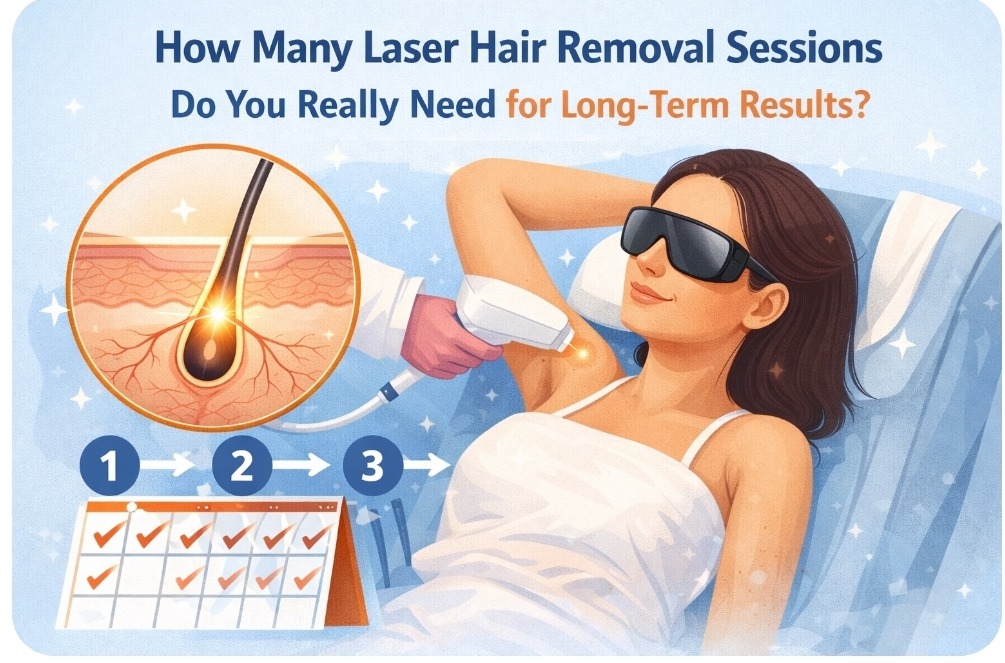
Most evidence-based treatment plans begin with six to eight sessions as a baseline. This range is supported by clinical studies demonstrating 70-90% long-term hair reduction after a complete treatment series, depending on the area treated and individual response.
It is essential to clarify what this reduction means clinically. Long-term hair reduction refers to a sustained decrease in hair density, thickness, and growth rate, not absolute elimination of every follicle.
Patients who complete fewer than six sessions frequently experience partial results followed by noticeable regrowth within several months.
Not all areas of the body respond the same way to laser energy. Growth cycles, follicle depth, and hormonal sensitivity vary widely by location.
The face is one of the most hormonally active regions of the body. Areas such as the upper lip, chin, and jawline respond directly to androgen fluctuations, which can stimulate new hair growth even after successful treatment.
Clinical experience shows that facial hair often requires 8-12 sessions, followed by periodic maintenance treatments. Patients frequently notice early improvement but need consistency to achieve stability.
This is especially common in women with underlying hormonal imbalances, where laser hair removal reduces density but cannot entirely override hormonal stimulation.
Body areas such as the legs, arms, underarms, chest, and back generally have longer growth cycles and are less influenced by hormones. These regions tend to respond more predictably, with many patients achieving stable results within the standard six- to eight-session range.
Once hair reduction is achieved in these areas, maintenance sessions are often infrequent or unnecessary.
Laser hair removal technology has evolved dramatically over the past decade. Earlier systems could not safely adjust for varying skin tones and hair characteristics, leading to inconsistent outcomes.
Advanced laser platforms now allow providers like Pure Skin Laser Center to customize the wavelength, pulse duration, and fluence to meet individual needs. This precision improves follicle targeting while minimizing unnecessary heat exposure to the skin.
Even with the right technology, improper session spacing can compromise results.
Clinical protocols typically recommend 4-6 weeks between facial treatments and 6–8 weeks between body treatments. This timing aligns with hair-cycling patterns and ensures that each session targets a new population of active follicles.
Treating too frequently does not accelerate results and may increase irritation. Waiting too long allows untreated follicles to re-enter growth cycles unchecked, extending the overall treatment timeline.
Hormonal activity remains one of the most underestimated factors in laser hair removal outcomes. Androgens stimulate hair growth in areas such as the face, chest, and abdomen, particularly in women.
Patients with conditions such as PCOS, thyroid disorders, or those experiencing hormonal changes due to pregnancy or menopause often require ongoing maintenance sessions, typically once or twice per year.
Maintenance does not indicate failure. It reflects the body’s ability to activate new follicles over time.
From a clinical perspective, successful laser hair removal results in sustained hair reduction rather than total elimination.
Most patients experience finer, lighter regrowth that is slower and less dense. Skin texture often improves as irritation, razor bumps, and ingrown hairs decrease.
Residual hair is usually cosmetic rather than problematic.
Even with advanced technology, outcomes depend heavily on provider skill. Proper assessment, customized settings, and ongoing adjustments are essential for safe and effective treatment.
At Pure Skin Laser Center, treatment plans are tailored to each patient’s skin type, hair characteristics, and long-term goals rather than relying on standardized packages.
Patients who want clarity on session timelines and expected results are encouraged to schedule a laser hair removal consultation to receive a personalized treatment plan.
There is no universal answer to how many laser hair removal sessions are required for long-term results. While six to eight sessions are a common baseline, true success depends on biology, technology, timing, and professional oversight.
By committing to a complete treatment plan and working with experienced providers, patients can achieve lasting hair reduction and smoother, healthier-looking skin.