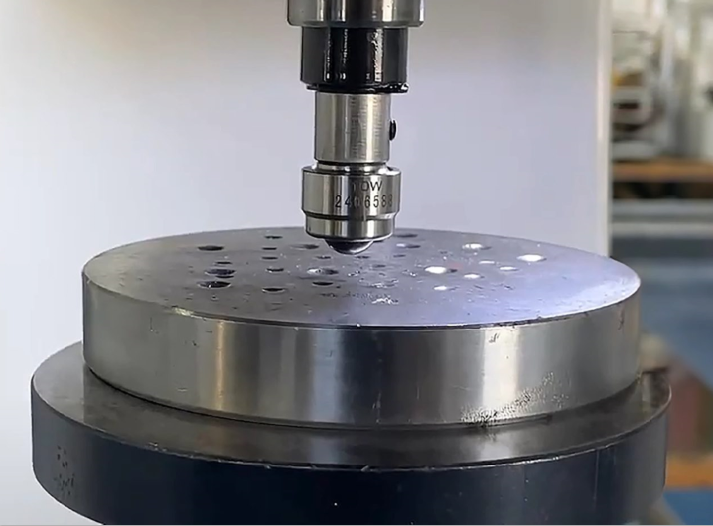
Hardness numbers move quickly through factories and test labs. They can clear a heat lot, flag a bad casting, or confirm a treated surface before machining. Still, Brinell and Vickers do not answer the same question in the same way. Brinell uses a tungsten carbide ball and judges hardness by the size of a round impression. Vickers uses a diamond pyramid and calculates hardness from two measured diagonals under a microscope.
The choice starts to matter when parts are not uniform. A larger Brinell indent can average out local microstructure variation in castings and forgings. A smaller Vickers indent can track hardness changes across a case-hardened layer or a thin wall. Those trade-offs show up in surface preparation, measurement consistency, and the speed of routine QC checks.
Brinell is often used when the metal’s structure is uneven from place to place. Cast irons, cast steels, and large forgings are common examples. In those materials, hardness can swing over short distances. A Brinell hardness tester leaves a comparatively large impression, so the reading reflects a wider patch of material.
The method is straightforward. A tungsten carbide ball is pressed into the surface under a specified force. After the load is removed, the round impression is measured by its diameter. That diameter is then used to calculate the Brinell hardness value.
On the production floor, Brinell’s size can be an advantage. The larger indent tends to dampen the influence of a single hard particle or a soft pocket. That makes it a practical choice for “mixed” microstructures where small indents can bounce around.
Most shops run familiar setups. Ball sizes around 10 millimeters are common. Forces can reach a few thousand kilograms-force on thick steel sections. Smaller balls and lighter loads show up on softer alloys or thinner stock, but the logic stays the same. The goal is a clean, readable edge.
Brinell has clear limits. Thin sections can bend or show “print-through” on the far side. Narrow features and small coupons can also force indents too close together. Once spacing becomes tight, the number can stop reflecting the bulk metal and start reflecting the geometry.
Vickers is often used when parts are thin or tightly shaped. Small ribs, narrow lands, and fine edges can make larger indents impractical. Hardness gradients also push teams toward Vickers. That includes case-hardened surfaces and coated layers. A Vickers hardness tester is built for this kind of work because it can produce small, repeatable impressions.
The method uses a diamond pyramid with a 136-degree geometry. The indent comes out as a small square. After unloading, the operator measures two diagonals under a microscope. The hardness number comes from the averaged diagonal length and the applied force.
The usable load range is what makes Vickers flexible. It runs from micro loads to higher forces used on bulk material. At low forces, it can place tiny indents in cases and coatings. At higher forces, it can check the base metal without changing indenter shape. Low-force work is common when a lab needs a hardness map, not a single pass or fail value.
In routine practice, Vickers is used for case depth checks and hardness traverses across heat-treated zones. It also fits small parts and thin walls where Brinell would leave an oversized impression. The method can capture rapid changes over short distances. That is hard to do with a large indentation.
Surface condition is the bottleneck. Vickers depends on clean, sharp corners in the impression. Scratches, debris, and glare can shift where diagonal endpoints get placed. Automated optics can also struggle when contrast is weak. Many procedures reject asymmetric indents and require a repeat after re-prep.
Surface preparation is where the two methods separate in everyday QC. Brinell can tolerate a rougher finish in many shop settings. The impression is larger, and the edge is usually easier to find. Vickers is less forgiving. The measurement is optical, and the corners are small. Polishing quality and cleaning steps can affect what the operator, or the software, thinks the diagonal endpoints are.
Audit problems often start with repeatability. Two operators can disagree on a Vickers diagonal when the corners look rounded or smeared. A slight tilt can stretch the impression and trigger rejection rules. Brinell has its own weak spots, including poor lighting and inconsistent diameter reads. Still, it is typically less dependent on microscope technique.
Reporting is what keeps hardness data usable across shifts and sites. A result should state the method, test force, dwell time, and indenter type. It should also list how many indents were made and where they were placed. Surface condition notes matter, too, especially if the finish was limited by part geometry. Without these details, hardness values can look precise while being hard to compare.
Standards define the shared language. Brinell work is commonly tied to the ISO 6506 family. Vickers procedures often cite ISO 6507. Many labs also reference ASTM E92 for Vickers practice and ASTM E384 for microindentation work. Those references become most important when results move between customers, suppliers, and outside testing labs.
Most method disagreements come down to indent size and what the part can tolerate. Speed also shapes the choice. A production line may need a quick acceptance number. A lab may need a hardness profile that supports a heat-treat decision.
Material type often sets the direction first. Castings and forgings with mixed phases usually favor Brinell because the larger indent averages local variation. Uniform wrought alloys can work with either method, depending on part geometry and the level of detail needed.
Thickness and feature size usually settle the rest. Thick sections and wide, flat areas tend to accept Brinell without trouble. Thin walls, small parts, and narrow ribs often push work toward Vickers, since the indent can be kept small and placed precisely. Hardness range matters too. Very hard surfaces, cases, and coatings are commonly checked with Vickers because Brinell impressions can become difficult to interpret.
When the goal is one bulk number, Brinell is often enough. When the goal is a gradient, a traverse, or a case depth check, Vickers is usually the better fit.