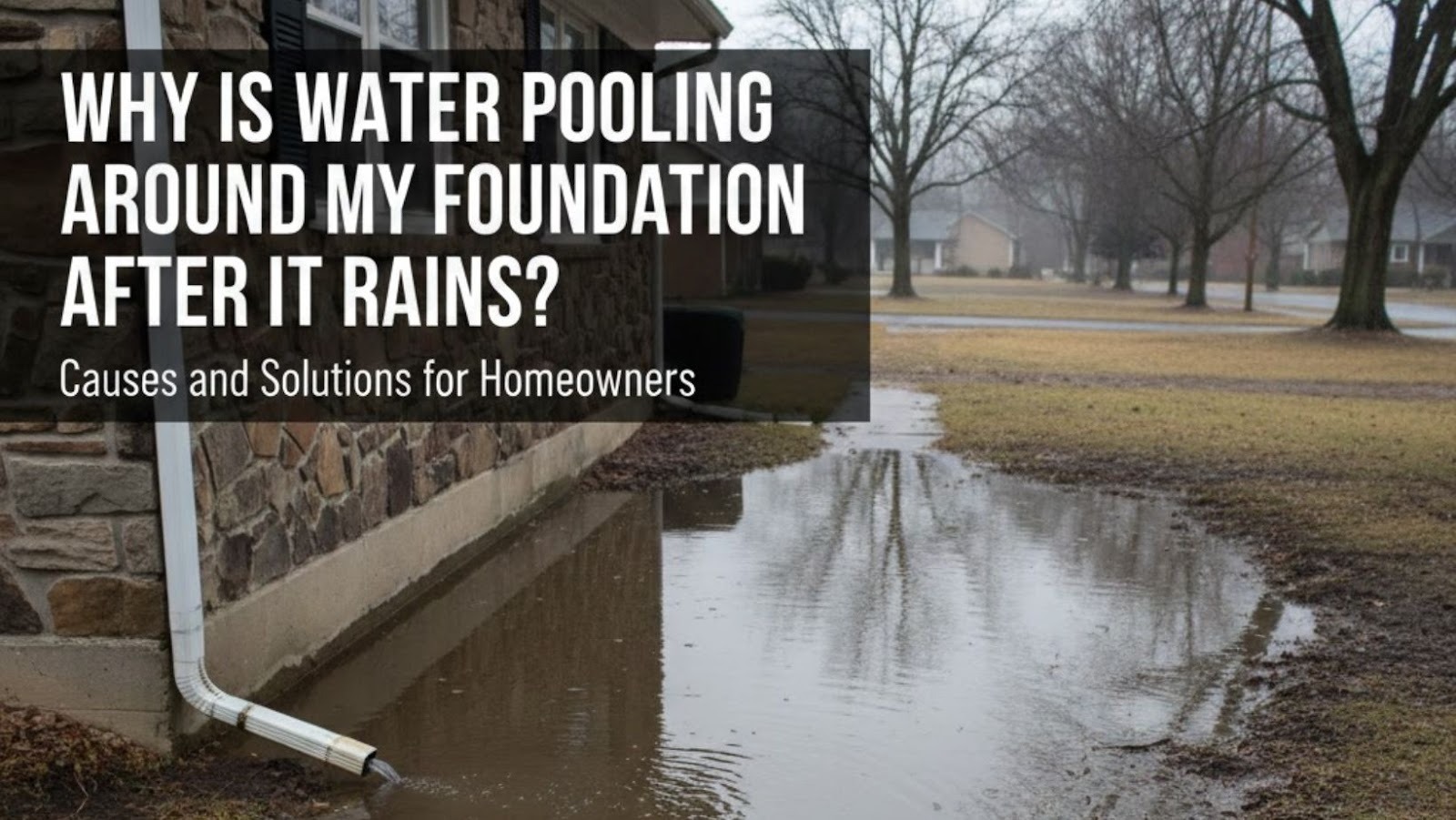
As a homeowner, few things are as unsettling as walking outside after a heavy storm and seeing "mini-lakes" hugging the sides of your house. In Naperville, where we deal with everything from spring downpours to heavy winter slush, water management isn't just a landscaping choice, it’s a foundation survival skill.
When water pools near your foundation, it’s a red flag. If you ignore it, that water will eventually find its way into your basement or cause your foundation to shift. Here is a guide on why this happens and how you can protect your home’s structural integrity for the long haul.
You can have the best yard grading in the world, but if your gutters aren't working, your foundation is still at risk. When gutters fill up with leaves, maple "helicopters," or shingle grit, the water has nowhere to go. Instead of flowing through the downspout, it spills over the sides of the gutter like a waterfall.
This falling water hits the ground with immense force, rapidly eroding the soil and creating deep trenches right next to your foundation. This bypasses your yard's natural drainage and dumps water directly against the basement walls. Keeping your system clear is the most cost-effective way to prevent foundation rot. Many homeowners find that hiring the best gutter cleaning in Naperville IL is the simplest way to stop this "waterfall effect" before it leads to structural failure.
Water doesn't just "stay" in one place unless something is forcing it to. Usually, pooling is caused by a failure in your yard's ability to move water away.
The most frequent culprit is "negative grading." Ideally, your yard should act like a slide, carrying water away from your home’s walls. Experts generally recommend a slope where the ground drops at least six inches over the first ten feet away from the foundation.
Over the years, soil settles. You might have started with a great slope when the house was built, but as the earth packs down or as you add heavy landscaping mulch, the ground can become flat or even tilt back toward the house. When the grade is negative, gravity sends every drop of rain straight to your foundation.
We often deal with heavy clay soil in Illinois. Unlike sandy soil which acts like a sieve, clay is dense and doesn't allow water to soak in quickly. The top layer of soil becomes saturated and "rejects" more water, leading to surface pooling when a heavy rain hits.
Worse yet, clay expands significantly when wet and shrinks when dry. This constant "push and pull" against your foundation walls is known as hydrostatic pressure. If water pools there regularly, that pressure stays constant, eventually forcing its way through tiny pores in the concrete or causing walls to bow and crack.
Your roof is a massive water collection surface. A single inch of rain on a 2,000-square-foot roof can produce over 1,200 gallons of runoff. Your downspouts are responsible for moving that volume safely away.
However if your downspouts end just two or three feet from your house, you are essentially dumping a thousand gallons of water right at the corners of your foundation. This leads to soil saturation and "pockets" of water that never seem to dry out.
It is constantly looking for a way in when water sits against your house. It can be three major problems:
You need a strategy that moves water "out and away" to stop the pooling for good.
Protecting your foundation from water pooling is a race against time. You stop structural damage before it starts by correcting negative grading, extending downspouts, and ensuring your soil can breathe. Remember your roof is your home's biggest water collector; don't let it become a liability. Staying proactive with drainage solutions and the best gutter cleaning in Naperville IL ensures that rainwater stays where it belongs away from your home.