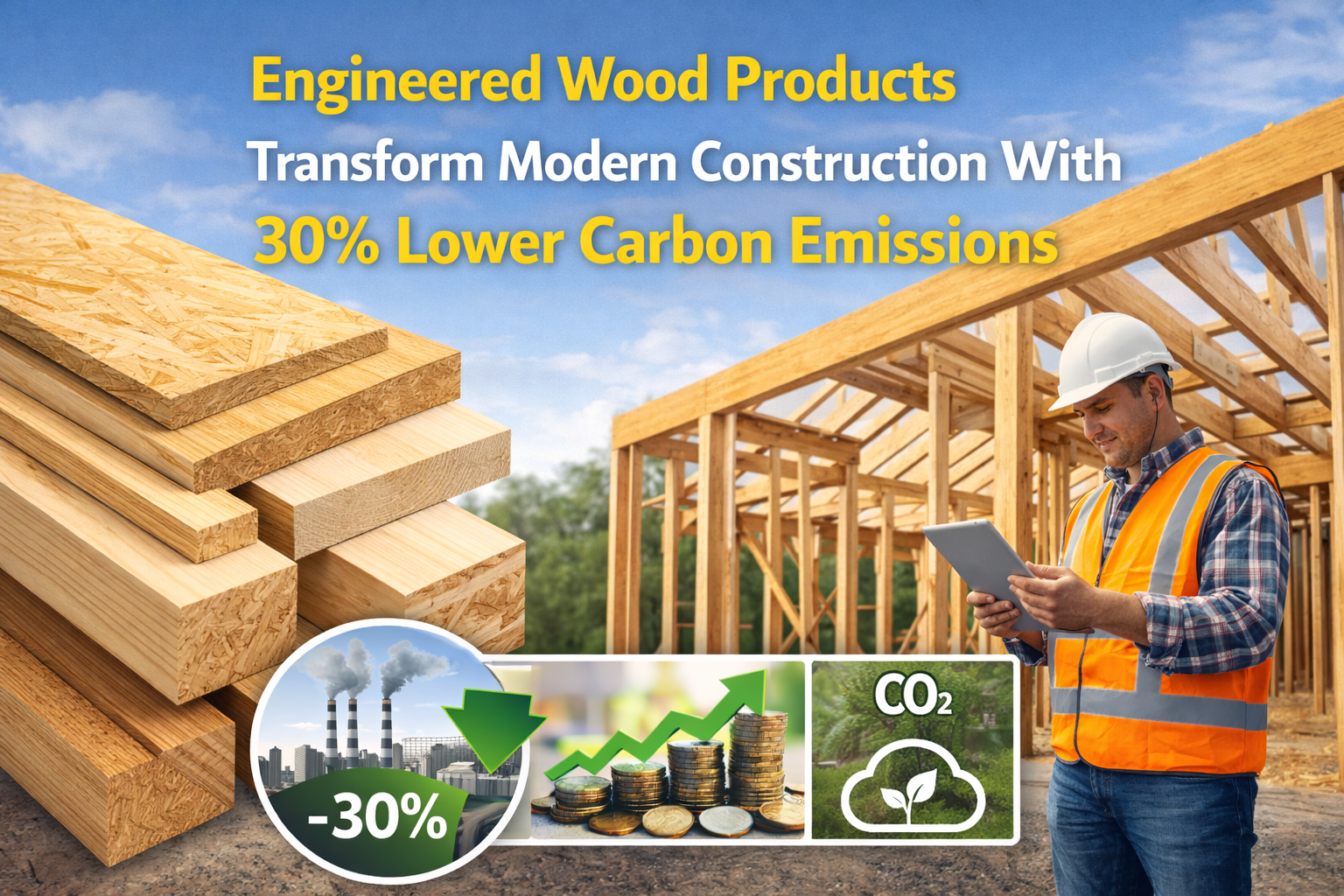
Engineered wood products reduce construction time by 20% while lowering carbon emissions by 30% compared to traditional building materials. These manufactured wood solutions offer superior strength, dimensional stability, and environmental benefits that make them essential for sustainable construction projects.
Engineered wood encompasses laminated veneer lumber, cross-laminated timber, glulam beams, and structural composite lumber that outperform traditional lumber in strength and consistency. RedBuilt specializes in manufacturing these advanced wood products including Red-I joists and RedLam LVL beams that enable builders to create stronger, more sustainable structures while reducing material waste and construction costs.
Engineered wood products undergo precision manufacturing processes that eliminate natural defects found in solid lumber while maximizing structural performance. Unlike traditional lumber that contains knots, splits, and varying grain patterns, engineered wood uses adhesives and heat to bond wood strands, veneers, or particles into uniform components with predictable strength characteristics. This manufacturing process creates products that resist warping, twisting, and shrinking while maintaining consistent dimensions throughout their service life.
The production of laminated veneer lumber and other engineered solutions allows manufacturers to utilize smaller trees and wood waste that would otherwise go unused. Wood based materials sequester approximately 1.8 metric tons of CO₂ per cubic meter, making them carbon negative building materials that actively remove greenhouse gases from the atmosphere. This environmental advantage combines with superior structural properties to make engineered wood the preferred choice for architects and engineers designing sustainable buildings.
Manufacturing facilities like those operated by RedBuilt employ advanced quality control systems that test every batch of engineered lumber for strength, moisture content, and dimensional accuracy. These rigorous standards ensure that builders receive materials that meet or exceed building code requirements while providing consistent performance across entire projects.
Cross laminated timber represents a breakthrough in engineered wood technology that enables construction of buildings up to 18 stories tall using primarily wood materials. These massive panels consist of multiple layers of lumber boards stacked crosswise and bonded with structural adhesives, creating incredibly strong and stable building components. CLT panels arrive at construction sites prefabricated with window and door openings already cut, allowing crews to erect entire floor systems in days rather than weeks.
The structural performance of cross laminated timber rivals that of concrete and steel while weighing significantly less, reducing foundation requirements and seismic loads. Buildings constructed with CLT panels demonstrate excellent fire resistance due to the charring properties of mass timber, which creates a protective layer that maintains structural integrity during fire events. This combination of strength, safety, and sustainability makes CLT ideal for urban housing projects where construction speed and environmental impact are critical considerations.
RedBuilt partners with architects and engineers to optimize CLT panel designs for specific project requirements, ensuring efficient material use and streamlined installation processes. The precision manufacturing of these engineered wood panels eliminates on site waste while providing superior acoustic and thermal performance compared to traditional construction methods.
Glulam beams deliver exceptional strength to weight ratios that make them ideal for long span applications in commercial and residential construction. These engineered wood products consist of multiple layers of dimension lumber bonded together with waterproof adhesives, creating beams that can span distances exceeding 100 feet without intermediate supports. The manufacturing process allows for curved and arched configurations impossible with traditional solid timber beams.
Engineered wood production consumes 50% less energy than concrete and 80% less than steel according to the Forest Products Laboratory, making glulam an environmentally responsible choice for structural applications. The natural aesthetic appeal of exposed glulam beams eliminates the need for additional finishing materials while providing the warmth and beauty that only wood can deliver. These beams maintain their structural integrity in fire conditions longer than unprotected steel, which loses strength rapidly when exposed to high temperatures.
Installation of glulam beams requires standard carpentry tools and techniques familiar to most construction crews, reducing labor costs and construction timelines. RedBuilt manufactures custom glulam solutions for projects ranging from simple residential headers to complex commercial roof systems, with each beam engineered to meet specific load requirements and architectural specifications.
Engineered wood products actively combat climate change through carbon sequestration while reducing the environmental footprint of construction projects. Every cubic meter of wood used in construction stores approximately one ton of CO₂ that trees absorbed from the atmosphere during growth, creating buildings that function as long term carbon storage facilities. This carbon remains locked within the wood structure for the entire life of the building, potentially spanning centuries.
The sustainable forestry practices that supply raw materials for engineered lumber ensure continuous carbon capture through replanting and forest management programs. Modern manufacturing facilities utilize virtually every part of harvested trees, converting sawdust, chips, and other byproducts into structural composite lumber and engineered panels.
Buildings constructed with laminated veneer lumber, structural insulated panels, and other engineered wood products require less heating and cooling energy due to wood's natural insulation properties. The reduced weight of wood construction compared to concrete and steel also decreases transportation emissions and allows for smaller foundation systems that disturb less soil and require less concrete.
Structural composite lumber combines wood fibers with advanced resins to create engineered products that outperform traditional lumber in virtually every metric. These materials include laminated strand lumber, parallel strand lumber, and oriented strand lumber that provide consistent strength and stiffness for demanding structural applications. The manufacturing process aligns wood strands in specific orientations to maximize strength along load paths while eliminating the variability inherent in natural wood.
Red I joists carry heavy loads over long spans while using wood economically with uniform and predictable strength manufactured to resist twisting, bowing, and shrinking, enabling faster installation times that cut down on labor costs. These engineered components work together as integrated systems, with rim boards, headers, and beams designed to complement each other for optimal structural performance. The dimensional stability of structural composite lumber eliminates callbacks due to shrinkage and movement that plague traditional framing materials.
Builders appreciate the consistent quality and reliability of engineered wood beams that arrive at job sites straight, true, and ready for immediate installation. The ability to order exact lengths reduces waste and eliminates the time spent sorting through lumber piles to find acceptable pieces for critical structural applications.
Engineered wood panels provide architects with unprecedented design freedom through their ability to create large, uninterrupted spaces without visible supports. Products like oriented strand board and medium density fiberboard offer smooth, uniform surfaces ideal for both structural and aesthetic applications. These panels can be manufactured in sizes up to 8 feet by 24 feet, enabling designers to minimize joints and create seamless interior and exterior surfaces.
The consistent properties of engineered panels allow architects to push design boundaries with confidence, knowing that materials will perform as specified regardless of environmental conditions. Structural insulated panels combine insulation and structure in a single component, simplifying construction while achieving superior energy performance. These prefabricated panels can incorporate electrical chases and window openings during manufacturing, reducing on site labor and ensuring precise tolerances.
RedBuilt collaborates with design professionals to develop custom engineered wood solutions that meet specific project requirements while maintaining cost effectiveness. The versatility of laminated veneer lumber and other engineered products enables creation of unique architectural features that would be impossible or prohibitively expensive with traditional materials.
Sustainable construction demands materials that minimize environmental impact while maximizing performance and longevity. Engineered wood products meet these requirements through efficient resource utilization, reduced embodied energy, and carbon sequestration capabilities. The manufacturing process for engineered lumber uses fast growing, sustainably managed forests that regenerate quickly compared to the decades required for old growth timber.
The durability and longevity of properly installed engineered wood products ensure buildings remain functional for generations, amortizing their environmental impact over extended service lives. Modern treatments and manufacturing techniques provide resistance to moisture, insects, and decay that rivals or exceeds traditional building materials while maintaining the renewable nature of wood construction.
Engineered wood joists revolutionize floor system construction through their superior strength, dimensional stability, and installation efficiency. These products eliminate the bounce and squeaks common in traditional joist systems while spanning greater distances with less material. The open web design of many engineered joists allows easy routing of plumbing, electrical, and HVAC systems without compromising structural integrity.
RedBuilt provides comprehensive floor system packages that include all necessary components designed to work together seamlessly. This systems approach ensures optimal performance while simplifying ordering and reducing the potential for jobsite errors that can delay construction schedules.
Engineered wood products deliver cost savings throughout the construction process despite potentially higher initial material costs compared to traditional lumber. The reduced construction time enabled by engineered materials translates directly to labor cost savings that often exceed any premium paid for the products themselves. Engineered wood reduces construction time by 20% compared to traditional materials, allowing developers to complete projects faster and begin generating revenue sooner.
The dimensional stability and consistent quality of laminated veneer lumber and other engineered products eliminate costly callbacks for repairs and adjustments common with traditional framing materials. Reduced waste due to precise manufacturing and ordering capabilities means builders purchase only what they need, avoiding the typical 10 to 15 percent waste factor associated with conventional lumber. The lighter weight of engineered wood compared to steel or concrete reduces transportation costs and allows use of smaller, less expensive lifting equipment during construction.
Building codes worldwide increasingly recognize and accommodate engineered wood products as primary structural materials for various construction types. The International Building Code now permits cross laminated timber construction up to 18 stories, opening new markets for wood construction previously limited to steel and concrete. These code changes reflect extensive testing and research demonstrating that properly designed mass timber buildings meet or exceed fire and life safety requirements.
Engineered wood products represent the future of sustainable construction, combining superior performance with environmental responsibility. These innovative materials enable builders to construct stronger, more efficient structures while reducing carbon emissions and construction timelines. As building codes evolve to recognize the capabilities of mass timber and other engineered wood products, their adoption will accelerate across all construction sectors. RedBuilt continues advancing engineered wood technology to meet growing demand for sustainable building solutions that deliver exceptional value without compromising performance or aesthetics.