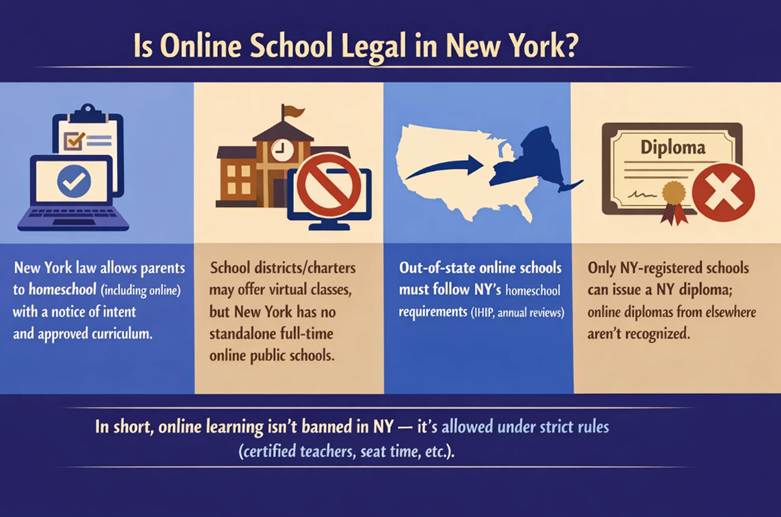
Many parents ask, “Is online school legal in New York?” This confusion stems from the state’s strict education laws. New York permits home instruction (homeschooling) under specific regulations and allows districts and charters to offer virtual instruction under state guidelines. However, there are no fully state-approved online public schools at present. Parents choosing online or home schooling must submit a notice of intent and an Individualized Home Instruction Program (IHIP) to the district. Families should separate fact from myth so any online program meets New York’s standards. Since the pandemic, many families have turned to remote learning and now need clarity on New York’s rules. Following guidance is crucial.
TL;DR
New York law expressly permits districts and charter schools to provide virtual instruction under specified conditions. NYSED clarifies that schools may “leverage virtual instruction” for students who cannot attend in person. In other words, if a district offers online classes, students may legally enroll when needed. All credit-bearing virtual courses must be taught by a New York–certified teacher employed by the district or BOCES. The state explicitly prohibits using a private vendor as the teacher of record. In all other respects, online courses must meet the same state standards as classroom instruction. BOCES and approved providers ensure these courses follow NY requirements. This maintains educational quality.
Full-time online schooling in NY typically falls under the state’s home instruction laws. Parents have a legal right to teach their children at home, but they must notify the district and submit an IHIP with planned curricula. NYSED clarifies that a student in an unregistered online program is treated as homeschooled. Families must cover all NY-mandated subjects and keep records of instruction. Homeschoolers may learn entirely online, but they do not earn a NY public-school diploma. Instead, they complete the IHIP process and annual reviews. Parents must also submit a required annual assessment (such as a test or portfolio review) each year. This oversight ensures online home education meets the same standards as public schooling.
As of now, New York does not authorize any fully virtual K–12 schools. The NYSED confirms there are no registered online charter or district schools. This means families cannot simply enroll in an independent online academy and expect it to function like public school. If a NY student takes a non-registered online program, that child must leave public school and be counted as homeschooled. The district then oversees the student’s learning through the IHIP and required assessments. In effect, any online program for NY students is treated as home instruction. The state treats any online program as home instruction under law. Families often use accredited online curricula within this homeschool framework to ensure compliance.
New York law restricts diplomas to state-registered schools. Students in out-of-state or unregistered virtual programs cannot receive a NY diploma, even if that school is accredited elsewhere. NYSED warns these students may need to pass the GED exam to attend NY colleges. Instead, homeschoolers and compliant online students receive a “letter of substantial equivalency” from their district. This letter certifies that the student’s education meets NY graduation standards. Homeschoolers often take the same NY Regents exams as public-school seniors to qualify for the equivalency letter. Districts typically review transcripts or test scores before granting it. In short, families must follow NY diploma rules when pursuing online education.
Myth: New York bans online schooling. Fact: NY law explicitly allows parents to homeschool (including online) and permits authorized virtual programs. Myth: Any online diploma is accepted. Fact: NYSED states diplomas from out-of-state virtual schools are not recognized — such students may need a GED to continue education. Myth: Homeschooling or virtual learning requires no oversight. Fact: NY law still mandates core subjects, annual assessments, and certified instruction for all formats. For example, even homeschoolers must cover state-required subjects (English, math, science, etc.) and submit annual progress reports. In short, online learning in NY is permitted but must follow the same rules as traditional education.
Below is a comparison of key aspects of fully online education versus traditional schooling in New York:
Feature | Online Schooling | Traditional Schooling |
State Recognition | Treated as home instruction; no NY-registered full-time online schools | State-recognized public, charter, or registered private schools |
Enrollment & Attendance | Must file notice of intent and IHIP; student is officially homeschooled | Enroll through district; compulsory attendance (ages 6–16) applies |
Curriculum & Oversight | Parent selects curriculum to cover NY-required subjects; IHIP and assessments required | District curriculum meeting NY state standards; regular in-class instruction |
Teachers & Instruction | Parents or tutors teach (no state certification needed for homeschool); district-led online courses use NYS-certified teachers | Taught by NY-certified teachers in classrooms |
Diplomas & Credits | No NY diploma unless through an NY-registered program; students rely on equivalency letter or GED | Students earn NY Regents/local diplomas by completing accredited programs |
Online schooling is not illegal in New York — it’s governed by precise rules. New York explicitly allows home instruction and authorized virtual programs, but parents must follow required procedures. This means filing proper notices, teaching mandated subjects, and using certified instructors. For example, an online program must cover core courses and satisfy assessments just as a regular school would, including compulsory attendance requirements. By following these regulations rather than myths, families can pursue online learning with confidence. With preparation and compliance, online education can serve as a valid alternative in New York. District or NYSED guidance can clarify any remaining questions.