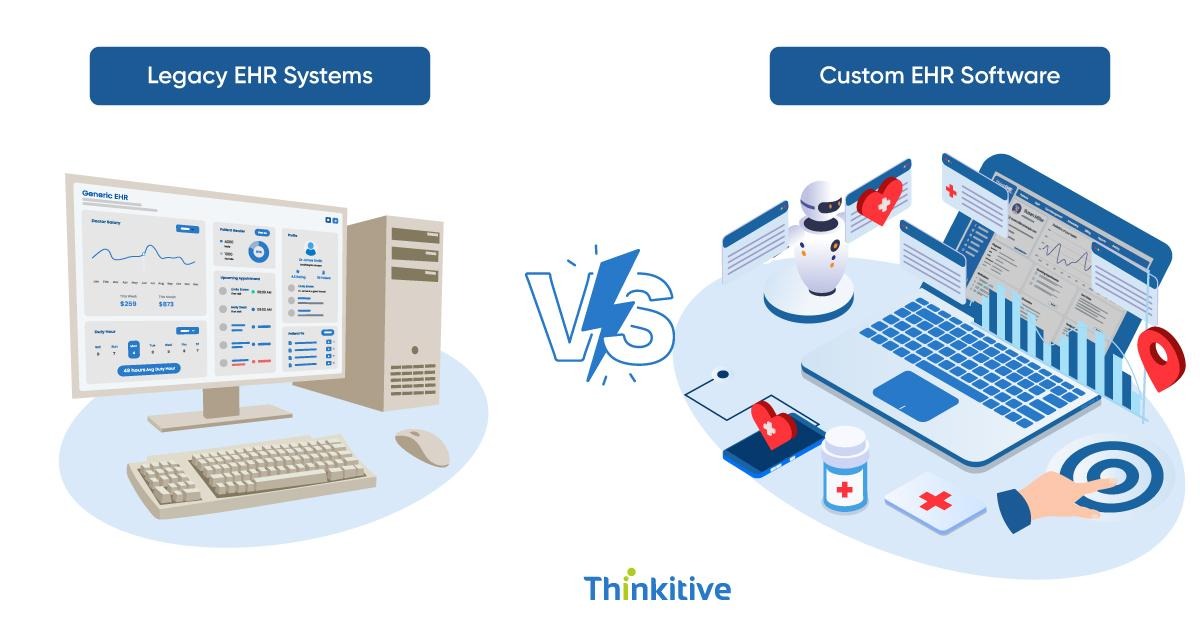
One of the underlying problems in the current healthcare landscape is the legacy EHR systems still in use in healthcare practices. While they still work, something simply just doesn’t click, right?
Well, that is exactly what the problem is. You see, the technological landscape is evolving, and that is revolutionizing the healthcare landscape as well. However, to harness the maximum benefits of these technological advancements, you would need modern systems and not legacy EHR systems.
And this is one of the major reasons why many healthcare professionals are entering the EHR software development ventures to enhance their healthcare systems. This is because the current demands of practices are interoperability, provider and staff efficiency, and reducing clinicians' burnout.
But you might think that every healthcare system is just a system, right?
Well, not exactly! You see, legacy EHR systems are built with a monolithic architecture approach. This means the entire system is tightly compressed with little room for customization and flexibility. Due to this, if you have to change anything in your system, then you would have to rewire the entire system.
On the other hand, modern EHR systems are built on a modular architecture. In this approach, every aspect of a feature of the system is individually developed to work together as one system. This gives you the flexibility and customization options you need to enhance your system change as per the changing requirements of the healthcare landscape.
But this is just an overview, to know everything about healthcare software modernization from legacy systems to modern EHR systems, read this blog below.
So, without further ado, let’s get started!
Legacy systems ruled the healthcare landscape for a brief period of time. However, with time, it was bound to fall short in certain aspects. And that exactly is what is troubling most healthcare practices.
On that note, here are some of the inefficiencies that almost all healthcare practices are facing with legacy EHR systems:
All these things make the EHR software slow, which has a trickle effect on other aspects of care that makes your healthcare practice slow and also increases the margin of error in care delivery. However, as many healthcare practices have identified custom EHR software as a possible solution to overcome these inefficiencies, here is how the catalyst changes the game:
There are some underlying differences between custom EHR software and legacy EHR software that you need to know. While the technicalities of this can be a little overwhelming, here is a table that will help you understand better and quicker:
Now that you know the key differences between a custom EHR software and legacy EHR system, here are some additional advantages that you get with a custom and scalable EHR solution:
Even though the demand for custom EHR software systems has reached an all-time high, there are still practices that are trying to complete their transition from legacy EHR systems to custom EHR software. This needs to be done correctly as the future of your custom EHR software depends on it.
First things first, begin with the planning of the integral part of your custom EHR software, which is data. Partner with a reliable and experienced healthcare IT provider, which will help you in data migration without disrupting the other aspects of your care delivery.
The rest of the things follow one after the other. However, the most crucial aspects come at the time of deployment. One of the best practices you can adopt for this is a phased rollout. This way, you not only minimize downtime, but you develop an MVP first, which plays in future scalability and customization aspects of your EHR software.
In this, the role of your healthcare software development is huge, as most of the aspects of your practice will depend on this and help you in a smooth transition from a legacy EHR system to a custom EHR with complete healthcare software modernization.
If you’ve made it this far, then you need to know an unsettling truth: legacy EHR systems helped the healthcare industry make a smooth transition from paper to digital. However, given the technological advancements and intricacies of the healthcare industry itself, they are simply unable to keep up with the latest trends and technologies.
That is why, if you are looking for EHR software development, and you’re here by the mercy of the internet, then it is the right time to make a switch. Custom EHR software gives you flexibility, efficiency, long-term stability, and reliability in your healthcare software systems.
On that note, keep a step ahead of the curve with healthcare software modernization. Click here to book your first free consultation and start your transition journey from legacy EHR systems to custom EHR software.
1. What are the primary signs that our practice has outgrown its legacy EHR?
A practice has typically outgrown its legacy EHR when everyday workflows start feeling like workarounds rather than solutions. Common signs include slow system performance, limited customization, difficulty integrating new tools (telehealth, RPM, AI scribes), and growing clinician dissatisfaction. If your team relies on spreadsheets, manual data entry, or third-party apps to fill gaps—and vendor updates no longer align with your clinical or operational needs—it’s a strong indicator that your EHR is no longer scalable for your growth.
2. How does custom EHR software development improve data migration safety from old systems?
Custom EHR software development enables a controlled, phased, and auditable migration process rather than a one-size-fits-all data dump. Data mapping is tailored to your clinical workflows, ensuring structured fields, historical records, and attachments retain integrity. Validation checkpoints, rollback mechanisms, and parallel system testing significantly reduce data loss, corruption, or downtime—making migration safer and more compliant than rushed transitions between off-the-shelf platforms.
3. Is custom EHR development more cost-effective than paying legacy maintenance fees over five years?
Over a five-year horizon, custom EHR solutions often deliver better total cost of ownership than legacy systems. While upfront development costs are higher, organizations avoid recurring licensing fees, forced upgrades, costly add-ons, and vendor lock-in. More importantly, productivity gains, reduced manual work, fewer integration expenses, and system longevity turn a custom EHR into a strategic investment rather than a perpetual maintenance burden.
4. Can a custom EHR system mimic the parts of our legacy system that our staff actually likes?
Yes—and this is one of the biggest advantages of a custom EHR. During discovery, teams identify which legacy features clinicians genuinely rely on versus those they tolerate. Effective custom EHR design preserves familiar workflows, shortcuts, and UI patterns while eliminating inefficiencies. The result is higher user adoption, faster onboarding, and minimal disruption—without being constrained by outdated architecture.
5. What are the security risks associated with keeping patient data on a legacy EHR system in 2026?
Legacy EHR systems pose increasing security risks due to outdated encryption standards, delayed patching, limited audit controls, and weak API security. Many were not designed for modern threat vectors such as ransomware, zero-trust architectures, or AI-driven attacks. As regulatory expectations tighten in 2026, unsupported or poorly updated systems increase the risk of data breaches, compliance violations, and operational downtime—making healthcare software modernization a security necessity, not just a technical upgrade.