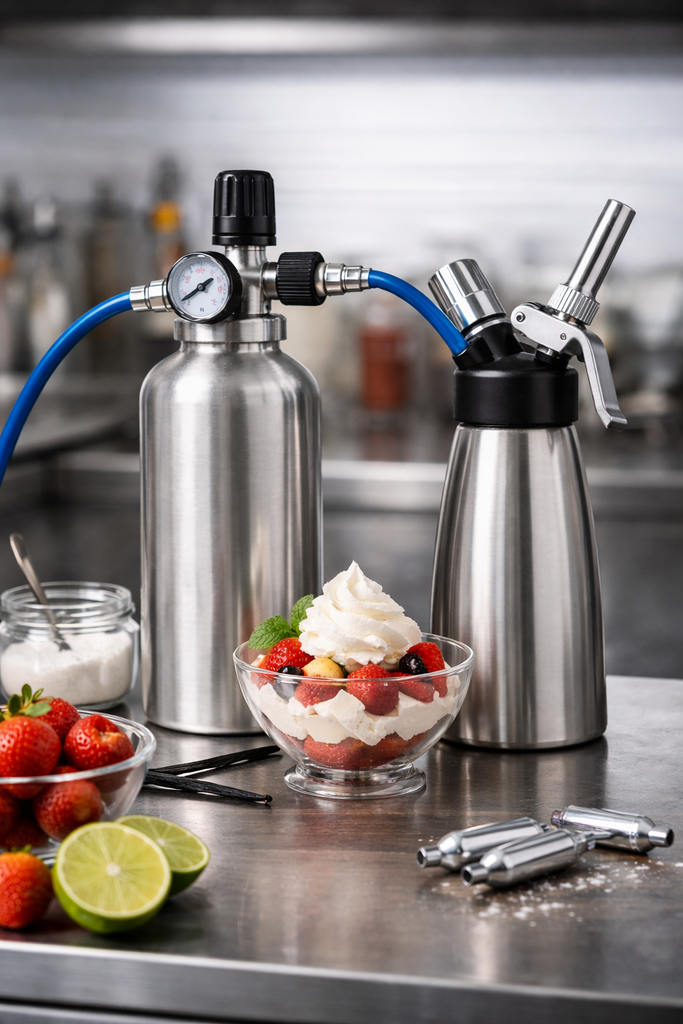
Whether you’re running a fast-paced café or aiming to recreate restaurant-quality desserts at home, knowing how nitrous oxide canisters work can make a huge difference. These pressurised steel cylinders have become a staple in professional kitchens and increasingly popular with serious home cooks, offering speed, consistency, and creative flexibility when making whipped cream, foams, and infusions.
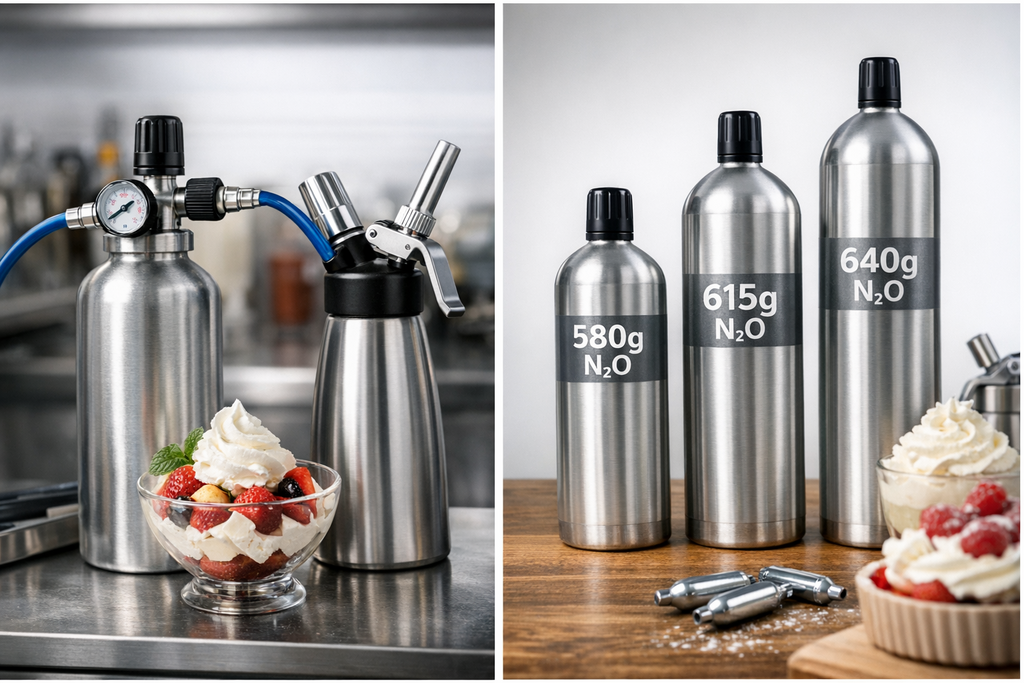
A nitrous oxide whipped cream canister is a non-refillable, pressurised steel cylinder filled with food-grade N₂O gas and designed specifically for use with whipped cream dispensers. Unlike traditional 8 g cream chargers, these larger cylinders contain significantly more gas—typically between 580 g and 640 g—making them ideal for higher-volume use.
You’ll commonly see three sizes on the market: 580 g, 615 g, and 640 g. To put that into context, a single 615 g canister can replace around 80 standard 8 g chargers. This means fewer cartridge swaps during service, less packaging waste, and a lower long-term cost for anyone who regularly produces whipped cream or foams.
These canisters connect to cream whippers or soda siphons using a pressure regulator and filling hose. The regulator attaches to the canister valve, while the hose connects to an adapter that fits most major whipper brands. Instead of piercing one charger at a time, you simply charge the siphon to the correct pressure in a single step.
Importantly, the gas itself is exactly the same as in small chargers: pure, food-grade nitrous oxide. The only difference is the delivery format, which offers better efficiency and workflow without compromising quality.
Choosing the right cylinder size depends on how much whipped cream or foam you produce and how often you want to reorder. Understanding capacity makes planning far easier.
As an example, a standard 0.5 L whipped cream dispenser usually requires about 8 g of N₂O per charge, yielding roughly 1.5 litres of whipped cream due to expansion. With a 615 g cylinder, that’s enough gas for more than 75 dispenser charges—easily covering hundreds of drinks or desserts over several days of service.
While all sizes contain the same food-grade gas, pressure recommendations can vary slightly by brand. Always follow the regulator and manufacturer guidelines to avoid over-pressurising your equipment.
The science behind whipped cream is simple but effective. When nitrous oxide is injected into cream under pressure, the gas dissolves into both the fat and liquid components. When the cream is dispensed, the sudden drop in pressure causes the gas to expand, creating thousands of microscopic bubbles that form a stable, fluffy texture.
Nitrous oxide is ideal for whipped cream because it is non-flammable, flavourless, and highly soluble in fat. It also helps inhibit bacterial growth inside the sealed dispenser, allowing prepared cream to stay fresh for several days. Using air would result in poor texture, while CO₂ would add unwanted acidity.
For professionals, speed and consistency are the biggest advantages. Large canisters allow staff to recharge dispensers in seconds—crucial during busy service periods. Texture remains consistent from one serving to the next, which is difficult to achieve with hand-whipped cream.
Beyond traditional whipped cream, these systems are used for cocktail foams, savoury espumas, light mousses, and rapid flavour infusions, making them invaluable across both kitchen and bar operations.
At home, the benefits are just as appealing. You can create smooth, stable whipped cream without effort, prepare in advance for gatherings, and store it refrigerated for up to a week. Larger canisters also make experimenting with modernist techniques—like flavoured foams or infused spirits—far more accessible.
For frequent users, buying gas in bulk often works out cheaper than purchasing box after box of small chargers.
Most modern nitrous oxide canisters are designed to work with universal regulators and adapters, making them compatible with the majority of cream whippers on the market. This means upgrading usually doesn’t require replacing your existing equipment.
Compatibility depends on:
Always follow manufacturer instructions, use only approved gases, and never mix gas types in the same siphon.
Nitrous oxide in these canisters is intended solely for food preparation. Inhalation is dangerous and restricted or illegal in many regions. Some countries and regions now enforce age limits and sales controls, so always check local regulations before purchasing.
Before recycling, ensure the canister is fully empty by safely venting any remaining gas using a discharge nozzle or regulator. Once confirmed empty, most steel cylinders can be recycled through standard metal recycling streams, subject to local rules.
Nitrous oxide is a powerful greenhouse gas, making responsible handling essential. Larger cylinders help reduce environmental impact by replacing dozens of single-use chargers, cutting down on packaging waste and transport emissions.
Most quality canisters are made from 100% recyclable steel, and when used efficiently and disposed of correctly, they represent a more sustainable option for regular users.
If usage is occasional, 8 g chargers may still be practical. Once consumption increases, a 580 g or 615 g cylinder offers better value and convenience without taking up excessive space.
Busy restaurants, cocktail bars, and catering operations benefit most from 615 g or 640 g systems paired with a reliable pressure regulator. The reduced downtime and lower per-use cost quickly justify the initial investment.
How long does whipped cream last in a dispenser?
When refrigerated and handled hygienically, around 7–10 days. Shake briefly before dispensing if volume decreases.
Can I use CO₂ instead of N₂O?
No. CO₂ adds acidity and is unsuitable for dairy unless the manufacturer explicitly states otherwise.
Is it safe to leave a partially used canister connected?
Yes, if the regulator is closed and the cylinder is stored correctly in a cool, ventilated space.
Can I use warm liquids?
Only if your siphon is rated for warm use. Always check temperature and pressure limits.
What if my dispenser leaks or won’t dispense?
Release pressure safely, clean all components, inspect seals, and replace worn parts. Never increase pressure to compensate for a fault.