Viral reach feels like success. Revenue proves success.
In 2026, marketers no longer struggle to get views. They struggle to convert attention into repeatable income. Many campaigns generate millions of impressions with no lasting impact.
The reason is structural. Most viral videos are designed for visibility, not monetization.
This article explains why viral content often fails to produce revenue and how marketers use AI-driven systems to turn attention into scalable returns.
A viral spike creates noise. It does not create leverage. Most viral videos share three characteristics:
Once the moment passes, the value disappears. Marketing teams need assets, not events.
From a monetization perspective, most viral videos fail for predictable reasons.
Custom filming, manual editing, and repeated performance increase cost per asset. ROI collapses when results cannot be replicated cheaply.
Trends decay fast. Late execution reduces ad efficiency and organic testing windows.
Winning elements are not captured as templates. Every new video starts from zero. Virality without structure is expensive.
Motion drives engagement. Engagement drives CPM efficiency.
In short-form ads, UGC-style content with natural movement consistently outperforms polished brand videos. However, producing motion-heavy content at scale is difficult.
This is where mimic motion changes marketing economics.
Mimic motion captures movement from a reference clip and applies it across new creatives. One successful performance becomes a reusable asset.
For marketers, this means:
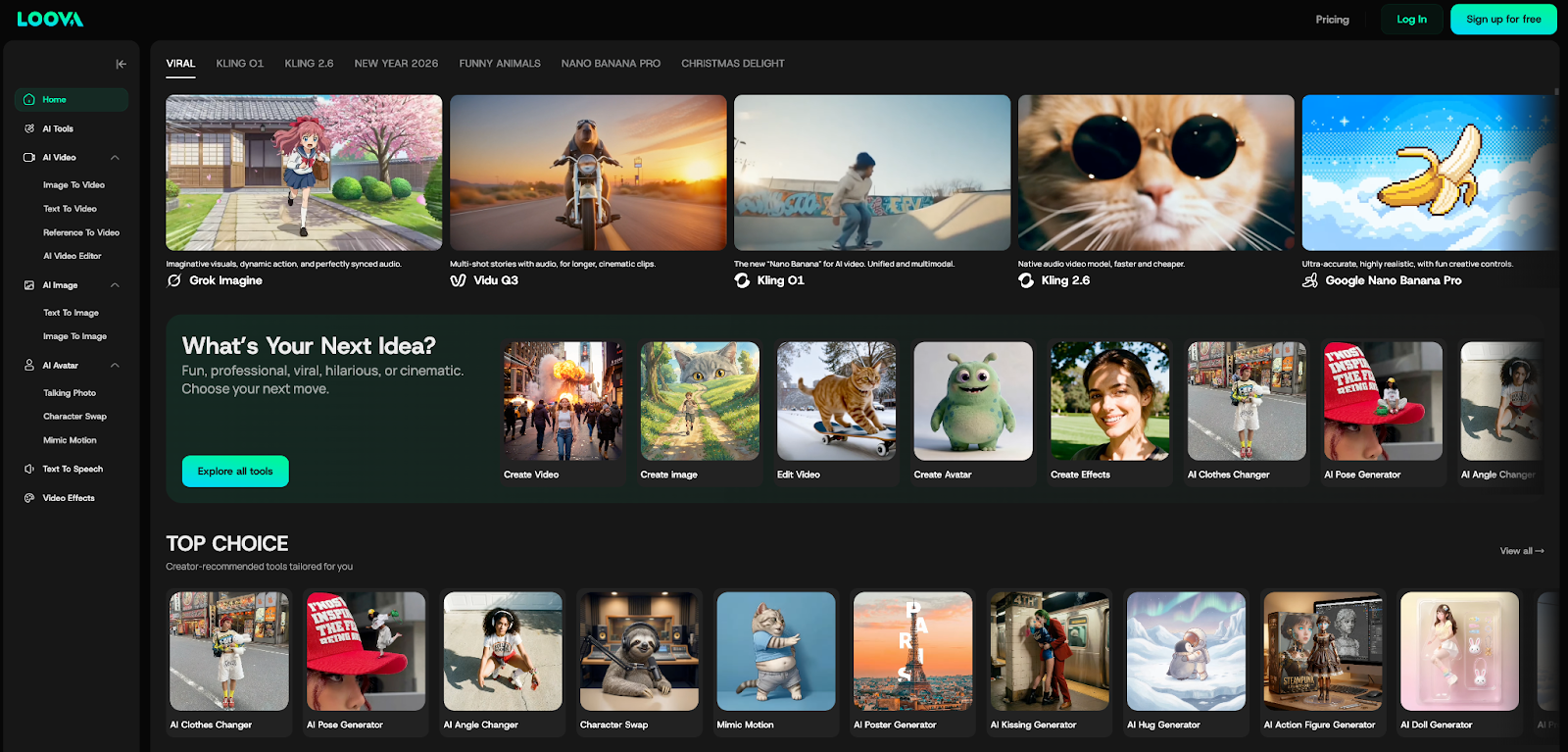
Platforms like Loova integrate mimic motion directly into video workflows, allowing teams to reuse proven motion patterns across ads, affiliates, and landing-page creatives.
Motion stops being a bottleneck. It becomes leverage.
High-performing marketing teams do not rely on single creatives. They build portfolios.
A strong video concept generates:
Batch production is critical. AI-driven workflows enable marketers to generate dozens of variations from one concept. Minor changes test different audiences without restarting production.
This approach improves:
Timing directly affects monetization. Early creatives benefit from:
Slow production inflates acquisition cost.
Automation compresses the gap between insight and execution. When teams can react within hours instead of days, revenue opportunities expand.
Loova supports this by combining generation, editing, motion reuse, and adaptation into one environment.
Speed becomes a strategic advantage, not an operational detail.
Monetization Requires Reuse, Not Reach
Reach does not scale revenue. Reuse does. Marketers monetize viral content by:
Each reuse multiplies lifetime value. AI tools reduce friction in this process. Creative teams focus on optimization instead of rebuilding.
Creativity sparks interest. Structure sustains profit.
High-performing marketing teams:
They treat content as infrastructure. AI does not replace creative strategy. It operationalizes it.
Most viral videos fail to make money because they are not built for reuse.
In 2026, marketing success depends on turning attention into systems. Motion, pacing, and narrative must become reusable assets.
AI-driven platforms like Loova enable this shift by embedding mimic motion, batch production, and rapid adaptation into one workflow.
Virality creates opportunity. Structure turns opportunity into revenue.