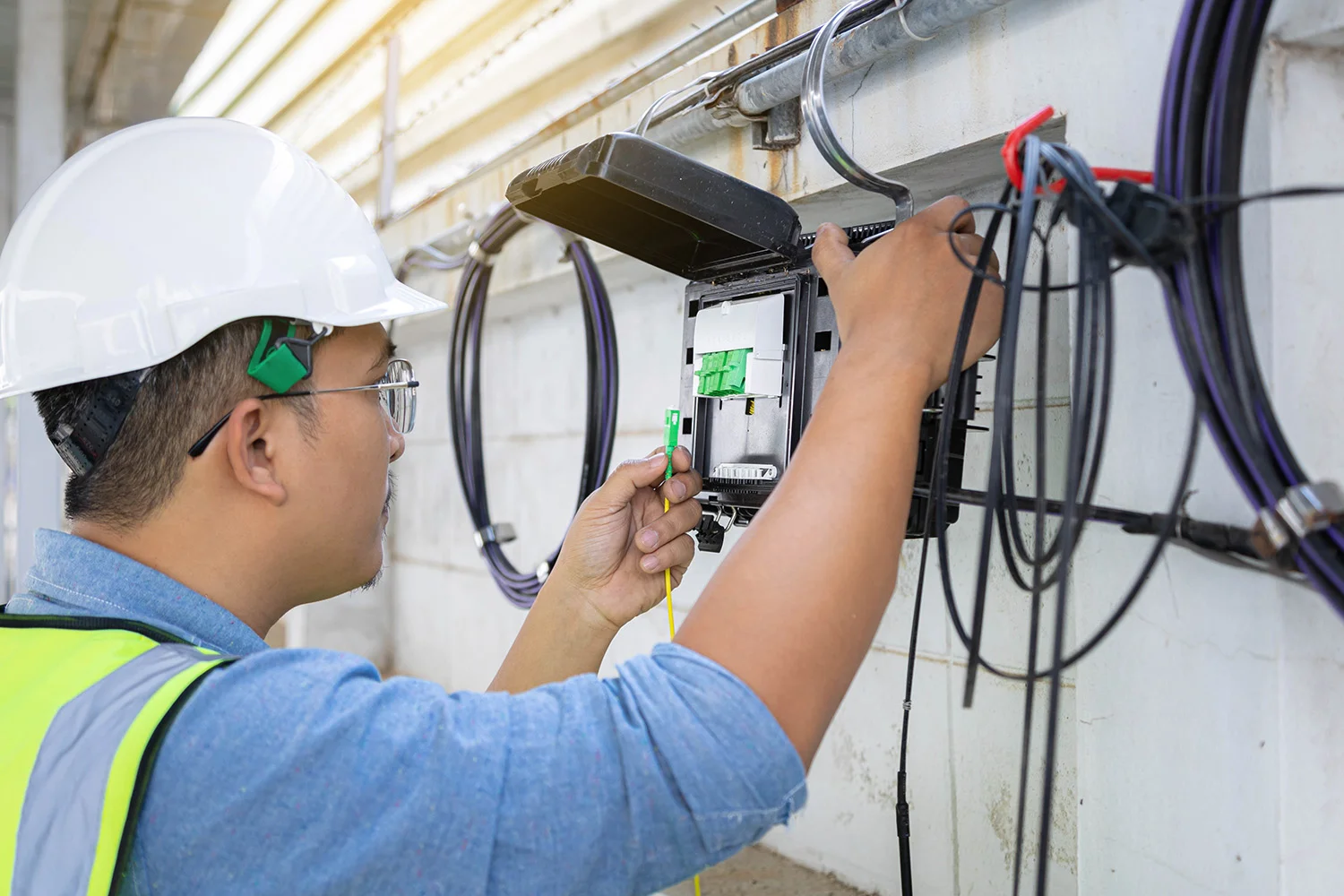
As fiber networks continue to expand globally—particularly across FTTx and FTTH deployments—installation efficiency has become just as critical as network performance itself. Internet service providers, contractors, and installers are under increasing pressure to roll out networks faster, with tighter budgets and fewer skilled technicians available on site.
In many real-world projects, deployment timelines are compressed while installation environments remain unpredictable. According to industry field reports, labor-related costs already account for 40–60% of total access network deployment expenses, making installation efficiency a decisive factor in overall project success.
Under these conditions, traditional termination methods that require controlled environments, specialized equipment, and highly trained personnel are becoming harder to scale. As a result, many field teams are no longer asking whether fiber can be deployed—but how it can be deployed efficiently, consistently, and with fewer operational constraints.
Fusion splicing has long been considered the benchmark for fiber termination. When performed correctly, it delivers excellent optical performance and long-term reliability. However, its practical limitations become increasingly apparent in large-scale or distributed access network deployments.
Fusion splicing typically requires certified technicians, dedicated splicing equipment, and stable working conditions. In the field, these requirements often translate into longer installation times and higher labor costs. Industry estimates suggest that a standard fusion splice—including preparation, splicing, protection, and testing—can take 3–10 minutes per fiber, depending on site conditions and technician experience.
Environmental factors further complicate the process. Weather exposure, limited workspace, and inconsistent power availability can all impact installation quality and efficiency. While fusion splicing performs exceptionally well under ideal circumstances, many last-mile deployment environments are far from ideal.
These realities do not diminish the importance of fusion splicing—but they do explain why alternative termination methods are increasingly being evaluated alongside it.
For years, fiber fast connectors were often regarded as a temporary or emergency solution rather than a permanent installation choice. That perception has changed significantly.
Modern fast connectors benefit from factory pre-polished ferrules, improved mechanical alignment structures, and refined installation processes. As a result, optical performance has become far more consistent, while installation complexity has dropped dramatically.
In practical terms, many current-generation fast connectors allow trained technicians to complete fiber termination in under 60 seconds, without fusion splicing equipment. Field studies and contractor feedback commonly report installation time reductions of 40–60% compared to traditional splicing methods in last-mile scenarios.
More importantly, fast connectors reduce dependency on highly specialized labor. Installation steps are standardized, training time is shortened, and re-termination—if required—can often be completed immediately on site.
In many access network deployments today, fast connectors are no longer selected as a fallback option. They are increasingly specified during the planning stage as a deliberate strategy to improve deployment speed and operational flexibility.
Fiber fast connectors are particularly effective in environments where installation speed, accessibility, and consistency are critical. Typical use cases include FTTH drop cable termination, indoor wiring, multi-dwelling unit (MDU) installations, and building entry points—locations where controlled splicing conditions are often unavailable.
They are also widely adopted for emergency repairs and network extensions, where minimizing service downtime is essential. In many deployments, fast connectors enable temporary installations to transition smoothly into permanent solutions without additional rework.
To better illustrate their practical advantages, the table below compares fusion splicing and fiber fast connectors across common deployment scenarios:
To meet these field demands, many installers now rely on field-installable fiber fast connector solutions designed for consistent performance and simplified on-site termination.
By reducing installation complexity and standardizing results, fast connectors help teams maintain efficiency without compromising network reliability.
Beyond speed, fast connectors play a key role in improving deployment consistency. In large-scale projects involving multiple installation crews, quality variations between technicians can significantly impact performance and maintenance costs.
Fast connectors help minimize these variables through factory-controlled fiber preparation and repeatable installation steps. Contractors frequently report lower rework rates and more predictable test results when fast connectors are used in access network environments.
From a scalability perspective, fast connectors also simplify workforce expansion. New technicians can be trained more quickly, reducing onboarding time and enabling faster project ramp-up. This consistency directly supports tighter deployment schedules and more accurate cost forecasting.
No single termination method is ideal for every deployment scenario. Fusion splicing, pre-terminated assemblies, and fast connectors each serve distinct roles depending on network design, scale, and environmental conditions.
The industry trend is not toward replacement, but toward integration. Fast connectors are increasingly used as part of a broader termination strategy—complementing traditional methods where flexibility, speed, and accessibility are prioritized.
As fiber networks continue to expand, termination decisions are becoming part of a broader FTTx fiber optic solution, rather than isolated technical choices.
Viewing termination from this holistic perspective allows network designers and installers to balance performance, cost, and efficiency more effectively.
In real-world fiber deployments, practical solutions often outperform theoretically perfect ones. Fiber fast connectors have evolved into a reliable, efficient option that directly addresses modern installation constraints.
By reducing installation time, lowering labor dependency, and improving consistency, fast connectors have secured their place in today’s access networks. As deployment pressure continues to increase, their role in scalable fiber infrastructure is expected to grow even further.
The most effective networks are built not only on performance metrics—but on solutions that work reliably in the field.