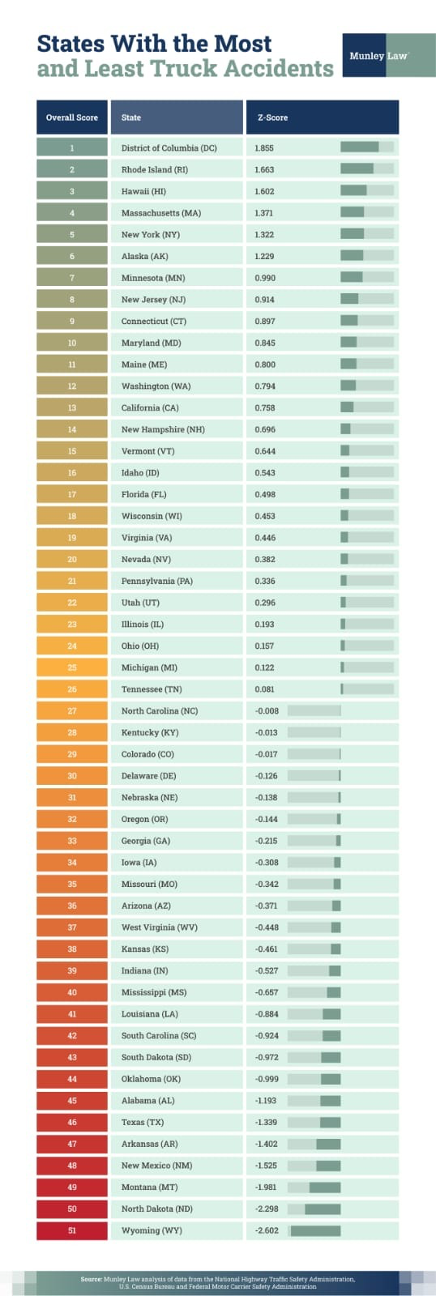
New Jersey has emerged as one of the safest states in the nation for commercial truck accidents, ranking sixth in a comprehensive new analysis of trucking safety metrics across all 50 states and the District of Columbia.
The study, released by Munley Law, analyzed data from the National Highway Traffic Safety Administration and the Federal Motor Carrier Safety Administration, examining eight critical safety factors including fatal truck accidents per capita, fatalities caused by impaired truck drivers, and roadside inspection violations.
New Jersey's strong performance stems from a combination of low fatality rates and robust driver compliance measures. The state records just 0.56 fatal large-truck deaths per 100,000 residents, keeping deadly outcomes relatively rare compared to national averages.
Driver impairment remains notably low in New Jersey. Truck driver drug and alcohol traffic violations occur at a rate of just 1.07 per 100,000 people, ranking fourth-best nationwide. Fatal large-truck crashes involving drivers with a blood alcohol concentration of 0.05 grams per deciliter or higher occur at 0.10 per 100,000 residents, placing the state sixth in this category.
Commercial driver licensing compliance also contributes to New Jersey's safety record. Drivers without valid commercial driver's licenses involved in fatal large-truck crashes appear at a rate of only 0.16 per 100,000 residents, seventh-best in the nation.
Despite these positive statewide metrics, certain roadways present elevated risks. Interstate 95 recorded four fatal truck accidents in New Jersey, making it the state's most dangerous road for commercial vehicle incidents.
The analysis identified the nation's most dangerous highways for truck accidents. Interstate 10, spanning eight states, topped the list with 122 fatalities. Interstate 40 followed with 101 fatalities across eight states. Interstate 80, which passes through New Jersey and 10 other states, recorded 83 fatalities. Interstate 95, also traversing New Jersey and 10 additional states, saw 78 fatalities. Interstate 75 rounded out the top five with 62 fatalities across six states.
Safety advocates emphasize the importance of both regulatory enforcement and driver compliance in maintaining low accident rates. New Jersey's performance suggests that strict adherence to commercial licensing requirements and low tolerance for impaired driving among commercial operators correlate with reduced fatality rates.
The eight-factor analysis provides state officials and transportation planners with data-driven insights for targeting safety improvements and allocating enforcement resources to areas presenting the greatest risks to public safety.
Safety experts note that these results are notable given New Jersey’s role as a key transportation hub in the Northeast. The state’s highways connect major ports, distribution