Long-term lived experience — the honest account the spec sheet cannot give you
I want to be honest with you about something before we get into the detail of this review. I went into this test sceptical. Not sceptical in the way that reviewers sometimes perform scepticism as a narrative device before delivering a glowing verdict — genuinely, practically uncertain about whether a motorised standing desk had any business being in a flat of this size.
I live in a first-floor conversion flat in South London. The room I use as an office is 11 square metres. The ceiling is 2.55 metres. There is one sash window, east-facing, which means good morning light and almost none by early afternoon. There is a built-in wardrobe on one wall that I cannot remove, a radiator on the wall I would most naturally put a desk against, and a door that opens inward and, when fully open, reduces the available floor width on that side of the room by about 80 centimetres.
I had been working from a fixed-height desk — a solid oak surface on trestle legs — for three years. It looked right in the room. I was not unhappy with it. The question was whether a standing desk small flat UK living would actually support was a worthwhile upgrade, or an ergonomic vanity project I would use for a fortnight before reverting to sitting in the same position I have always sat in.
Before the desk arrived, I did what I should have done before ordering it: I measured everything. Floor depth from the window wall to the wardrobe: 2.9 metres. Width: 3.1 metres. Available wall space for a desk, accounting for the radiator and the door swing: approximately 1.4 metres of clean wall. The Julia's surface is 121cm wide and 65cm deep. It fits. With clearance enough to work with, which felt reassuring after a week of anxious measuring.
I positioned it under the window — the only sensible desk position in the room — which meant the east-facing light comes in from the left during the morning working hours. The frame, in the lowered position, sits below the sash transom. At standing height, the surface clears the window ledge with approximately 15 centimetres to spare. None of this is comfortable. None of it is impossible.
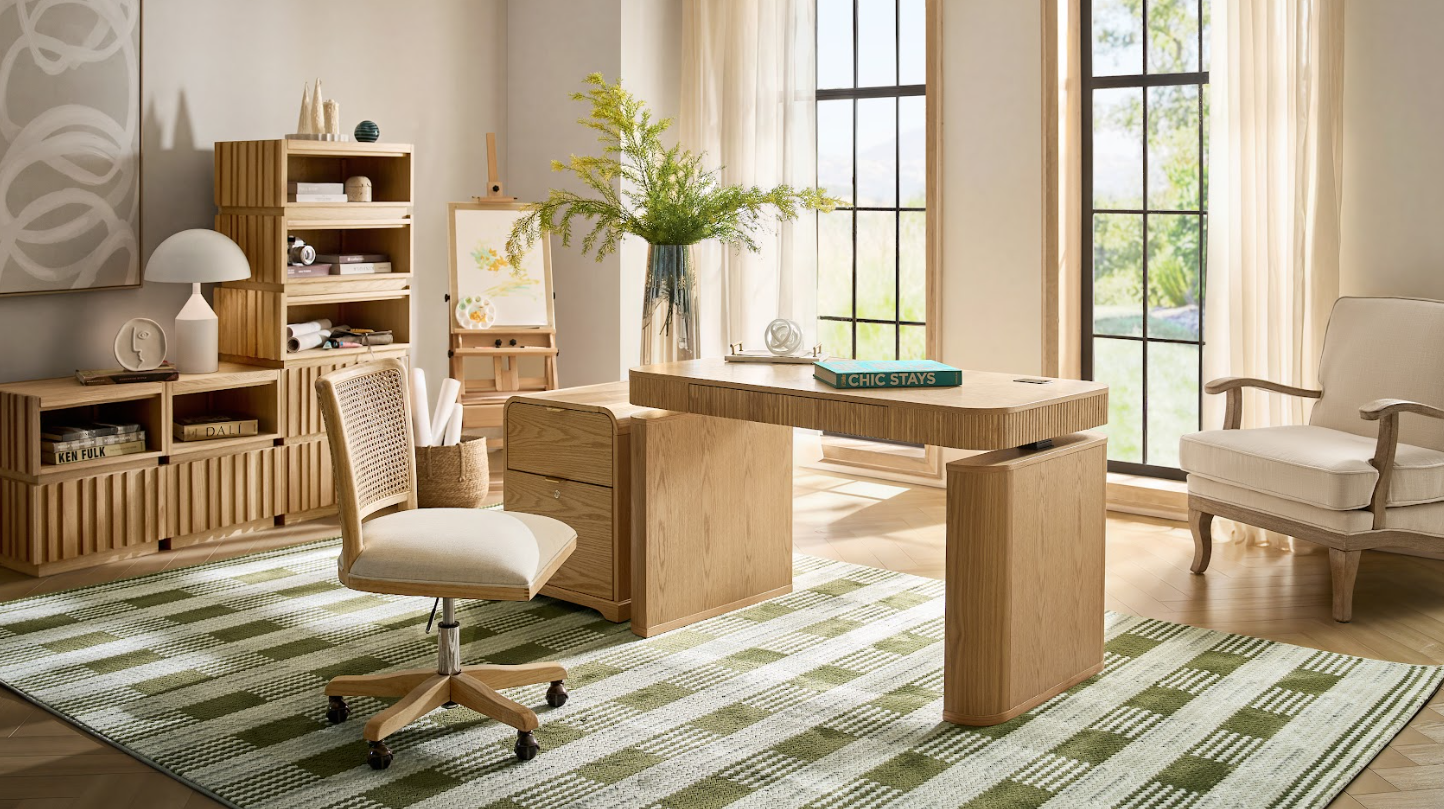
The first thing I noticed when the Julia was assembled and in position was that it looked considerably better in the room than I had expected. The solid wood surface — warm, faintly grained, noticeably not the laminate I had steeled myself for — sat against the painted floorboards and the off-white walls with the quality of an object that belonged there. My previous desk had been chosen partly because it looked right. I had not expected its replacement to clear the same bar. It did.
Assembly took around 15–30 minutes with a friend helping. The instructions are printed, clear, and well-sequenced — the one step that benefits from a second pair of hands is attaching the frame to the surface, which requires someone to hold one end while the other is bolted. We managed comfortably. I would not attempt it entirely alone, but it is far from difficult.
The first motor adjustment revealed something I had not considered: I had been sitting at the wrong height for three years. My previous desk was fixed at a height that suited a chair position I had drifted into rather than chosen. The Julia's motorised adjustment forced me to think about what 'correct' seated height actually means for my body. The answer, once I had calibrated it properly, was about 4 centimetres lower than I had been working. This sounds trivial. The difference in shoulder tension over the course of a working day is not trivial at all.
Motor noise: I tested it at 11pm on a Tuesday, when the flat was quiet and my upstairs neighbour was, as far as I could tell, asleep. The motor completes its full travel in just over four seconds. The sound is a low, smooth hum — nothing like the grinding mechanical noise I had half-expected. My neighbour has not mentioned it. I consider this the most important single data point in this review for anyone in a converted flat or terraced house.
The standing function: I used it twice on day one, three times on day two, once on day three. The novelty was already wearing off by the end of week one, and I found myself sitting for the majority of most days. This is, I later came to understand, entirely normal. The habit does not form in week one. Week one is just about getting the heights calibrated and the muscle memory of reaching for the button beginning to develop.
Somewhere in the middle of week two, something shifted. I started standing at the beginning of video calls — not because I had decided to, but because standing up at the start of a call felt like a natural punctuation mark between one kind of work and another. I raised the desk when I switched from writing to reviewing. I lowered it when I settled in for a long reading session.
The memory presets became indispensable at this point. My sitting height and standing height are preset to buttons one and two. The transition takes four seconds and one button press. This matters because any friction in the habit — any moment where you have to think about what you are doing rather than just doing it — is a moment where the standing function does not get used. The presets remove that friction almost entirely.
I made two adjustments to the room during weeks two and three. The first was a felt desk pad — not for aesthetic reasons but because I kept pushing my mouse to the edge of a surface that felt slightly more precious than my previous laminate desk. The second was a cable management box on the floor, which resolved the one genuinely distracting visual element in the setup. With both changes in place, the room looked, if anything, calmer than it had with the fixed desk.
Week three was the week I stopped thinking about the desk as a desk and started thinking about it as part of the room. That is a meaningless-sounding sentence until it happens to you, and then it makes complete sense. The object had become furniture rather than equipment. The transition was complete.
At the end of week four I sat down — at the desk, ironically — and wrote an honest list of what had changed and what had not.
What changed: I stand for somewhere between 90 minutes and two hours of each working day, distributed across three or four intervals. My neck and upper shoulder tension, which I had attributed to general working-from-home posture, is measurably better — I am seeing my osteopath less frequently, which is as close to an objective measure as I have. The room, unexpectedly, looks better than it did before the desk arrived. The solid wood surface has a quality in afternoon light that my previous laminate desk did not, and it sits in the room with the particular quality of an object that was chosen rather than settled for.
What did not change: I do not stand for as long as I had imagined I would. The standing function is most useful as a transitional tool — a way of marking the shift between tasks — rather than as a sustained working position. I stand for twenty minutes at a time, not two hours. That is still, cumulatively, meaningful. But anyone expecting to spend half their working day on their feet will likely need to build that habit more deliberately than I did.
The surface condition after 30 days of daily use: unchanged. No visible wear, no marking from the mouse pad, no scratching from the monitor arm base. The wood looks exactly as it did on assembly day, which is either a testament to the finish quality or to the fact that I have been treating it with slightly more care than I treated the previous desk. Probably both. You can see the full specification and surface options for the Julia electric standing desk on the Hulala Home website — the surface detail in particular is worth reading before you order.
The Julia is the right desk for a specific kind of person. That person cares about how their room looks — not in a performative, everything-from-the-same-interiors-Instagram sense, but in the quieter sense of having made considered choices about the objects they live with and not wanting a single piece of equipment to undermine all of them. They work from home often enough that the ergonomic benefit compounds meaningfully over weeks and months. They live in a room with warm materials — timber, plaster, the worn stone or painted brick of a period building — where the aluminium-and-black-frame aesthetic of most standing desks would read as visually incongruous.
It works in a small flat. I want to be clear about that, because it was the thing I was most uncertain about before the desk arrived. It works in 11 square metres with a 2.55-metre ceiling and a sash window and a built-in wardrobe taking up half a wall. It requires measuring carefully and accepting that clearances will be tighter than they would be in a larger room. But it works, and once it is in, it makes the room feel considered rather than compromised.
One honest limitation: the Julia is a meaningful financial commitment. It is not a budget desk, and it should not be assessed as one. If your primary criterion is the lowest possible entry price into the standing desk category, look elsewhere. If your criterion is a desk you will still want in your home in five years — one that will not embarrass the room it lives in — the Julia is, in my assessment after 30 days, worth every pound of it.
Who should look elsewhere: anyone in a contemporary minimal room where the wood warmth would feel out of place; anyone buying primarily on budget; anyone who needs a surface wider than around 140 centimetres for a complex multi-screen setup. For everyone else working in a small, characterful British flat or terrace — the Julia is, I think, the desk the room has been waiting for.