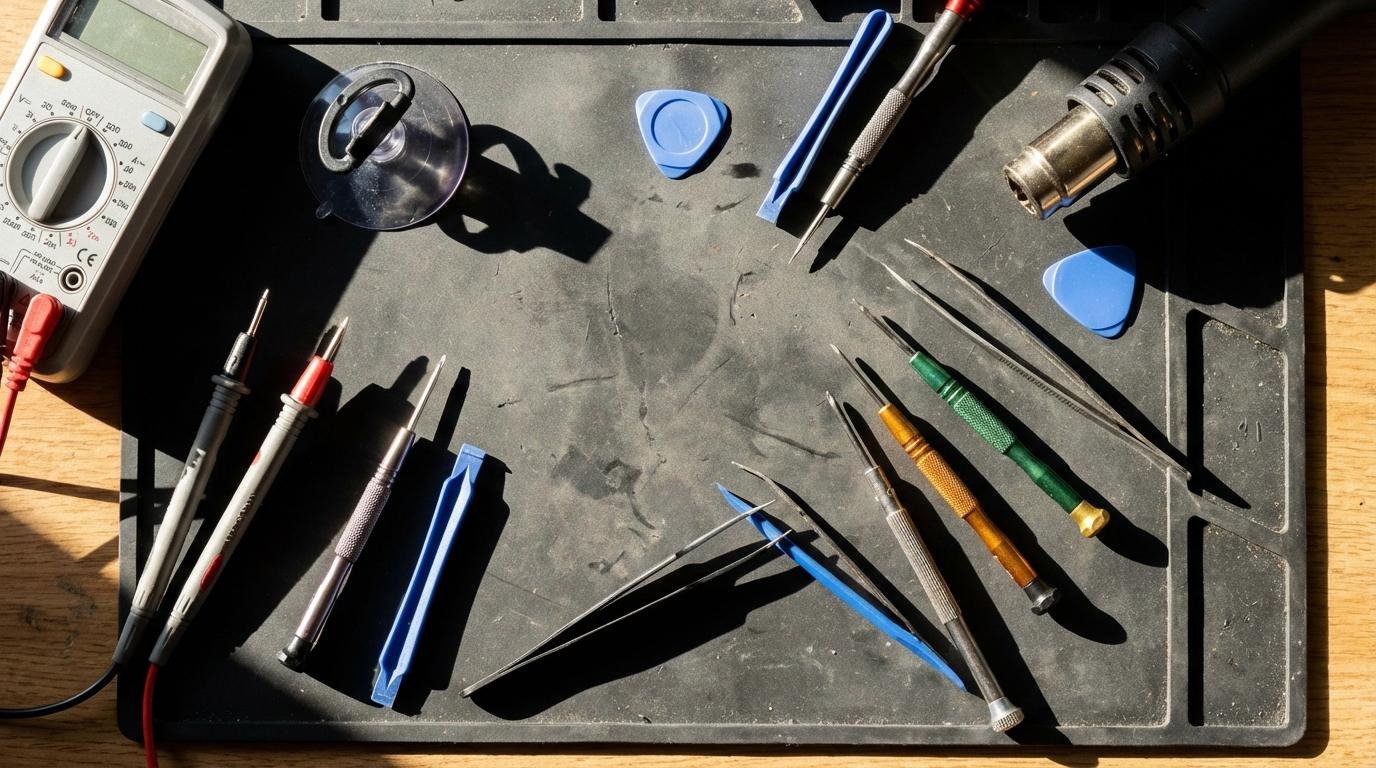
Did you know that professional repair technicians complete jobs up to three times faster than beginners and the primary reason is not experience, but equipment? The right tools do not simply make repairs easier. They determine whether a repair succeeds or fails, whether a component survives disassembly or gets destroyed, and whether a technician builds a reputation for quality or becomes known for causing additional damage. At DIYFIXTOOL, we have built our entire product range around exactly these nine tools the ones that separate competent phone repair from costly guesswork.
1. Pentalobe and Torx Screwdriver Set
Attempting to open a modern smartphone without the correct screwdriver is not merely inconvenient it is actively destructive. Apple has used Pentalobe fasteners since 2011, and most Android manufacturers rely on Torx and Phillips variants that standard screwdrivers cannot engage without stripping the fastener.
A stripped screw in a smartphone is not a minor setback. At 0.6 to 1.5 millimetres in diameter, a single stripped fastener can add an hour to a repair or make complete disassembly impossible.
What to look for: Full Pentalobe coverage (P2, P5, P6), JIS bits, hardened steel tips, a rotating cap handle, and magnetic tips. DIYFIXTOOL's precision screwdriver sets cover all major fastener types across iPhone, Samsung, Xiaomi, and Huawei devices.
2. Anti-Static Wrist Strap and Grounding Mat
Electrostatic discharge is the most underestimated risk in phone repair. Static built up on a human body can reach thousands of volts, silently destroying processors, memory chips, or power management ICs with no visible sign faults only appear at power-on.
The frustrating characteristic of ESD damage is that it mimics other faults entirely, making diagnosis significantly harder.
What to look for: An adjustable wrist strap with a coiled cord of at least 1.5 metres, a large grounding mat, and a built-in resistor tester to confirm the circuit is actually intact. Every DIYFIXTOOL anti-static kit includes a verified ground continuity tester so you know your protection is actually working.
3. Spudger Set
Inside a modern smartphone, ribbon cables connect to ZIF connectors that release only when a precise lifting force is applied along a specific axis. A fingernail, metal implement, or flathead screwdriver will tear, delaminate, or break the locking mechanism entirely.
A spudger typically a rigid nylon tool with a pointed tip and flat paddle is designed specifically for this interaction. The pointed end lifts connector locks cleanly; the paddle end presses connectors into place during reassembly.
What to look for: Nylon-glass composite construction, a ground pointed tip, a straight paddle edge, minimum 150mm length, and multiple profiles. DIYFIXTOOL spudger sets include multiple tip profiles to handle every connector type across all major smartphone brands.
4. Suction Cup with Adjustable Handle
Screen separation creates anxiety at every experience level, and for good reason. The adhesive bond is designed to survive years of thermal cycling and mechanical stress. A quality suction cup converts pulling force into even tension distributed across the glass preventing the point loading that cracks screens when pry tools are used without prior separation.
What to look for: A pump-action or lever mechanism, swivel handle, multiple cup sizes, a clean-release tab, and a smooth silicone cup surface. DIYFIXTOOL suction cups are available in multiple diameters to accommodate compact smartphones through to tablets and foldable devices.
5. Heat Gun with Digital Temperature Control
Modern adhesive compounds soften between 70 and 120 degrees Celsius. Below that range, components cannot be separated cleanly. Above it, display layers delaminate, battery chemistry is permanently damaged, and plastic chassis components warp.
A heat gun with digital temperature control removes the guesswork entirely. For best results, pair it with a silicone heat mat placed beneath the device it distributes conducted heat evenly across the rear panel and prevents the device from sliding during manipulation.
What to look for: A digital readout, temperature range starting at 100°C or below, independent airflow control, a ceramic heating element, and concentrator nozzle attachments. DIYFIXTOOL heat guns ship with a full nozzle set and are compatible with our silicone heat mat range.
6. Opening Picks
Once adhesive has softened, a tool must be introduced into the gap to maintain separation while working around the perimeter. Opening picks are thin enough to enter gaps under a millimetre, flexible enough to follow the chassis contour, and non-conductive so they do not scratch glass or risk electrical contact.
What to look for: A leading edge of 0.5mm or less, polycarbonate material, a smooth burr-free edge, and sets of six or more. DIYFIXTOOL opening pick sets include eight picks per pack enough to maintain separation around the full perimeter without reusing stressed picks.
7. Fine-Tip Tweezers
The smallest screws in a modern smartphone measure approximately 0.8mm in diameter. Antenna cables are thinner than a human hair. None of these components can be placed or repositioned with fingertips alone.
One important distinction: always avoid magnetic tweezers for work near sensitive ICs and memory components. Magnetic tips attract ferrous screw heads at inopportune moments and can magnetise components in ways that cause subsequent issues non-magnetic stainless steel or ceramic-tipped tweezers are the correct choice for internal repair work.
What to look for: Non-magnetic stainless steel or ceramic tips, multiple profiles (straight fine-point, curved, flat-paddle), consistent spring tension, anti-static treatment, and a knurled grip zone. DIYFIXTOOL tweezer sets include five tip profiles covering every manipulation task from screw retrieval to flex cable handling.
8. Magnetised Parts Organisation Mat
A smartphone disassembled for a battery replacement may yield twenty to sixty individual screws many visually identical but not interchangeable. A screw installed in the wrong location strips the boss on the first turn. Without a tracking system, reassembly becomes guesswork.
What to look for: Consistent magnetic field strength across the full surface, a dry-erase writeable zone, heat resistance, and a minimum A4 size (30 x 21cm). DIYFIXTOOL organisation mats include a pre-printed zone grid and are supplied with a dry-erase marker for immediate use.
9. Digital Multimeter
Every visible fault a phone that will not charge, a screen showing no image, a device powering off unexpectedly has an electrical cause. The symptom tells you something is wrong. The multimeter tells you exactly what and where.
Continuity testing confirms charging port pins connect correctly to the board. Voltage measurement confirms whether a battery or charging circuit is functioning at all.
What to look for: Auto-ranging capability, audible continuity mode, a minimum 200mV voltage range, CAT II safety rating, and fine hardened probe tips. DIYFIXTOOL multimeters are CAT II rated and include fine-tip probe sets suitable for smartphone-scale test points.
Equip Yourself with DIYFIXTOOL for Repairs That Succeed First Time
These tools are not luxuries they are the baseline equipment that separates repairs completed correctly from repairs that create additional damage. At DIYFIXTOOL, every tool in our range is selected for the demands of real-world repair work, backed by a one-year warranty, and quality-checked before dispatch. Whether you are equipping yourself for your first repair or upgrading a professional toolkit, explore the full DIYFIXTOOL range and build a kit that performs every time.