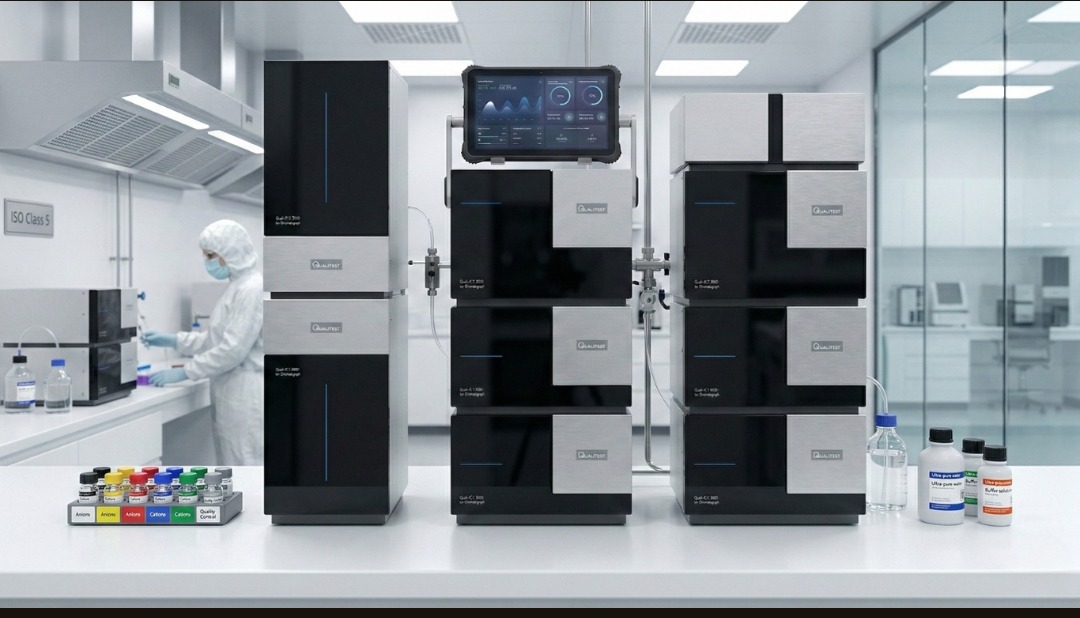
An Ion Chromatograph is a highly specialized analytical instrument used to separate, identify, and quantify ionic species within liquid samples. By utilizing high-performance liquid chromatography (HPLC) principles specifically for ions, these systems allow laboratories to determine the concentrations of anions, cations, organic acids, and inorganic ions. In environmental science, this capability is paramount; water and wastewater programs depend on accurate, repeatable ion analysis to ensure public safety, monitor industrial discharge, and maintain regulatory compliance.
Whether a laboratory is focused on routine municipal drinking water monitoring or complex industrial wastewater characterization, specifying the correct Ion Chromatography Instrument is the difference between seamless compliance and a workflow plagued by maintenance and data drift. Given the diversity of modern ion analysis needs, lab managers must move beyond basic hardware lists and instead focus on modularity, baseline stability, and material compatibility. To see how these requirements are met in professional hardware, you can explore Ion Chromatograph options from Qualitest to evaluate systems designed for everything from trace-level research to high-volume environmental testing.
In an environmental lab, the Ion Chromatograph serves as the primary tool for several critical control points:
By automating these separations through a dedicated Ion Chromatography System, laboratories can achieve much higher throughput and better method consistency than traditional wet-chemistry methods allow.
When specifying a system, the first filter should always be the sample matrix. environmental water testing is not a monolithic workflow; the demands of a drinking water lab differ significantly from those of a municipal wastewater facility.
Drinking water analysis is typically more routine and standardized. The ions of interest are well-defined, and the sample matrix is relatively "clean." In these environments, the priorities are sensitivity—specifically for regulated ions like nitrate and bromate—and reliable day-to-day operation. A laboratory in this sector needs a system that can run the same method repeatedly with minimal recalibration and high baseline stability.
Wastewater samples are inherently more variable and matrix-heavy. They often contain high concentrations of interfering ions and organic contaminants that can shorten column life or ghost-peak the results. This requires an Ion Chromatography Instrument with superior robustness, such as metal-free PEEK flow paths that resist corrosion and prevent leaching. In these workflows, method flexibility and the ability to scale up for more complex separations are the primary drivers of the purchase.
To ensure a successful long-term investment, certain core features should be non-negotiable in your specification:
While conductivity is the "universal" detector for Ion Chromatography, some environmental methods benefit from additional detection paths.
A modular Ion Chromatography System allows for the integration of multiple detectors, providing the flexibility to expand the lab’s analytical scope as new environmental regulations emerge.
The modularity of a modern Ion Chromatography Instrument allows labs to scale their hardware to match their workload.
A single-channel system is the standard choice for routine environmental labs with a stable method demand—for example, a lab that only runs the EPA 300.1 panel for anions. These are compact, efficient, and provide the best cost-to-performance ratio for focused workflows.
Multi-channel expansion becomes worthwhile when a lab expects to run both anions and cations simultaneously or when throughput requirements exceed the capacity of a single column. Modular designs allow for the addition of high-pressure pumps or different detector modules later, meaning the lab doesn't have to replace the entire instrument to add a new method. This scalability is a key reason why buyers often prefer a modular Ion Chromatography platform over fixed-purpose units.
Use this checklist to define your requirements before you compare ion chromatography systems on Qualitest:
While most water labs rely on benchtop instruments, certain workflows require more specialized hardware. For example, a Portable Ion Chromatograph is an excellent choice for real-time field monitoring, allowing environmental teams to get immediate results at the source rather than transporting samples back to a central lab.
Additionally, for labs involved in material science or coal and mineral analysis, a Combustion Ion Chromatograph might be necessary to handle solid samples. While these are adjacent to the routine water lab, they show the incredible range of modern Ion Chromatography technology.
Qualitest provides access to a modular family of instruments designed specifically for high-precision environmental analysis. Their systems emphasize stable baselines, inert flow paths, and the flexibility to move between single-channel and multi-channel configurations. By positioning the category around application fit and modular expansion, they help labs specify an Ion Chromatography System that can handle the specific chemical complexities of wastewater while maintaining the sensitivity required for drinking water compliance.
Explore Ion Chromatograph options from Qualitest and request a quote for the Ion Chromatography System that fits your environmental water and wastewater workflow.
The right Ion Chromatograph for an environmental lab is one that balances immediate routine needs with future analytical flexibility. By starting with a clear understanding of your sample matrix and target ions, and prioritizing features like PEEK flow paths and modular detector options, you can specify a system that delivers reliable, defensible data for years to come.
Whether you are safeguarding a municipal water supply or monitoring a complex industrial discharge, a well-specified Ion Chromatography Instrument is your strongest ally in the pursuit of environmental quality.