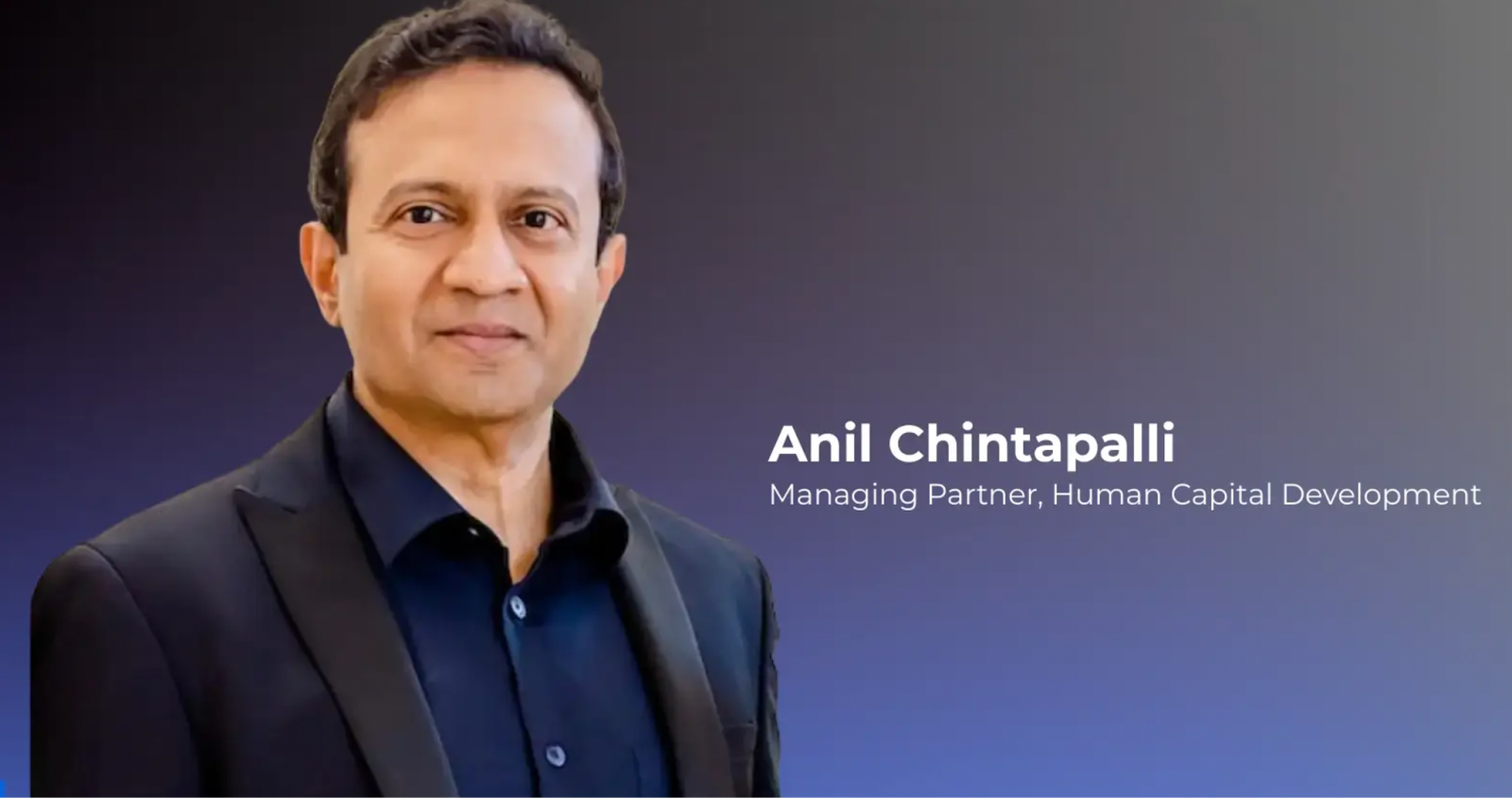
In a career spanning over 30 years, Anil Chintapalli has led by example as an "investor-operator" with multiple public listings, over 20 M&A transactions, including the recent $3.3 billion (cash) sale of WNS Holdings to Capgemini. We sat down with Anil Chintapalli, managing partner at Human Capital Development, senior advisor to McKinsey, and board member of the Forbes Business Council and Fast Company Executive Board, for his unique insights.
In this interview, we explored his unique methodology for architecting enterprise transformation, unlocking shareholder value creation and how organizations can turn technologies such as AI into a continuous engine for such shareholder value creation.
Anil Chintapalli: Over 30 years, I’ve seen transformations shift from "digitizing the past" to "architecting the future." In previous cycles, we were optimizing existing workflows. Today, we are in the era of cognitive orchestration. AI isn't just a layer you add to an old process; it’s a reasoning engine that demands a new foundation. My perspective has evolved from seeing technology as an efficiency tool to seeing it as a primary driver of enterprise valuation.
Q: You often speak about the "investor-operator playbook." Can you explain how this dual perspective changes the way a leader approaches a large-scale AI integration?
Anil Chintapalli: An "investor" looks for defensibility, scalability, and ROI. An "operator" looks at cultural friction, technical debt, and execution risks. When you combine them, you stop chasing "cool" AI and start building value-driven AI. An investor-operator doesn't ask, "Can this AI write an email?" They ask, "How does this agentic workflow compress our cash-to-order cycle by 40%?" This dual lens ensures that every dollar spent on AI is architected to produce a measurable, compounding return on capital.
Anil Chintapalli: The biggest mistake is "point-solution thinking." Companies deploy isolated chatbots for specific departments without a unified context orchestration layer. This creates "intelligence silos." To scale, you need a centralized architecture, what I call the AI-GCC (AI powered Global Capability Center). You must move away from simple prompting and toward building robust data environments where models can reason across the entire enterprise dataset safely and predictably. If you don't fix the data architecture first, your pilots will always fail.
Anil Chintapalli: The AWOS is about moving from "Human & Tool" to "Human & Agent." In this model, AI agents aren't just software you use; they are digital teammates capable of reasoning and autonomous task execution. The AWOS provides the governance, communication protocols, and ethical guardrails that allow human talent to move into high-value strategic roles while "swarms" of AI agents handle the high-volume cognitive lifting. It redefines the workforce as a hybrid ecosystem where productivity is measured by the quality of the orchestration, not just human hours logged.
Anil Chintapalli: If there is no investment from the middle management layer, transformation fails. You cannot ask a workforce to embrace AI if they fear it will replace them without benefit. I’ve always believed that equity and alignment are the true engines of change. When employees see AI as a tool that enhances their value and contributes to a company they have a stake in, whether through equity or performance-linked incentives, the resistance vanishes. Cultural alignment is the "social architecture" that supports technical architecture.
Anil Chintapalli: The lesson is simple: Predictability is the ultimate performance metric. In the era of generative AI, there is a strong temptation to pursue unrestrained power. But in a global enterprise, the winner is the one who can make AI behave predictably at scale. The next generation of architects must be "model agnostic but workflow obsessed." "Don't fall for the model of the month; love the system you build around it. That is how you create lasting enterprise value.
By focusing on clarity, disciplined execution, and the industrialization of AI capabilities, enterprises can move past the hype to achieve measurable business outcomes. His track record demonstrates that when strategy, technology, and culture operate in concert, the result is not just a more efficient company but a significantly more valuable one.