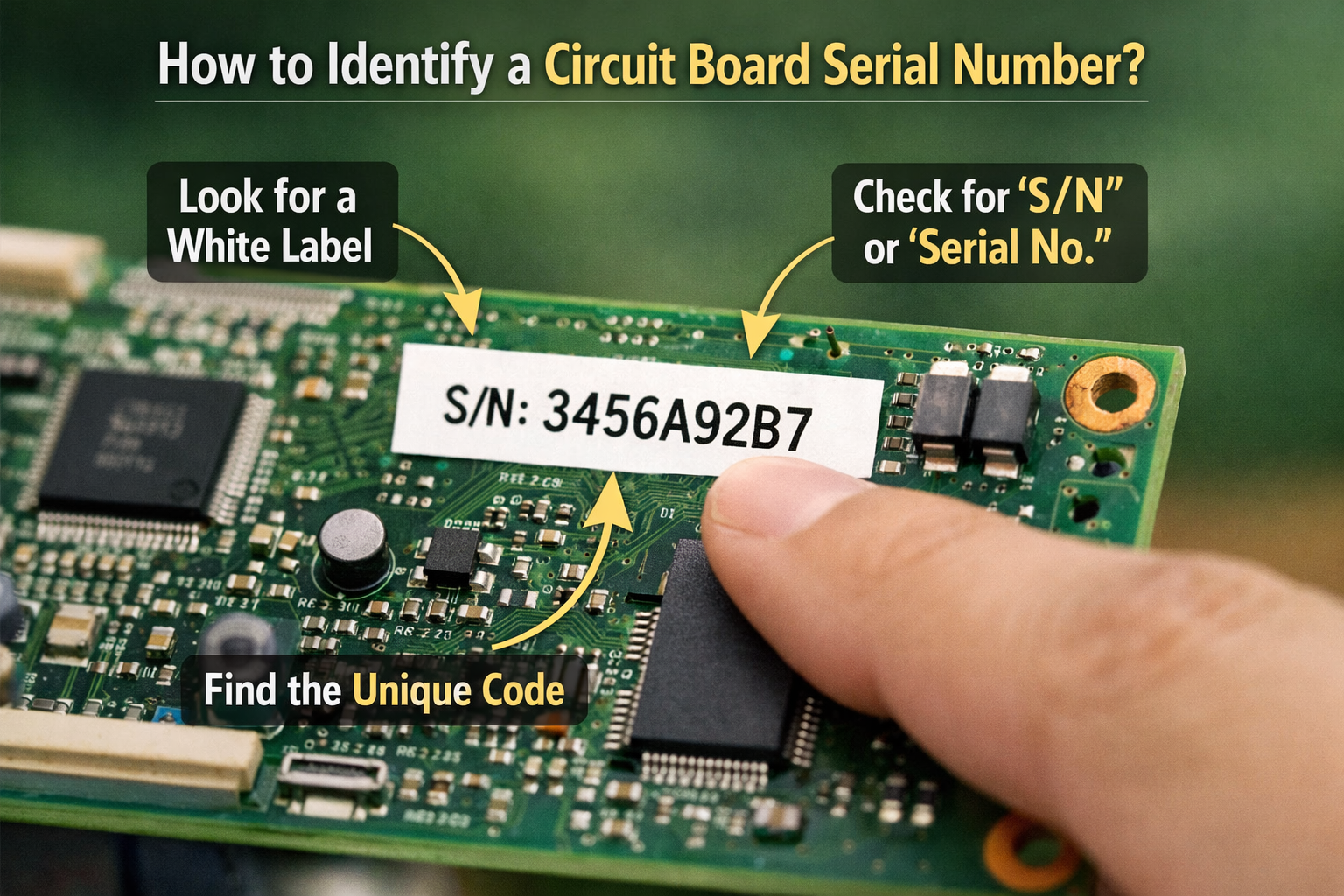
If you open almost any electronic device, you will see a printed circuit board (PCB) covered with small markings. These markings include part numbers, revision codes, and sometimes a serial number. At a glance, they can all look similar, which is why many people struggle to identify the correct one.
A circuit board serial number is not just another random code. It is a unique identifier that helps track, verify, and manage that specific board. Whether you are repairing a device, checking authenticity, or dealing with a warranty issue, knowing how to find and recognize this number is extremely useful.
This guide explains the process in a clear and practical way, so you can identify a circuit board serial number without confusion.
A pcb number is a unique code assigned to a single PCB. It is different from a model number or part number, which represent a group of identical boards. The serial number applies to one specific unit only.
You can think of it as an ID number. Even if thousands of boards are manufactured using the same design, each one should have its own serial number.
In many cases, the serial number contains structured information. It may include a manufacturing date, production batch, or factory code. However, there is no universal format. Each manufacturer uses its own system, so the structure can vary widely.
For example, some manufacturers such as PCBMASTER use structured serial numbering systems to improve traceability and quality control across production batches. This makes it easier to identify when and where a board was produced.
It is important to avoid confusing the serial number with other markings. A part number identifies the design, while a revision code shows version changes. A serial number stands out because it is unique and not repeated across multiple units.
Serial numbers play a key role in modern electronics, even though they are small and easy to overlook.
Manufacturers use them for traceability. If a defect is found, they can identify exactly which boards are affected. This allows them to isolate problems instead of recalling entire product lines.
For repairs, serial numbers help technicians confirm the exact board version. This reduces the risk of using incompatible components or incorrect replacements.
They are also important for authentication. Counterfeit electronics are a real issue in many industries. A valid serial number can often be checked against manufacturer records to confirm whether a board is genuine.
In addition, many support and warranty processes require a serial number. Without it, getting assistance or replacement parts can become difficult or even impossible.
The location of a serial number depends on the type of device and how it was manufactured. However, there are several common places where you should look.
In many cases, the serial number is printed directly on the PCB. This is usually done using a silkscreen layer, which appears as white or light-colored text on the board surface. The code is often placed near the edge or in an open area where it does not interfere with components.
Some manufacturers use laser etching instead of printed ink. This creates a more durable marking that does not wear off easily. Etched serial numbers can be harder to see, so lighting and viewing angle matter.
Another common method is the use of barcode or QR code labels. These are attached as stickers on the board. The serial number is encoded within the label and can be read using a scanner or smartphone.
In more advanced designs, the serial number may not be visible at all. Instead, it is stored electronically inside a chip, such as a microcontroller or EEPROM. Accessing it requires software tools or diagnostic equipment.
You should also check outside the board itself. Many manufacturers print the same serial number on the device casing, packaging, or user manual. These external labels often match the number on the PCB.
Identifying the correct serial number is mainly a process of careful inspection and elimination.
Start by examining the board closely under good lighting. Look across the entire surface, including edges and corners. Serial numbers are often placed in visible but unobtrusive areas.
Next, check for any barcode or QR code labels. If you find one, scan it using a mobile app. This can quickly reveal the serial number without needing to read small text manually.
If you see multiple codes, compare them carefully. A serial number usually appears more complex and less standardized than a part number. It may include a mix of letters and digits in a longer sequence.
You should also look near key components such as connectors, integrated circuits, or mounting points. These are common areas where manufacturers place identifying information.
If documentation is available, compare the codes on the board with examples from the manufacturer. This can help confirm which one is the serial number.
In cases where the number is embedded, use appropriate software tools to access it. This step is more technical, but it is sometimes necessary for modern electronic systems.
Distinguishing a serial number from other markings is one of the most important parts of the process. Part numbers are usually identical across all boards of the same model. If you see the same code repeated on multiple units, it is not the serial number.
Revision codes are typically short and clearly labeled. They often include terms like “Rev” followed by a number or letter. These indicate design updates rather than unique identity.
Serial numbers are usually longer and more varied. They often combine letters and numbers and may follow a structured pattern. However, the key feature is uniqueness.
If you have access to more than one board, compare them. The serial number should be different on each one, while other codes remain the same.
There is no single standard format for circuit board serial numbers, but some patterns are common. Some manufacturers use simple numeric sequences, especially in high-volume production environments. Others use alphanumeric codes to include more information.
In many cases, the serial number includes sections that represent different details. For example, the beginning might indicate the factory or product line, followed by a date code and a unique sequence.
Even though formats vary, serial numbers generally look more complex than other markings. Recognizing this difference can make identification easier.
You do not need advanced equipment to identify most serial numbers, but a few tools can make the process easier and more accurate.
A magnifying glass can help you read small or tightly printed text. For very compact boards, a basic microscope or zoom camera is even more effective.
Barcode and QR code scanner apps are useful for decoding labels quickly. They reduce the chance of misreading characters and save time.
For embedded serial numbers, manufacturer-specific software or diagnostic tools may be required. These tools allow you to access internal data directly from the board.
In some situations, identifying a serial number can be challenging.
If the marking is faded, dirty, or partially damaged, careful cleaning can improve visibility. Adjusting the lighting or viewing angle can also help reveal etched or low-contrast text.
If you cannot find a serial number on the board, check external labels on the device or its packaging. Some designs rely entirely on these external identifiers.
When multiple codes are present, take time to compare them. Focus on the one that appears unique and not repeated across similar boards.
If uncertainty remains, consulting the manufacturer or official documentation is often the most reliable solution.
A circuit board serial number may look like a simple string of characters, but it serves an important purpose. It allows manufacturers, technicians, and users to identify and track individual boards with precision.
By understanding where to look, how to recognize the correct code, and how to distinguish it from other markings, you can identify serial numbers with confidence.
The process does not require advanced expertise. With careful observation and a structured approach, it becomes straightforward and reliable.