
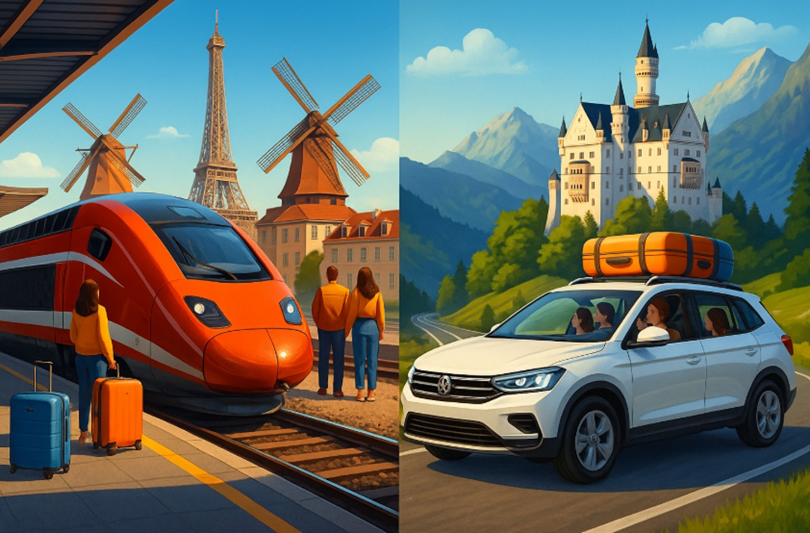
Europe has long been a favorite destination for family vacations. Paris with its museums, Barcelona with its beaches, Provence with lavender fields, or the castles along Germany’s Romantic Road — the list is endless. But along with choosing the itinerary comes a very practical question: what is the best way to get around? Families often find themselves deciding between Europe’s excellent public transportation and the flexibility of renting a car. Both options have strong advantages and some downsides, and the choice often depends on the kind of trip you are planning and, of course, whether you are traveling with children.
Traveling with children always means more logistics. You are not just managing luggage, but also a stroller, bags full of toys, snacks for the road, and sometimes even a travel crib. Add in the pressure of catching trains or buses on time, and the idea of loading everything into a car and driving on your own schedule starts to look like a real lifesaver.
For families, renting a car comes with several big advantages:
– Flexibility. No need to follow train timetables. You can stop in a small town, extend your visit at a scenic spot, or change plans along the way.
– Convenience. Luggage and supplies are always within reach, and kids can nap comfortably in the back seat.
– Memorable experiences. The drive becomes part of the adventure, with the freedom to detour to viewpoints, local cafés, or even a spontaneous picnic.
Europe is famous for its reliable and extensive public transportation. In many cases, it is the smarter choice.
– France. High-speed TGV trains connect Paris, Lyon, and Marseille faster than any car journey.
– Germany. Deutsche Bahn and low-cost buses such as FlixBus cover nearly the entire country.
– The Netherlands. Cities like Amsterdam or Rotterdam are best explored on foot, by tram, or on a bicycle.
In major cities, driving can even be a burden. Parking can cost €30–40 per day, traffic is heavy, and many cities have “green zones” or restricted access areas (ZTL in Italy, Umweltzone in Germany). In these places, public transit is simply the easier and cheaper option.
Some of Europe’s most unforgettable experiences lie beyond the major cities. Vineyards in Tuscany, villages in Provence, Bavarian castles, or the small towns of Transylvania are nearly impossible to reach without a car.
In Romania, for example, you can see much of Bucharest by metro or taxi, but visiting Bran Castle, Sinaia, or the winding roads of the Carpathian Mountains is a completely different story. That is why, upon arriving in Romania, it is often best to start with car rental in Bucharest and then plan trips into the mountains, castles, and countryside.
With kids, travel is unpredictable. On a train or bus, you cannot stop when a child urgently needs the restroom or when everyone simply needs a break. With a car, you can pull over, take a pause in a park, or find a café. For parents, this flexibility reduces stress, and for children it makes the trip more enjoyable.
Do not overlook the cost factor. Four train tickets between major cities often add up to more than renting a car. In Italy, for example, a high-speed train from Milan to Florence can cost around €120 one way for a family of four. Renting a car for a day may be €60–70 plus fuel and tolls. For short point-to-point trips, trains are convenient, but for multi-day routes with stops in smaller towns, a rental car is often the better value.
Renting a car is not without its difficulties, and families should be prepared.
– Parking. In historic centers, parking is scarce and expensive. In Rome or Paris, daily parking may cost €30–40, and hotels often do not include free spaces.
– Rules and restrictions. Each country has its own system: Austria requires highway vignettes, Italy enforces ZTL restricted zones with cameras, and Germany has Umweltzone emissions areas. Not knowing the rules can mean fines.
– Fuel. Gas is much more expensive than in the United States. A full tank can easily cost €70–100.
– Insurance and deposits. Rental companies typically block €500–1500 on your credit card. For some travelers, this can be a shock if the card limit is not high enough.
– Navigation. While smartphones work well in most places, rural areas in Romania or Portugal can lack strong mobile service. Downloading offline maps in advance is a must.
To make the most of a rental car in Europe, families should plan ahead:
– Book in advance. Especially in summer, the best cars get reserved weeks ahead.
– Choose the right size. A wagon or minivan is more practical for suitcases and child seats.
– Review insurance options. Basic insurance may not cover glass or tire damage; full coverage can be worth the extra cost.
– Check child seats. If you book them through the rental company, make sure they fit your child’s age and weight.
– Know the border rules. Some contracts restrict crossing into neighboring countries, or require an added fee for insurance coverage.
– France. Spend several days in Paris using the metro, then rent a car for a road trip through Lyon and Provence. This way you combine convenience in the city with freedom in the countryside.
– Italy. Take the high-speed train between Milan and Florence, but rent a car for Tuscany. Vineyards and medieval towns are scattered across hills far from train stations.
– Germany. Fly into Munich, enjoy the city on foot and by tram, then rent a car to explore Bavaria’s castles like Neuschwanstein and Hohenschwangau. Without a car, these landmarks are difficult to reach.
– Romania. Use public transport for Bucharest itself, but rent a car to explore Transylvania. Bran Castle, Sinaia, and the Carpathians are not well served by trains or buses.
Route / Country | Train (4 tickets, one way) | Car Rental (1 day + fuel + tolls) | Notes |
Milan – Florence (Italy) | ~ €120–140 (high-speed) | ~ €70 rental + €30 fuel + €10 tolls = €110 | Trains are faster, but a car allows stops in Tuscany villages. |
Paris – Lyon (France) | ~ €150–160 (TGV) | ~ €80 rental + €40 fuel + €20 tolls = €140 | Costs are similar, but car is better for side trips in Provence. |
Munich – Neuschwanstein (Germany) | No direct train (bus + train: ~ €80 total) | ~ €90 rental + €25 fuel = €115 | Car is far more convenient for castles and small Bavarian towns. |
Bucharest – Bran Castle (Romania) | ~ €60 (slow train + bus transfers) | ~ €60 rental + €20 fuel = €80 | Car saves hours of travel and allows flexibility. |
So, is renting a car worth it for a family vacation in Europe? The answer depends on the trip. For itineraries focused on capital cities and major hubs, public transportation is faster and less stressful. But if you want to see the “real” Europe — winding roads, castles, small villages, and open countryside — a rental car opens the door to experiences you would otherwise miss.
For many families, the best solution is a combination: use public transportation in the cities and rent a car when heading into the countryside. This approach blends convenience, flexibility, and genuine freedom, turning a family trip into the adventure it was meant to be.







